
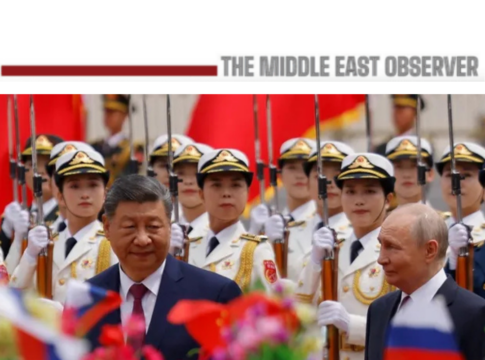
Chinese President Xi Jinping and Russian President Vladimir Putin used their Beijing summit on 20 May to reinforce the strategic partnership between China and Russia, extending their landmark friendship treaty while expanding cooperation across energy, trade, transport, technology and global governance.
The meeting, held at Beijing’s Great Hall of the People, came only days after U.S. President Donald Trump’s visit to China and amid escalating conflict in the Middle East, pressure on global energy flows, and continuing Western concern over China-Russia alignment since the war in Ukraine.
The most important formal outcome was the agreement to further extend the China-Russia Treaty of Good-Neighborliness and Friendly Cooperation, first signed in 2001. Chinese state media said Xi supported the extension and called for both sides to uphold the treaty’s spirit while advancing “back-to-back strategic coordination.”
Xi said China and Russia should view their relationship from a long-term strategic perspective and work together to build what Beijing describes as a more just and reasonable global governance system. Chinese official reporting also quoted him warning that the world risks returning to “the law of the jungle,” language widely read as criticism of unilateral pressure and Western-led dominance.
The Middle East crisis was a central part of the talks. Xi called for a complete cessation of hostilities, arguing that ending the conflict would reduce disruption to energy supplies, industrial chains, supply chains and international trade. Local and European media reports also cited Xi as saying the Gulf region stands at a critical point between war and peace.
Putin described Russia-China relations as having reached an “unprecedented level” and invited Xi to visit Russia next year. He also presented Russia as a reliable energy supplier to China at a time of rising instability in global markets, saying energy cooperation remains a driving force behind bilateral economic relations.
Energy remained one of the summit’s strategic pillars. China is now Russia’s top trading partner and a major buyer of Russian oil and gas. AP reported that Russian oil exports to China rose by 35% in the first quarter of 2026, while bilateral trade reached around $228 billion in 2025, according to Xinhua figures cited by AP.
The two leaders oversaw the signing of more than 40 cooperation agreements covering trade, technology, media exchanges and other sectors. Local reporting also highlighted a new railway agreement across the Russia-China border, designed to expand freight capacity between Zabaykalsk in Russia’s Far East and Manzhouli in China’s Inner Mongolia region. The project is expected to increase annual freight capacity by about 11 million tons by 2030.
Financial cooperation also featured prominently. Putin said nearly all Russia-China trade settlements are now conducted in rubles and yuan, with both sides studying a fuller transition to local-currency trade. This reflects Moscow and Beijing’s broader effort to reduce exposure to the U.S. dollar-based financial system, particularly under the pressure of Western sanctions.
On Ukraine, the summit produced no visible shift in Beijing’s position. Western officials had hoped Xi might pressure Putin to end the war, but European reporting noted that China has remained Russia’s most important international partner since Moscow’s full-scale invasion, while avoiding explicit endorsement of the war.
The broader outcome of the summit was therefore clear: Beijing and Moscow are moving to institutionalize a long-term strategic alignment built around energy security, trade corridors, local-currency settlement, technology cooperation and a shared vision of a multipolar world order. While China continues to balance its relations with Washington, the treaty extension and cooperation package signal that Russia remains central to Beijing’s wider geopolitical and economic strategy.