
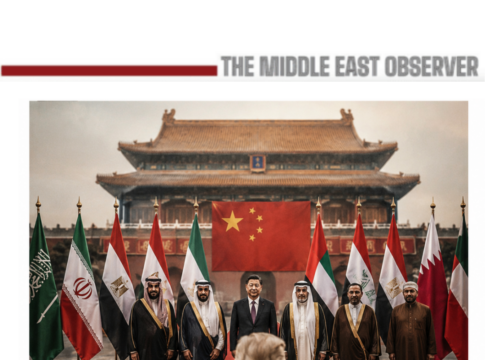
By the end of President Donald Trump’s visit to China, the glittering promises heavily hyped by the White House as a historic success evaporated. The actual strategic yield was nothing but a mirage, while the geopolitical reality tilted heavily in Beijing’s favor. The three-day trip was rich in carefully choreographed pageantry, giving Trump the high-profile “media spectacle” he thrives on-ranging from the 10-second “power handshake” outside the Great Hall of the People, which generated immense chatter among analysts, to the core of the post-summit fallout: Washington receiving a stern Chinese lecture regarding the exhausting war with Iran.
Despite Trump’s claim aboard Air Force One that he and Chinese leader Xi Jinping were “very aligned” on the necessity of reopening the blockaded Strait of Hormuz, the official Chinese statement delivered a sharp, public rebuke to the U.S. administration.
China’s Foreign Ministry openly lambasted the Western-led military intervention, pointedly calling it a conflict “which should never have happened, and has no reason to continue”. This stance created new, unannounced constraints on American maneuvers:
The Diplomatic Brake: Beijing effectively stripped away international legitimacy from any potential U.S. military escalation.
The Shift in China’s Stance: Beijing moved away from the “gray zone” (buying Iranian oil covertly under the table) toward a position where it might find itself morally and politically obligated to openly support Iran (via UN Security Council vetoes or defensive technical support) if Washington pursues a large-scale escalation. This serves to protect Chinese energy interests and preserve its international prestige. Instead of pressuring Tehran, Beijing sent a clear message to Trump: The flaw lies in your military adventures, not in Tehran. Consequently, any American bullet fired in the region became a direct challenge to China’s declared position.
Faced with rapidly closing margins for maneuver, the U.S. administration resorted to what is known in political science as a “Saving-Face Exit Strategy”- a cinematic, “Hollywood” scenario perfectly suited to Trump’s pragmatic and populist mindset:
Executing a limited escalatory plan by bombing specific Iranian facilities (such as centrifuges in Natanz or Fordow, or Revolutionary Guard bases) and marketing it domestically in America as a “crushing blow that set Iran’s programs back 20 years,” followed by declaring victory, halting the war, and withdrawing.
Directing media apparatuses to hyper-focus on the scale of the American strike while completely blacking out the inevitable Iranian retaliation.
The “Ghosts and Empty Bases” Tactic: Since U.S. bases in the Gulf have already been drawn down and emptied, any Iranian missile retaliation would lose its strategic value, as Iran would essentially be bombing concrete and ghosts. This tactic spares Trump the nightmare of “human casualties” and grants him the luxury of ignoring the Iranian response politically; equipment can be replaced with billions of dollars, but soldiers’ lives cannot be replaced in the domestic election market.
The administration no longer cares about the geopolitical price- be it the shaking of allies’ confidence or leaving the Strait of Hormuz under total Iranian control- as long as the U.S. exits the “quagmire” cloaked as a strong victor.
The Great American Outflow left behind a massive geopolitical vacuum. Washington attempted to push Israel to fill this void by imposing political and security treaties on its Gulf allies to reinforce the “illusion of victory”. However, Israel collided with two structural problems that prevented it from playing the American role:
Lack of Strategic and Human Depth: The Israeli military is designed for high-tech, lightning wars directly on its borders. It lacks the human mass (boots on the ground) or the long-term stamina to deploy military corps to protect oil facilities in Abqaiq or Abu Dhabi thousands of kilometers away.
A Crisis of Trust and Political Legitimacy: An overt Israeli military presence in the Gulf constitutes “political suicide” for the ruling regimes in front of their populations. This is compounded by historical Gulf skepticism regarding Tel Aviv’s intentions, fearing Israel might turn their territories into a “testing ground” or a forward launching pad to settle its own scores with Iran without bearing any local costs.
Faced with the failure of the gamble on Israel and a refusal to capitulate to Iranian expansion, the Gulf states revitalized their traditional, trusted alliances by summoning the Cairo-Islamabad axis. This axis deployed actual troops to Saudi Arabia and the UAE as a highly capable and legitimate regional move:
The Egyptian Military (The Strategic Stabilizer): Possessing the largest conventional and institutional human mass in the region, Egypt’s presence carries full Arab nationalist legitimacy, provoking no public sensitivities. Rather, it is viewed as a shared defensive duty dictated by the “distance of a glance” (Masafat Al-Sikka) doctrine. For Cairo, the security of the Gulf is directly linked to vital assets like the Suez Canal and economic investments, making the Egyptian military a stabilizing anchor against any Iranian naval or land expansion.
The Pakistani Military (The Silent Nuclear Deterrent): Historically serving as the “unannounced guardian” of Saudi borders and holy sites, Pakistan’s deployment to the Gulf at this juncture sends two critical messages to Tehran. First, that Pakistan is a nuclear-armed neighbor preempting any Iranian oversteps, and any direct military clash with Pakistani forces in the Gulf could open a costly eastern front that Tehran cannot handle. Second, the military presence of a neighboring, friendly state like Pakistan might be preferable to an American presence and could provide Iran with a desirable narrative of domestic victory. Furthermore, the Pakistani military possesses vast experience in asymmetric warfare and border security, enabling it to secure vital Gulf centers with an efficacy surpassing any Western or Israeli technology.
Due to its total immersion in the Ukraine conflict—which drains Moscow’s military and diplomatic energy—Russia does not have the luxury of entering new adventures in the Middle East. Therefore, its reaction boiled down to accepting the new reality to guarantee the stability of global energy markets and avoiding an economic collapse, while keeping oil prices high enough to ensure a steady flow of liquidity into its treasury via its alternative routes (China and India). Welcoming the Egypt-Pakistan axis because it secures the flow of supply while simultaneously ending the American hegemony that Moscow has long contested.
The reaction of the Eastern superpowers was governed purely by pragmatic self-interest. China seeks purely commercial and economic gains from these shifts, avoiding the “American trap” of massive military spending to secure waterways. Instead, it prefers a policy of free-riding, letting others fight while it reaps the trade profits. The Cairo-Islamabad axis represents a “geopolitical dream come true” for Beijing for two core reasons: Pakistan: As Beijing’s closest ally and strategic depth, the China-Pakistan Economic Corridor (CPEC) is the crown jewel of the “Belt and Road” initiative. The Pakistani military’s presence in the Gulf implicitly means that China’s energy security is now guarded by hands that are highly friendly and aligned with Beijing. Egypt: A trusted Belt and Road partner, Egypt stands as China’s most critical trade hub in Africa and the Middle East via the gateway of the Suez Canal. Consequently, China extends full political and economic support to this regional axis. The security of its oil supply is now guaranteed by its economic allies, without Beijing having to bear the cost of building a single military base or firing a single bullet.
The scene of the “Great American Outflow” concludes with a highly paradoxical result. While Washington- under Trump’s pragmatic management- thought it could strike and withdraw, leaving the region for its Israeli proxy to run, regional reality shocked it by spawning an authentic security system (Egyptian-Pakistani). This system did not just arrive to set a protection foundation with its Gulf allies; it transformed into a free security umbrella shielding the vital commercial interests of China, Russia and the wider international community, all of whom increasingly seek stability and secure trade corridors away from a war that few global actors appear willing to see continue. Ultimately, the United States emerged from the crisis with a diminished regional influence, while Beijing positioned itself among the principal strategic beneficiaries — securing major geopolitical gains without bearing the direct military or financial costs typically associated with such influence. Yet beyond the calculations of prestige and political image, the reality remains that abandoning a prolonged and potentially uncontrollable war is ultimately the wiser path for all sides, regardless of how victory narratives are marketed domestically or internationally.