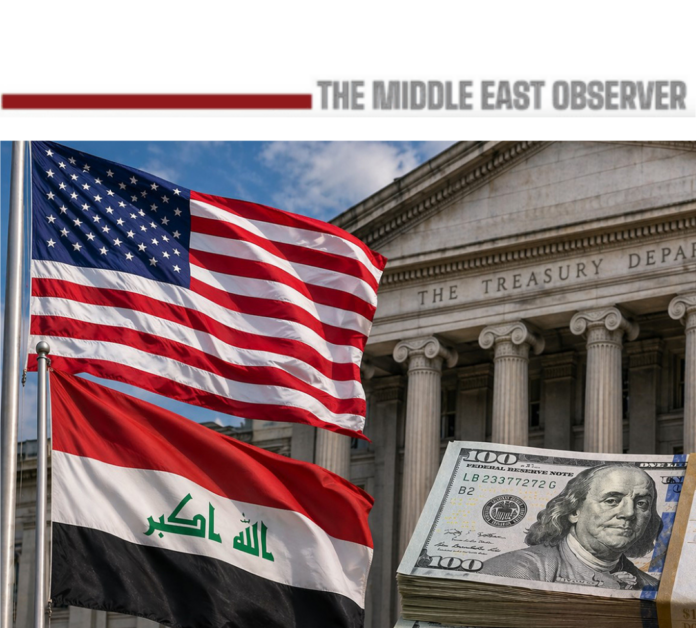
Iraq’s incoming government is placing the resolution of delayed US dollar shipments from Washington among its highest immediate economic priorities, amid mounting fears that prolonged disruptions could destabilize the country’s exchange market and deepen financial pressures already intensified by the ongoing Iran war.
The latest dispute centers around a delayed $500 million cash shipment reportedly suspended by the Trump administration, as Washington increases pressure on Baghdad to curb the influence of Iran-backed armed factions operating inside Iraq and across the region.
According to Iraqi officials cited by regional media, the suspended shipment forms part of Iraq’s long-standing annual dollar-transfer mechanism with the United States rather than representing an extraordinary emergency payment. Iraq receives part of its oil revenues through periodic cash dollar shipments estimated at roughly $10 billion annually, transferred via special flights to Baghdad under arrangements established following the 2003 US invasion.
The broader framework originates from an executive order issued by former US President George W. Bush after the fall of Saddam Hussein, under which Iraqi oil revenues were deposited into the “Development Fund for Iraq,” managed through the US Federal Reserve Bank of New York. The mechanism was originally designed to protect Iraqi oil revenues from international legal claims while overseeing reconstruction financing after the war.
Since then, renewals of the arrangement have effectively granted Washington significant oversight authority regarding major dollar transfers to Baghdad, leaving Iraq’s financial stability closely tied to the American-controlled dollar system.
US officials confirmed that the latest dollar shipments remain “suspended,” although Washington has not publicly detailed the precise conditions required for their release. Reuters previously reported that the freeze was linked to broader US efforts to pressure Baghdad into limiting the operational space of Iran-aligned militias accused of launching attacks against Gulf states and facilities connected to US interests since the regional conflict escalated earlier this year.
Current American pressure on Baghdad appears centered on several interconnected objectives. These include reducing the operational influence of Iran-backed armed factions, tightening oversight of Iraqi dollar transactions, reinforcing sanctions compliance mechanisms targeting Tehran, preventing attacks against coalition-linked assets and Gulf states, and ensuring Iraqi territory, financial channels, and airspace are not used to facilitate Iranian military operations or sanctions evasion activities.
The United States additionally appears focused on strengthening banking transparency and preventing dollar leakages toward networks viewed by Washington as financially linked to Iran’s regional influence structure.
Although the delayed $500 million shipment represents only part of Iraq’s wider dollar inflows, Iraqi officials fear that prolonged delays could widen the gap between the official exchange rate and the parallel market, threatening broader dinar stability at an exceptionally sensitive moment for the Iraqi economy.
A widening divergence between official and black-market exchange rates could further increase import costs, fuel inflationary pressures, complicate salary financing for the public sector, and intensify liquidity strains within Iraq’s banking system. Such pressures could eventually translate into broader domestic political and social tensions if financial instability begins affecting salaries, subsidies, and essential imports.
According to IMF-linked assessments and regional economic estimates, Iraq’s economy is expected to contract by approximately 6.8% this year due to disruptions tied to the Iran war and the closure risks surrounding the Strait of Hormuz. Oil exports account for nearly 90% of Iraq’s state revenues, leaving Baghdad extraordinarily vulnerable to any disruption in maritime energy flows.
The impact on Iraq’s energy sector has been especially severe. Iraqi oil production reportedly fell from nearly 4 million barrels per day to approximately 1.2 million barrels daily during some phases of the conflict following export bottlenecks, regional shipping disruptions, and attacks affecting maritime infrastructure.
Iraq’s near-total reliance on Hormuz for maritime oil exports has exposed vulnerabilities not faced to the same degree by Gulf states such as Saudi Arabia or the UAE, both of which maintain stronger alternative export infrastructure bypassing the Strait.
Baghdad has therefore accelerated efforts to reduce this exposure by expanding flows through the Kurdistan–Ceyhan pipeline toward Turkey, reviving discussions surrounding the aging Kirkuk–Baniyas pipeline through Syria, and seeking additional overland export flexibility to preserve energy revenues amid worsening regional instability.
Simultaneously, Iraq continues to face another critical vulnerability through its dependence on Iranian gas supplies, which contribute between one-third and 40% of Iraq’s electricity generation needs according to Iraqi electricity officials.
Attacks affecting Iranian gas infrastructure during the war triggered widespread electricity disruptions inside Iraq, including major outages linked to reduced gas flows from Iran’s South Pars field, further exposing the depth of Baghdad’s economic vulnerability to the conflict.
From the earliest days of the war, Baghdad officially declared neutrality, insisting that Iraqi territory should not serve as a launch platform for attacks by either Iran or the United States. Iraqi Prime Minister Mohammed Shia Al-Sudani repeatedly emphasized that Iraq rejects becoming a battlefield for regional confrontation.
Yet Iraq’s economic and geopolitical structure leaves it deeply interconnected with both rival powers simultaneously.
On one side, Iraq remains financially integrated into a US-controlled dollar architecture through Federal Reserve oversight of oil revenues, banking-system monitoring mechanisms, sanctions compliance structures, and broader security cooperation with the US-led coalition.
On the other side, Iraq remains heavily tied to Iran economically, politically, and energetically through electricity imports, gas supplies, trade flows, and longstanding political relationships with influential Shiite factions.
Iran meanwhile views Iraq as both a strategic economic depth and a critical geopolitical buffer. Tehran’s priorities appear focused on preserving political influence among Iraqi Shiite factions, maintaining logistical and economic access routes, sustaining energy exports to Iraq, avoiding the emergence of a strongly US-aligned government in Baghdad, and preventing Iraqi territory from being used for military operations against Iran.
At the same time, Iraq remains one of Tehran’s most important economic partners and a key destination for Iranian gas, electricity, food exports, and financial flows under the pressure of international sanctions.
The ongoing conflict has therefore transformed Iraq into one of the region’s most economically exposed states: financially tied to Washington, energy-dependent on Tehran, and geographically trapped at the center of an escalating confrontation.
Against this backdrop, resolving the suspended dollar shipments has become one of the incoming Iraqi government’s first urgent tests.
Prime Minister-designate Ali Al-Zaidi, viewed by several observers as a relatively pragmatic figure acceptable to competing domestic camps, is expected to prioritize negotiations with Washington aimed at restoring financial stability and reassuring markets while simultaneously attempting to preserve Baghdad’s delicate regional balancing posture.
Iraqi authorities are seeking to prevent wider pressure on the dinar, contain inflationary risks, preserve public-sector financing capacity, and avoid deeper fiscal deterioration as falling oil revenues and regional instability increasingly strain state finances.
The challenge facing Baghdad therefore extends far beyond the delayed $500 million shipment itself.
Iraq is now attempting to preserve economic stability while navigating one of the most dangerous regional confrontations in decades without alienating either of the two powers upon which much of its economic survival currently depends.
As The Middle East Observer notes, Iraq’s current crisis highlights the systemic dilemma that has shaped the country since 2003: politically and geographically tied to Iran, yet financially integrated into a US-controlled global dollar architecture.
The ongoing war has exposed how fragile that balance can become when regional conflict transforms economic interdependence into a strategic vulnerability capable of directly threatening monetary stability, state revenues, energy security, domestic social stability, and the broader foundations of Iraq’s economic order.