
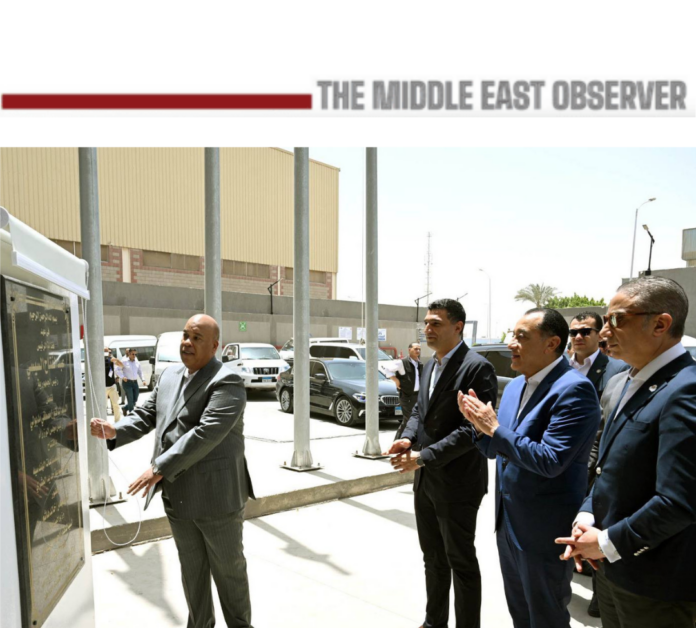
Egyptian Prime Minister Mostafa Madbouly conducted an extensive industrial tour across Sadat City and 6th of October City on Monday, inaugurating and inspecting a broad range of factories operating in strategic manufacturing sectors as Cairo accelerates efforts to expand domestic manufacturing, attract investment, and increase exports.
Accompanied by Industry Minister Khaled Hashem and local governors, Madbouly stressed that the government is continuing to expand industrial infrastructure, logistics networks, and technology-transfer initiatives to strengthen Egypt’s competitiveness as a regional manufacturing hub serving African, Gulf, and European markets. He reiterated that industry remains one of Egypt’s primary engines of economic growth alongside agriculture, tourism, and ICT.
The tour covered factories operating in steel manufacturing, automotive components, electrical cables, engineering products, adhesives, household detergents, and food industries. Among the key stops was the inauguration of Galva Engineering Industries, part of El Ashry Steel Group, which produces steel towers, lighting poles, cable supports, and heavy engineering products with monthly production capacities exceeding 8,000 tonnes, in addition to one of the region’s largest hot-dip galvanization lines utilizing Italian technology.
Madbouly also inspected expansions at electrical cable factories supporting Egypt’s energy and infrastructure sectors, alongside visits to automotive component manufacturers and industrial chemical facilities in 6th of October City. Official statements described the inspected facilities as successful examples of technology transfer and production expansion capable of increasing local output while supporting export growth and job creation.
The industrial expansion drive comes as Egypt seeks to narrow its trade deficit and strengthen hard-currency inflows through export-oriented manufacturing. According to official government targets, Egypt aims to raise annual non-oil exports to $100bn by 2030 under the National Industrial Strategy 2026–2030, which focuses on manufacturing expansion, logistics modernization, deeper private-sector participation, and attracting additional Arab and foreign investment.
Egypt’s current non-oil exports are estimated at roughly $40bn annually, underscoring both the scale of the challenge and the growth potential embedded in the government’s export strategy. Industrial exports continue to rely heavily on construction materials, chemicals, fertilizers, engineering products, textiles, and food industries.
Analysts note that expanding production capacity within Egypt’s industrial zones, combined with infrastructure investments, rising Gulf sovereign-backed investments, and expanding Asian manufacturing partnerships, could materially improve the country’s export trajectory over the coming years. According to The Middle East Observer’s assessment, the significance of Madbouly’s tour lies less in the opening of individual factories and more in signaling a broader state-backed manufacturing expansion strategy aimed at positioning Egypt as a regional production and export platform. While the $100bn export target remains ambitious, ongoing industrial reforms, supply-chain expansion, and infrastructure development suggest the objective is increasingly being treated as a long-term strategic economic benchmark rather than a purely aspirational figure.
