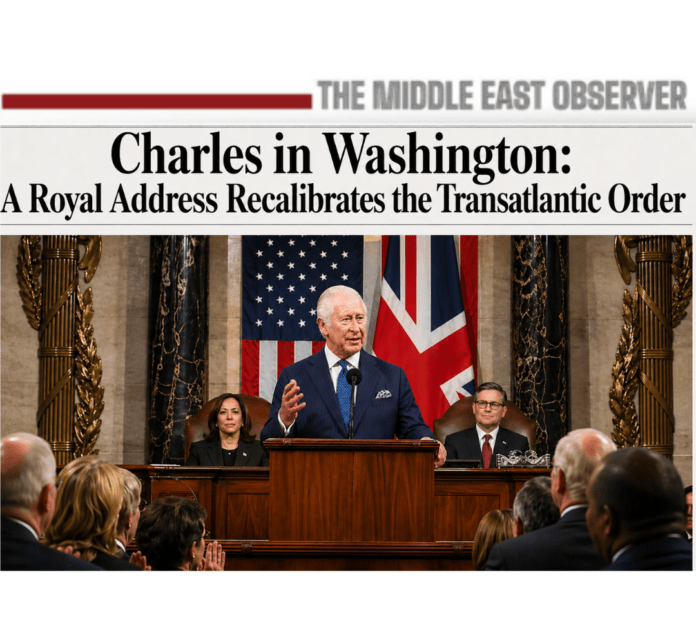
By : Mahmoud Fouda

Monarch’s Congress speech blends alliance repair with calibrated signals on power, policy, and global responsibility
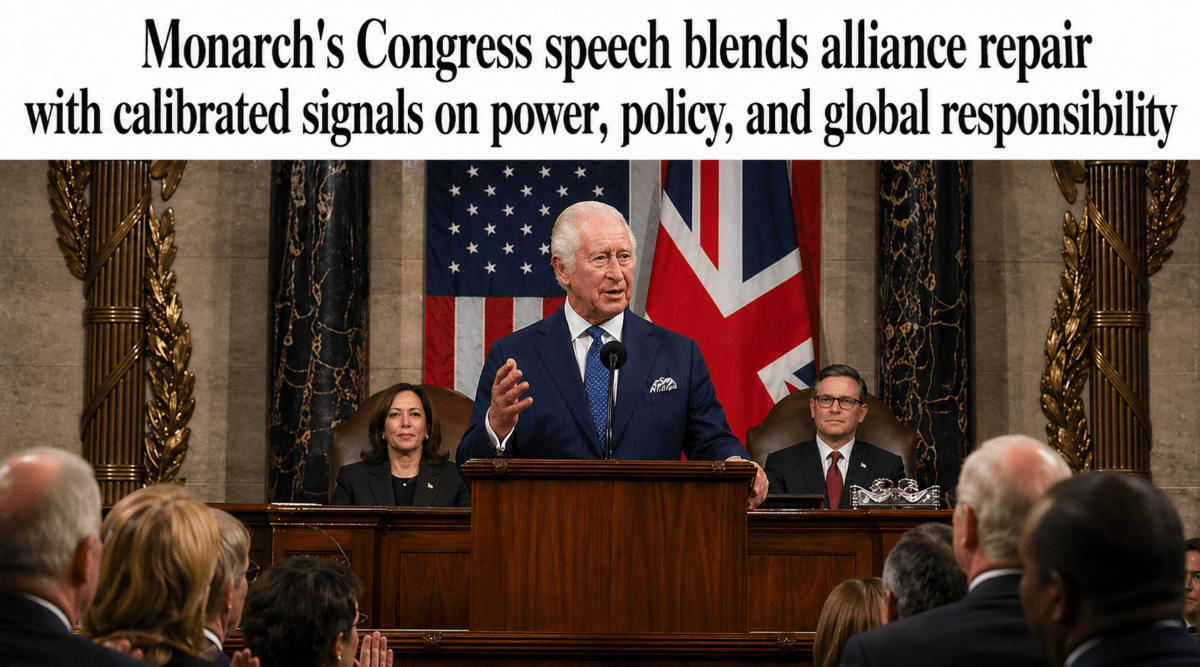
In what was formally framed as a ceremonial address marking America’s 250th anniversary, King Charles III delivered a speech on Tuesday before the US Congress that extended far beyond symbolism—emerging instead as a carefully calibrated geopolitical intervention at a moment of transatlantic strain.
While the occasion celebrated the enduring “special relationship” between the United Kingdom and the United States, the substance of the address revealed a more complex diplomatic objective: to stabilise relations while subtly recalibrating their strategic terms.
“We can perhaps agree that we do not always agree.”
Opening with a deliberate acknowledgment of “times of great uncertainty,” the King anchored his remarks in the realities of a rapidly destabilising global environment. Conflicts in the Middle East and Europe, formed the backdrop to a speech that sought to reconcile unity with divergence. In a line that resonated across political aisles, the monarch stated: “We can perhaps agree that we do not always agree.”
This was more than rhetorical nuance—it was a deliberate articulation of managed divergence, reflecting widening transatlantic fault lines across security, defence commitments, and geopolitical priorities, including NATO cohesion and burden-sharing, alongside tensions linked to the U.S.–Israel war on Iran and Europe’s strategic posture on the Ukraine conflict.
executive power “subject to checks and balances”
The most consequential passage came through the King’s implicit invocation of constitutional tradition, referencing the principle of executive authority operating under institutional oversight—a concept historically associated with the Magna Carta and embedded in the American system. The phrasing “Even kings must follow the law” was presented as a historical principle rather than a direct policy assertion, reinforcing the enduring doctrine that authority is constrained by legal frameworks.
The remarks were met with a notably strong reaction within Congress, particularly among Democratic lawmakers, and were widely interpreted in US media as a measured yet discernible caution regarding the exercise of executive power under Donald Trump.
In diplomatic terms, such messaging—delivered by a monarch within the legislative heart of the United States—constitutes a rare, carefully calibrated signal rather than an explicit political intervention: that institutional balance and adherence to the rule of law remain central to democratic legitimacy.
“The actions of this great nation matter even more”
Further sharpening the tone, the King underscored that while America’s words carry global influence, “America’s words carry weight and meaning, as they have since independence,” adding that “the actions of this great nation matter even more.”
This formulation—simple in structure yet significant in implication—echoes a growing international sentiment that US foreign policy is increasingly judged through its operational outcomes rather than declarative rhetoric. It reflects unease across allied capitals regarding perceived divergences between stated commitments and strategic execution.
NATO, security, and expanding definitions of risk
“The commitment and expertise of the United States Armed Forces and its allies lie at the heart of NATO, pledged to each other’s defence.”
The speech also reaffirmed the centrality of NATO as the backbone of Western security, invoking shared history and collective defence obligations. Notably, the King integrated environmental and climate considerations into this security framework, positioning global warming and related risks as emerging strategic variables rather than peripheral concerns. By doing so, the address advanced a broader interpretation of alliance responsibilities, linking traditional defence with long-term environmental stability.
Despite the gravity of its content, the speech employed measured humour and historical references to soften delivery—a hallmark of royal diplomacy. Yet beneath this tone lay a cohesive and strategically layered set of messages aimed at recalibrating expectations within the transatlantic partnership.
As The Middle East Observer notes, this was not merely a speech of commemoration—it was a speech of strategic calibration, carrying the tone of a measured yet unmistakable lecture in statecraft, infused with the weight of historic British institutional experience, its resonance extending across the Congressional chamber as a subtle yet deliberate signal of a transition in Anglo-American relations—from implicit alignment to increasingly tense and divergent partnership dynamics.
At a time when geopolitical tensions are reshaping alliances and testing institutional resilience, King Charles III’s address stands as both a reminder and a tempered admonition that even the most enduring partnerships must evolve—or risk gradual erosion amid shifting global realities.