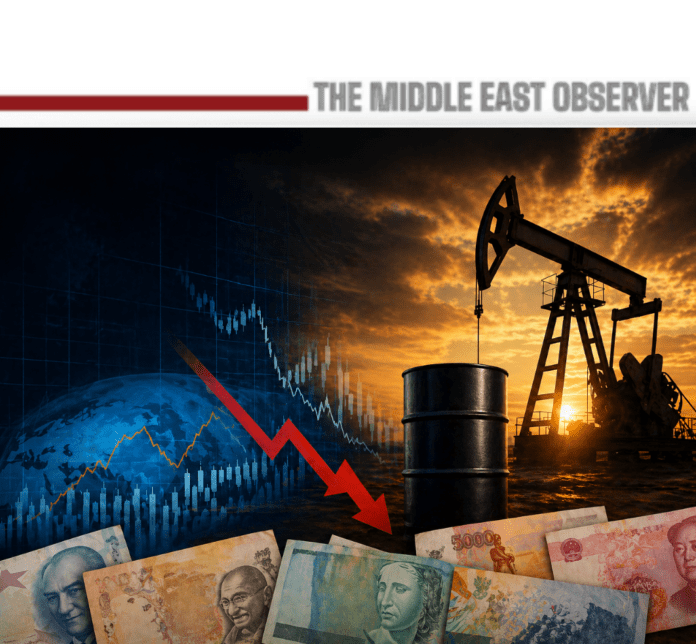
Global currency markets are undergoing a sharp divergence as the ongoing Iran-related conflict drives oil prices higher, creating winners and losers across emerging economies, according to analysis by Bloomberg Intelligence.
Since the escalation of tensions, crude prices have risen from around $65 to nearly $100 per barrel, triggering a redistribution of income between oil-exporting and oil-importing countries—reflected directly in currency movements.
Currencies of oil-exporting economies, including Kazakhstan, Colombia, and Brazil, have recorded the strongest gains, supported by rising export revenues and improved external balances.
By contrast, oil-importing economies such as Philippines, Thailand, and India have come under pressure, as higher energy costs increase import bills and intensify demand for the US dollar.
The Egyptian pound has weakened more sharply than its direct oil exposure might suggest, according to the analysis, reflecting Egypt’s geographic proximity to the conflict zone and heightened market risk perception. At the same time, rising global energy and food costs, alongside pressure on key foreign currency inflows such as tourism, are reinforcing strain on external balances.
While multiple factors influence exchange rates, the analysis underscores that oil remains the dominant driver in the current environment. Improvements in trade balances among exporters are translating into currency gains, while higher energy import costs are amplifying losses for importing economies.
Performance among exporters has also varied. The Russian ruble, for example, has risen less than expected despite higher oil prices, reflecting disruptions to energy infrastructure.
The assessment draws on trade data from UN Comtrade, evaluating crude and refined petroleum flows. It assumes oil prices averaging $100 per barrel, with corresponding effects on trade balances and current accounts, while factoring in reduced import volumes in response to higher prices.
The Middle East Observer notes that the divergence highlights a structural reality: energy dependency remains a central determinant of macroeconomic stability in emerging markets. The Middle East Observer further observes that current volatility is reinforcing the need for energy diversification, fiscal resilience, and more balanced trade structures.
As geopolitical uncertainty persists, currency movements are expected to remain closely tied to energy price dynamics, with oil acting as the primary transmission channel between conflict and financial stability.