
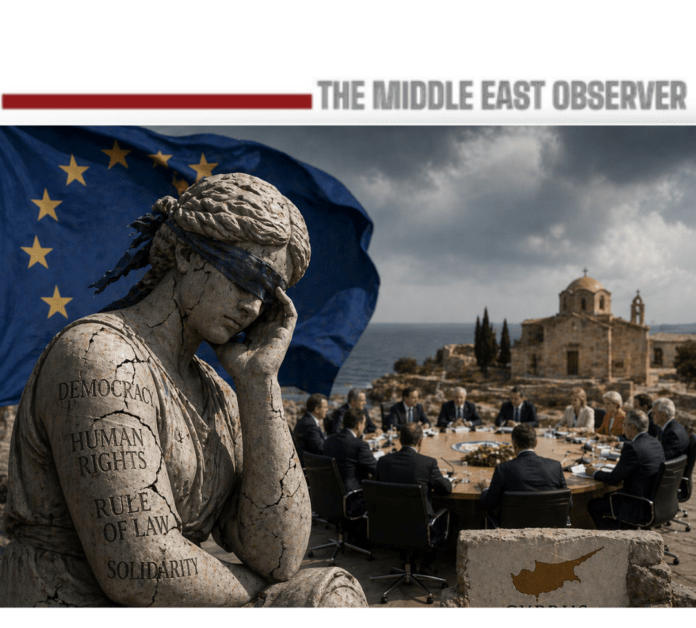
EU leaders convene today, 23 April 2026, in Lefkosia, Cyprus, for an Informal Meeting of Heads of State or Government under the Cyprus Presidency of the Council of the EU. Bringing together the 27 member states alongside the Presidents of the European Council and the European Commission, the two-day gathering provides a platform for direct, strategic exchanges on pressing political developments and the European Union’s broader direction. The format allows leaders to align positions, test consensus, and address sensitive issues with flexibility ahead of binding negotiations.
The agenda focuses on key geopolitical and economic priorities, including the Russian invasion of Ukraine with Volodymyr Zelenskyy, the Middle East crisis and its energy impact, the EU’s multiannual budget, and the “One Europe, One Market” roadmap to complete the single market by 2028.
However, absent from the formal agenda is a substantive reassessment of the Union’s core value framework. The EU’s commitment to human rights, rule of law, and collective decision-making faces renewed scrutiny following member states’ failure to reach consensus on suspending the EU–Israel Association Agreement amid escalating tensions in Gaza and the West Bank. While European leaders continue to express concern and mobilize humanitarian and reconstruction support, critics argue that this approach risks falling short of addressing ongoing violations on the ground.
At its core, the debate returns to a foundational principle: a nation’s—or union’s—legitimacy rests on shared values that generate cohesion and identity, forming the basis of sustainable power. Power endures when it derives from justice, not coercion; alignment between authority and moral purpose is what ultimately underpins resilience and long-term stability.
Europe’s own history offers a cautionary parallel. Its fragmented response to the Holocaust—marked by a mix of collaboration, resistance, and inaction—demonstrated the consequences of failing to translate moral awareness into coordinated action. Today, while Europe is far more integrated and strategically aligned, the challenge remains: ensuring that its proclaimed values are not only articulated, but consistently operationalized in policy and decision-making.
In this context, Europe’s current trajectory—towards deeper unity and institutional strength—will ultimately be judged not only by economic integration or geopolitical positioning, but by the extent to which its actions reflect the very values on which its legitimacy is built.
Values and moral principles remain the cornerstone of a nation’s strength and independence. Taking a clear stand against injustice and apartheid is not only a humanitarian imperative, but also reflects the ethical foundations embedded across religions and the collective conscience of societies. Such positions shape the identity of future generations and define the credibility of national leaderships. History will ultimately judge the decisions made today, underscoring the need for principled, decisive action to advance peace, justice, and a sustainable future grounded in moral responsibility.
