
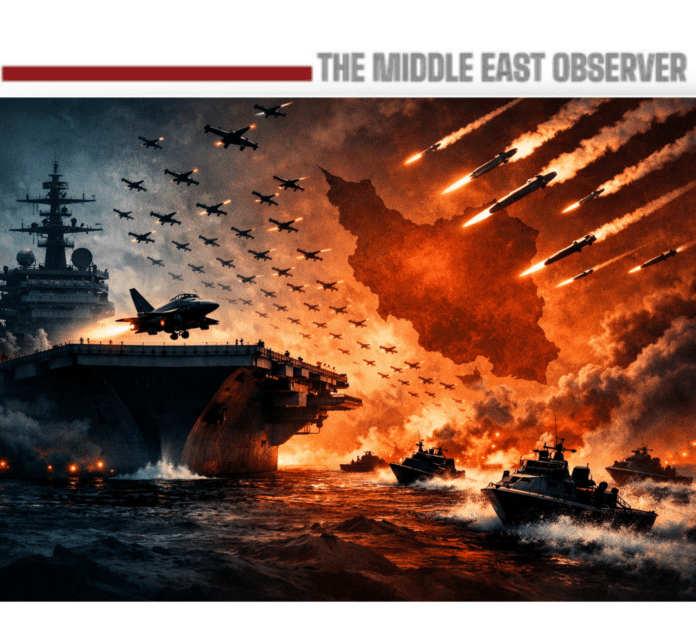
The Iran conflict is increasingly defined not only by military dynamics, but by a profound shift in the economics of warfare. What is unfolding is a redistribution of cost-efficiency across the battlefield, where lower-cost, adaptable systems are imposing disproportionate financial and operational burdens on far more expensive conventional capabilities. The result is a recalibration of how military power is measured—not in absolute strength, but in cost-imposition and sustainability.
At the core of this shift lies the declining return on investment (ROI) of high-value military assets when confronted with mobile and decentralized threats. The difficulty in targeting relocatable rocket launchers illustrates this imbalance: advanced precision strikes—costly in terms of intelligence, surveillance, and munitions—are often deployed against targets that are inexpensive, transient, and easily replaced. This creates a structurally inefficient exchange ratio, where the marginal cost of engagement exceeds the strategic value of the target.
Unmanned aerial systems further amplify this economic distortion. Low-cost drones, particularly when deployed in volume, force defenders to activate layered air defense systems that rely on significantly more expensive interception technologies. The resulting dynamic is a classic case of cost asymmetry: the attacker spends minimally to generate disruption, while the defender incurs escalating costs to maintain baseline security. Over time, this erodes the financial sustainability of traditional defense postures.
Maritime operations reflect a similar inversion. Large naval platforms—capital-intensive assets with high maintenance and operational costs—are increasingly challenged by small, fast-attack boats that require only a fraction of the investment. In strategically sensitive waterways, the ability of these low-cost units to disrupt trade routes or threaten high value vessels introduces a persistent risk premium. This has direct economic implications, from increased insurance costs and shipping delays to broader volatility in energy and commodity markets.
Equally important is the diffusion of advanced air defense capabilities. Systems influenced by platforms such as the S-300 missile system and S-400 missile system are no longer confined to major powers. As these technologies become more accessible and locally adapted, they impose higher operational costs on air campaigns by increasing risk, requiring additional countermeasures, and extending mission complexity. The economic effect is cumulative: each sortie becomes more resource-intensive, reducing overall campaign efficiency.
Taken together, these developments signal a transition toward what can be described as “economic warfare by design.” Success is increasingly determined by the ability to impose costs faster than one’s adversary can absorb them. This favors actors capable of leveraging scalability, redundancy, and low- cost production over those reliant on fewer, high-value assets with long replacement cycles.
The broader implications extend beyond the battlefield. Defense budgets—particularly in advanced economies—may face growing pressure as the cost of maintaining technological superiority rises without a corresponding increase in effectiveness. Procurement strategies will need to shift toward mixed portfolios that balance high-end capabilities with scalable, lower-cost systems. At the same time, industries tied to global trade—shipping, energy, and insurance—must adapt to a security environment where disruption can be generated at minimal cost but with outsized economic impact.
In this context, the Iran conflict serves as a critical case study in the financial logic of modern warfare. It demonstrates that the balance of power is no longer defined solely by the size or sophistication of military assets, but by the efficiency with which resources are deployed, the resilience of systems under sustained pressure, and the capacity to sustain operations within an increasingly asymmetric cost structure.
