
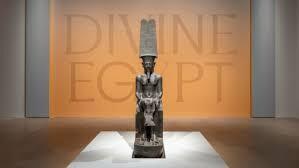
For the first time in over a decade, the Metropolitan Museum of Art has turned its spotlight back on ancient Egypt. Its new exhibition, “Divine Egypt,” brings more than 200 masterpieces from across millennia to Manhattan’s Upper East Side, illuminating how Egyptians imagined their gods — and themselves — in a world governed by cosmic order.
The show, which opened October 12 and runs through January 2026, traces 3,000 years of Egyptian civilization through monumental statues, golden miniatures, and intricate reliefs. “It’s the first ancient culture we learn about as children,” says Dr. Diana Craig Patch, the Met’s curator of Egyptian art. “But what we’re showing here is how deeply personal these gods were — not distant figures, but companions in daily life.”
Among the highlights is a commanding sculpture of the sun god Amun-Re enthroned above a youthful Tutankhamun, on loan from the Louvre. Elsewhere, the falcon-headed Horus and the many-formed Hathor embody power, fertility, and love in vivid artistic forms. Visitors encounter the sun god Re as a colossal scarab beetle pushing the sun into the sky, while the goddess Maat — symbol of truth and balance — appears in serene perfection, reminding viewers that justice and harmony were as sacred as worship itself.
The exhibition also re-creates moments of public devotion once limited to temple festivals. A reconstructed golden barque displays a solid gold statuette of Amun, acquired by the Met in 1926 from Lord Carnarvon’s collection — the same financier of Tutankhamun’s tomb discovery. “This captures how ordinary Egyptians experienced divinity — through festival, ritual, and joy,” notes Dr. Nicholas Reeves, an archaeologist and Egyptologist.
The final gallery explores the afterlife through the luminous triad of Osiris, Isis, and Horus, on loan from the Louvre, underscoring Egypt’s vision of death as transformation rather than end. “Even in their funerary art,” says Patch, “the Egyptians were affirming life.”
For museum director Max Hollein, “Divine Egypt” is both celebration and reflection. “It shows how ancient ideas of creation, justice, and immortality continue to define human imagination,” he says.
