The Shanghai Cooperation Organisation (SCO) summit opened on August 31, 2025 in Tianjin, China, bringing together a broad coalition of leaders from across Eurasia. The gathering—hailed by Chinese state media as the “largest-ever” in the bloc’s history—comes at a critical geopolitical moment. Russian President Vladimir Putin, Indian Prime Minister Narendra Modi, Iranian President Masoud Pezeshkian, and Belarusian President Alexander Lukashenko joined counterparts from Central Asia and Pakistan, with observer nations such as Egypt, Nepal, and Malaysia also present. The summit’s timing underscores both the economic turbulence unleashed by new U.S. tariffs on India and the delicate state of Russia–Ukraine peace contacts, making Tianjin a focal point for shifting global alignments (Xinhua, Aug. 28, 2025; Reuters, Sept. 1, 2025).
Shifting global context
Just days before the summit, Washington imposed tariffs of up to 50% on Indian goods, citing New Delhi’s purchases of discounted Russian oil. The move threatens India’s export access to U.S. markets and is forcing a recalibration of trade priorities (Reuters, Aug. 27, 2025). At the same time, Putin arrived in China fresh from U.S. talks, suggesting “understandings” on Ukraine, though Kyiv has rejected Beijing as a potential guarantor of any future settlement (Reuters, Sept. 1, 2025). Against this backdrop, Beijing is repositioning itself as a convener of economic opportunity, using the SCO to project a leadership style centered on partnerships, credit flows, and trade corridors rather than overt military alliances (AP, Sept. 1, 2025).
Xi’s pledges and new initiatives
In his keynote remarks, President Xi Jinping rejected what he called a “Cold War mentality” and urged members to strengthen artificial intelligence cooperation as part of a new technological agenda. He announced that China has invested $84 billion in other SCO countries and pledged support for 10,000 students to join Beijing’s Luban vocational education program. Xi also unveiled plans for cooperation platforms in new energy, green industry, and digital economy, alongside centers for tech innovation, higher education, and vocational training.
Most significantly, leaders endorsed the Tianjin Declaration and a development plan extending through 2035, described as the bloc’s blueprint for its next decade of growth. Chinese officials confirmed that the summit also approved the launch of an SCO Development Bank, with Foreign Minister Wang Yi presenting it as another multilateral instrument in line with Beijing’s previous initiatives such as the Asian Infrastructure Investment Bank. In parallel, Xi introduced a Global Governance Initiative, building on his earlier Global Development and Global Security proposals, emphasizing that global order should be shaped by “coordination and cooperation, not unilateral bullying.”
Diplomacy and optics
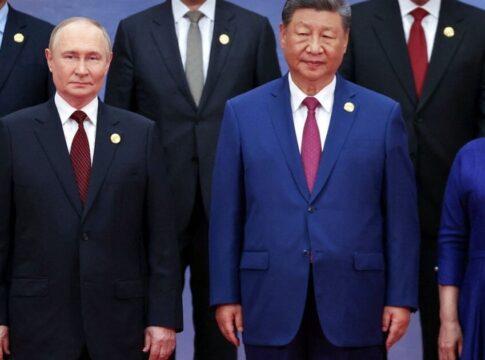
The summit was as much about symbolism as substance. Ahead of his speech, Xi gathered with Putin and Modi for a photo session, underscoring the high-level triangle at the bloc’s center. Over the weekend, Xi also met with at least ten visiting leaders, including Turkey’s Recep Tayyip Erdoğan and Cambodia’s Hun Manet, reinforcing Beijing’s image as a regional convener. Modi and Xi’s bilateral, the first since 2018, reiterated the importance of being “partners, not rivals,” with India’s foreign ministry stressing that cooperation between their “2.8 billion peoples” is essential for growth and stability. Analysts noted that this thaw could give India access to critical intellectual property and technology to accelerate its industrialization, while helping China soften its image as a disruptor.
Russia’s stakes
For Moscow, the summit is a platform to showcase enduring partnerships amid sanctions and war pressures on liquidity and resource investments. Nearly 90% of China–Russia trade is now settled in rubles and yuan, reducing dollar dependence (MERICS, 2024). Putin is expected to push for longer-term oil and gas supply contracts within the SCO framework, with broader adoption of local-currency settlements by India, Iran, and Central Asian states. With the war in Ukraine still unresolved, the SCO provides Russia diplomatic cover and access to sympathetic markets.
India’s balancing act and semiconductor push
Prime Minister Modi’s presence marked his first official visit to China since 2018. This diplomatic reset comes as India faces steep U.S. tariffs and searches for new markets. At the same time, Delhi is pursuing a high-stakes industrial policy: building a domestic semiconductor ecosystem to reduce reliance on Western suppliers.
India’s Semiconductor Mission, launched in 2021 with a $10 billion incentive package, has by August 2025 approved ten units worth nearly $18 billion. Projects include the HCL–Foxconn joint venture in Noida, expected to produce 36 million display-driver chips per month by 2027, and CG Semi’s OSAT facility in Gujarat. Engineering conglomerate L&T has announced plans for a $10 billion fab, while Lam Research has committed $1 billion in Karnataka (Reuters, May 2025; Economic Times, Aug. 2025). India’s edge lies in raw materials such as rare earths and in R&D capacity, but large-scale chip production is unlikely before 2027. In the meantime, India is likely to focus on assembly, testing, and packaging, while leveraging SCO ties for technology partnerships and market diversification.
Areas of cooperation taking shape
The Tianjin summit is expected to generate a series of incremental agreements rather than sweeping declarations. Energy cooperation will likely deepen through long-term oil and gas contracts, increasingly denominated in local currencies to reduce exposure to Western sanctions. Finance ministers have endorsed frameworks for an SCO Development Bank, which could co-finance infrastructure projects and stabilize trade flows. Connectivity remains central, with plans for upgraded rail freight corridors linking China, Russia, and Europe, alongside customs digitization and cold-chain logistics to expand agricultural exports. Agricultural trade itself is poised for growth, with China importing $13.7 billion in farm goods from SCO members last year; new sanitary protocols and digital certification are expected to make these flows more scalable. At the technological level, cooperation in artificial intelligence, semiconductor assembly, and power electronics is emerging as a frontier, aligning India’s chip ambitions with the bloc’s broader innovation agenda. Finally, digital payment systems are moving toward interoperability, with several members testing cross-border QR platforms and bank-to-bank links to insulate commerce from sanctions.
A cautious but clear shift
The SCO’s consensus model and internal rivalries mean that sweeping communiqués are unlikely. Yet the Tianjin summit underscores a broader trend: the bloc is evolving from a security forum into a sustainable platform for trade, finance, and industrial cooperation. For China, this represents a chance to entrench economic leadership and present itself as a global peacemaker. For Russia, it offers a way to counter isolation by binding energy exports to friendly markets. For India, squeezed between U.S. tariffs and Chinese rivalry, it provides hedging opportunities in energy, trade, and technology.
Other members also bring distinct expectations. Iran seeks to leverage the SCO to expand energy exports and bypass sanctions, while Belarus looks to offset European isolation through new trade and logistics links. Central Asian states hope for infrastructure investment, stronger agricultural exports, and secure energy transit routes, whereas Pakistan is focused on financial relief and energy partnerships. Observer states such as Egypt, Nepal, and several Southeast Asian nations see the SCO as a channel to diversify trade and explore new avenues for economic cooperation.
Taken together, the Tianjin Declaration, Xi’s new initiatives, and the expected deals point to a bloc that, while cautious, is steadily realigning Eurasian trade and finance away from Western dominance and toward a model of multipolar growth.