
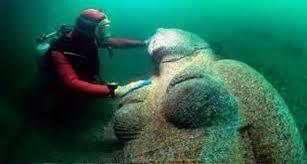
Just off the shimmering Mediterranean coast of Alexandria, where fishing boats bob gently on the horizon, a forgotten city has stirred back to life. From the depths of Abu Qir Bay, colossal statues, shattered columns, and fragments of temples—lost for more than two millennia—are emerging once again, carrying with them whispers of an era when Alexandria was the beating heart of the ancient world.
On Thursday morning, cranes heaved stone figures from the seabed, their waterlogged forms glistening in the sunlight. Divers, still dripping from their descent into history, erupted in cheers as each artifact broke the surface. It was a scene, part excavation, part celebration—a moment where modern Egypt met its ancient self.
The Ministry of Tourism and Antiquities announced that the discoveries are likely remnants of Canopus, a once-flourishing city during the Ptolemaic dynasty, which later thrived under Roman rule. Archaeologists believe earthquakes and encroaching sea levels gradually dragged the settlement—and the nearby port of Heracleion—beneath the Mediterranean centuries ago.
“There’s a lot underwater, but what we’re able to bring up is limited; it’s only specific material according to strict criteria,” explained Tourism and Antiquities Minister Sherif Fathi, standing on the shore as statues were carefully secured. “The rest will remain part of our sunken heritage.”
A City Between Two Worlds
Canopus was not just a city—it was a crossroads. Ancient texts describe it as a place of worship, where pilgrims sought healing from the god Serapis, and as a port where spices, silks, and precious metals flowed between Egypt and the Mediterranean world. Its proximity to Alexandria linked it to the cosmopolitan hub founded by Alexander the Great, yet its fate reminds us how fragile civilization is before nature.
Dr. Hala Abdel Rahman, an Egyptologist at Cairo University, believes the new finds reinforce that Canopus was “a fusion point of cultures—Egyptian tradition, Greek influence, and Roman governance all intermingled there. What lies beneath Abu Qir Bay is a living archive of how civilizations blended and traded ideas.”
Rediscovering the Drowned World
The sunken cities of Abu Qir Bay first reemerged in global consciousness in 2000, when French marine archaeologist Franck Goddio and his team mapped the seabed and uncovered sprawling ruins. Since then, Canopus and Heracleion have yielded treasures ranging from colossal statues of pharaohs and queens to delicate gold coins and amulets. Each dive adds a brushstroke to a submerged canvas of history.
Exclusive sources within the Antiquities Ministry hinted that recent sonar imaging has revealed unexplored sectors of the site, including what may be the outlines of larger religious structures. If confirmed, such a find could rival the earlier rediscovery of Heracleion, once dubbed the “Atlantis of Egypt.”
Preserving the Past, Inspiring the Future
While some of the artifacts will be displayed in the Grand Egyptian Museum and the National Museum of Alexandria, officials are exploring the possibility of creating an underwater museum where visitors could dive or take glass-bottomed tours to see relics where they have rested for centuries.
For now, the statues and fragments pulled from Abu Qir Bay undergo meticulous conservation. But their resurfacing is more than a victory for archaeology—it is a reminder of how Egypt’s history is never static, always capable of surprising, always capable of resurfacing.
On the shores of Alexandria, as divers toasted their latest triumph, the sea seemed to whisper its secrets once more: stories of gods and merchants, of earthquakes and empires, of a city that refused to be forgotten.
