
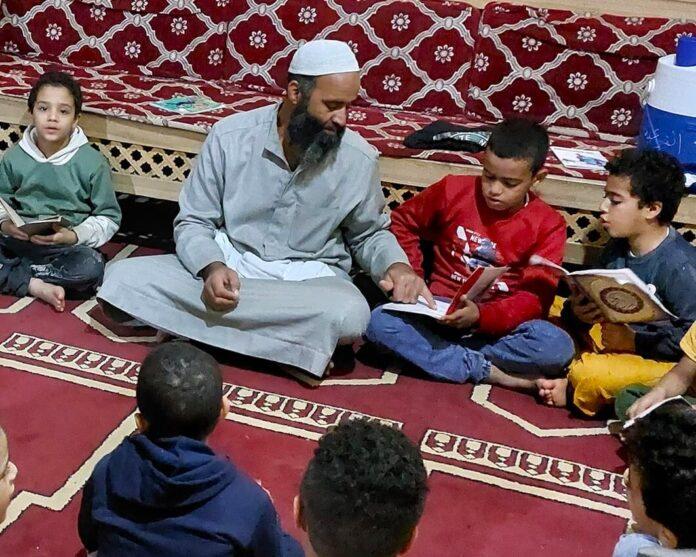
In the heart of Egypt’s cultural and spiritual heritage lies a centuries-old educational institution: the Kuttab (plural: Katateeb). For centuries, these humble Qur’anic schools were the bedrock of Egyptian education, shaping generations not only in literacy but also in ethics, identity, and discipline. In villages across Upper Egypt, the morning scene was familiar—children seated on mats, holding wooden slates, repeating Qur’anic verses in unison under the guidance of a sheikh.
But the Kuttab was never just about memorization. It was about building character. It was where children first learned discipline, patience, respect, and a profound sense of belonging. In many ways, the Katateeb were Egypt’s earliest institutions for holistic education, blending faith with social responsibility.
Today, as Egyptian society grapples with rising materialism, ethical decline, and a growing detachment from cultural roots, a new question emerges: Could the revival of the Katateeb serve as a strategic investment in shaping future generations?
Kuttab in History: Laying the Foundations for a Modern Egypt
The Katateeb origins trace back to early communal learning traditions in Egypt, when reading, writing, and record-keeping were essential to social life. With the advent of Islam, they took structured form: children memorized the Qur’an, learned Hadith, practiced Tafseer, perfected Tajweed, and mastered basic arithmetic. Ultimately, building a responsible educated individual.
By standardizing Classical Arabic through Qur’anic memorization, Katateeb became the guardians of the Arabic language. They created a unified linguistic identity that transcended regions and dialects.
Even Muhammad Ali Pasha—the architect of modern Egypt—recognized the potential of the Kuttab system. Building on the discipline and literacy it cultivated, he selected the nation’s brightest students and sent them to France for advanced studies. Figures such as Rifa’a al-Tahtawi, the pioneering writer, translator, Educator who spearheaded the Arab Nahda (renaissance), and Taha Hussein, the blind boy who became the “Dean of Arabic Literature” after first memorizing the Qur’an in a village Kuttab before continuing his studies in Paris, returned to become pillars of Egypt’s modernization in literature, and education. In this sense, the Kuttab served not merely as a village school but as a foundation stone for the country’s intellectual awakening.
Many of Egypt’s most celebrated figures shared similar beginnings. Reformist thinker and Grand Mufti Mohammed Abduh also started in Kuttab before spearheading transformative reforms at Al-Azhar. Liberal intellectual Ahmed Lutfi al-Sayed, philosopher Mustafa Abdel Raziq, Nobel laureate Naguib Mahfouz, and the beloved preacher Sheikh Metwally Al-Shaarawy all began their journeys in these humble schools before rising to shape the nation’s cultural, intellectual, and religious life. Collectively, their paths underscore the Kuttab’s historic role as the first gateway to Egypt’s modern scholarly and cultural elite.
Decline Under Colonial and Modern Schooling
The golden age of the Katateeb lasted for centuries. But by the 19th and 20th centuries, their role began to shrink. Muhammad Ali’s centralization of education, followed by British colonial reforms, shifted emphasis toward Western-style schools. By 1938, Katateeb were formally absorbed into the new “primary education system.”
While modern schools introduced scientific and social studies, they inadvertently diminished the unique strengths of the Katateeb: mastery of Arabic, moral discipline, and community-rooted learning. The shift produced highly skilled graduates but also generations more materialistic and less grounded in ethical or cultural identity.
The Enduring Legacy of Katateeb
What made Kuttab special? Three key dimensions stand out:
- Language Mastery – By reciting and memorizing the Qur’an, children gained fluency in the uniquely rich Arabic language, grounding them in their linguistic heritage.
- Ethics & Discipline – Daily routines built patience, humility, and responsibility.
- Community & Identity – The Kuttab connected children with their cultural, ethical and religious roots, ensuring education was both personal and social.
This fusion of literacy and values produced resilient, principled individuals who later became reformers, scholars, and leaders.
Contemporary Disputes and Revival Efforts
Al-Azhar — Egypt’s historic center of Islamic education and widely regarded as a guardian of moderation — plays a pivotal role, working in tandem with the Ministry of Awqaf (Endowments). Grand Imam Ahmed Al-Tayyeb has emphasized the importance and transformative power of the Kuttab in raising future generations.
This vision aligns with Al-Azhar’s ongoing efforts, including, for instance, the launch of the Egyptian School of Recitation at Al-Azhar Mosque, which seeks to discover talented voices and train them through a comprehensive program covering the ten canonical readings while developing proper vocal performance to preserve Egypt’s distinguished recitation heritage. To date, more than 5,400 teachers and Qur’an instructors have been trained through Al-Azhar’s Qur’an learning halls, which operate across 1,250 branches nationwide.
Parallel to this, the Ministry of Awqaf is advancing the national initiative “Return of the Katateeb,” aimed at establishing supervised, modern centers where children learn the Qur’an, Arabic, and values education alongside literacy and numeracy. The goal is not to replace formal schooling but to complement it with a stronger moral and cultural foundation. According to ministry figures, more than 2,500 centers have already been modernized, with plans to open 4,500 more. Staffed by trained graduates, these centers blend Qur’anic memorization with literacy, numeracy, and interactive teaching methods — ensuring child safety and alignment with modern pedagogy.
Such initiatives, however, have sparked debate. Critics caution that reviving Katateeb could encourage rote memorization, outdated disciplinary practices, or even risks of extremism, while others worry about potential overlap with modern education. Al-Azhar and the Ministry of Awqaf, by contrast, argue that their reforms directly address these concerns.
By placing these programs under close supervision, the institutions maintain safeguards against misuse, ensuring that children receive a centrist, balanced education — rooted in Egyptian tradition yet responsive to contemporary needs. By combining authenticity with modern methods, they continue to nurture a generation of confident, skilled reciters and learners who embody both moderation and cultural identity.
A Path Forward: Integrating Katateeb into Modern Education
Reviving the Katateeb is not intended to replace Egypt’s modern schools but to complement them. Much like today’s extracurricular lessons in languages, sports, or the arts, Katateeb can serve as community hubs that provide cultural, ethical, and spiritual grounding. They may also be reintegrated into preschools, kindergartens, and the early primary stages, giving children a formative environment that combines learning with values from the very start.
Placed under Al-Azhar’s supervision, these centers promise a balanced approach: a curriculum that blends Qur’anic studies with literacy and comprehension; accredited educators trained in modern pedagogy; and a framework that both preserves Arabic and Islamic identity and fosters personal growth. In this vision, the Katateeb are not relics of the past but partners in shaping future generations—youth who are scientifically capable, culturally rooted, and ethically anchored.
Egypt’s greatest asset has always been its children. The Kuttab once produced leaders, scholars, and reformers who shaped the nation. Today, reviving them under careful supervision offers a chance to restore values eroded by modernity, while still embracing the benefits of modern education. Reviving the Katateeb is not about nostalgia. It is about reconnecting with Egypt’s educational roots to invest in a values-based future—a generation fluent in its language, proud of its identity, and resilient in its ethics.
In doing so, we are not turning backward. We are moving forward—armed with the wisdom of our past.
