
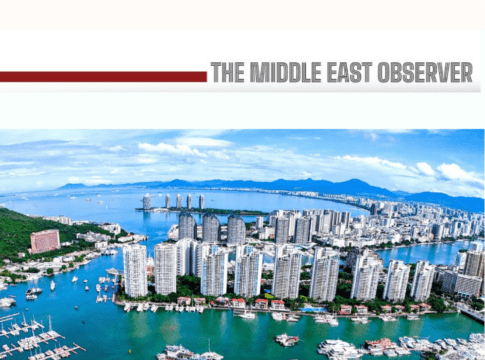
China has formally launched a new phase in its economic opening strategy by turning Hainan into a separate customs zone, a move that took effect in December 2025 and marks one of Beijing’s most ambitious trade experiments in decades. Framed domestically as a technical customs reform, the initiative is widely viewed—both inside and outside China—as a strategic test of how the country intends to shape globalization on its own terms at a time when much of the world is moving toward protectionism.
Hainan, China’s southernmost province, now operates under what Chinese authorities call “special customs operations,” effectively separating the island from the mainland’s trade regime. Spanning more than 35,000 square kilometres, the province is now the world’s largest free trade port by area, dwarfing established hubs such as Singapore and positioning China to trial large-scale openness without rewriting national rules.
Chinese state media, including Xinhua News Agency, describe the move as a structural upgrade rather than a policy adjustment. The objective, according to official commentary, is to create a high-standard business environment that can absorb global capital, technology and services while remaining firmly under central control.
Hainan’s location is central to the plan. Sitting at the northern edge of the South China Sea, the island lies closer to Southeast Asia than to China’s industrial heartland. Chinese media consistently frame the free trade port as a southern gateway linking China more directly with ASEAN, South Asia, the Middle East and Africa—regions Beijing increasingly sees as engines of future growth.
In this narrative, Hainan is not designed primarily for Western markets but for the Global South, reinforcing China’s long-term pivot toward emerging economies and maritime trade routes.
At the heart of the reform is a “two-line” customs system. The first line governs trade between Hainan and the rest of the world, where most tariffs have been removed and a wide range of goods—from raw materials to consumer products—can enter duty-free. The second line separates Hainan from mainland China, where standard customs controls remain in place.
This structure allows China to open outward while maintaining domestic safeguards. To encourage real economic activity on the island, goods that achieve at least 30% value added in Hainan can enter the mainland duty-free, creating incentives for manufacturing, processing and assembly rather than simple transshipment.
Customs reform is only one element of a wider policy package. Hainan offers a flat 15% corporate income tax rate for encouraged industries, lower than mainland China and competitive with regional hubs. Companies registered on the island can access freer capital flows through special bank accounts, while foreign universities are permitted to establish campuses without a Chinese partner.
Regulatory flexibility extends to healthcare and digital services. Medical products approved by recognized international regulators can be used in Hainan even if they are not yet approved on the mainland, and some firms can apply for broader internet access than is normally permitted elsewhere in China.
Visa-free entry has also been expanded, now covering visitors from dozens of countries for stays of up to 30 days, supporting Beijing’s push to develop Hainan as a combined business, medical and tourism destination.
The launch comes at a moment of rising global uncertainty. Trade fragmentation, investment screening and technology controls have become more common worldwide, while China itself faces slowing growth and shifting supply chains. Against this backdrop, Hainan functions as a pressure valve: a place where China can demonstrate openness, attract foreign participation and test international standards without exposing the entire economy to risk.
Chinese media openly compare the project to earlier reform experiments, such as the special economic zones of the late 1970s, which helped launch China’s export-led rise. The difference is scale. Hainan is intended to rival established hubs like Hong Kong, Singapore and Dubai—not by copying them exactly, but by combining openness with sovereign control.
What distinguishes Hainan from traditional free ports is Beijing’s underlying philosophy. Openness is presented not as a retreat or compromise, but as a tool of strategic influence. By offering access to a vast market through a tightly managed gateway, China aims to shape how globalization functions in an era of geopolitical tension.
The Communist Party has set clear milestones: full system establishment by 2025, institutional maturity by 2035, and strong global influence by mid-century. Whether Hainan can deliver on these ambitions remains an open question, but its role is already clear.
In a world where many economies are building walls, China is experimenting with selective openness—using geography as strategy and law as infrastructure. Hainan is not just a free trade port. It is a live test of how globalization may evolve when managed by a state determined to open on its own terms.