
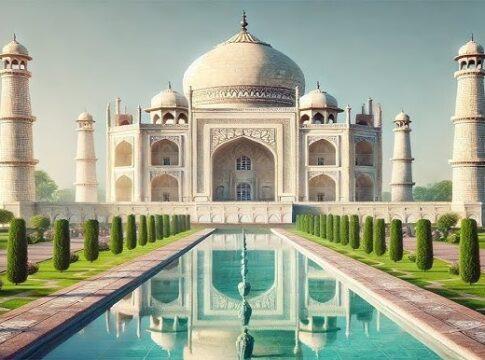
Few monuments in history embody both personal grief and universal beauty quite like the Taj Mahal. Rising from the banks of the Yamuna River, this ivory-white mausoleum has been hailed as “a teardrop on the cheek of time” by Nobel laureate Rabindranath Tagore—a poetic reminder that some architecture transcends function to become a living metaphor.
In 1631, Mughal emperor Shah Jahan’s world was shattered when his beloved wife, Mumtaz Mahal, died giving birth to their 14th child. Unlike many royal unions, theirs was a true partnership: Mumtaz was his advisor, confidante, and constant companion. Stricken by grief, Shah Jahan vowed to create a memorial worthy of her memory—one that would defy time itself.
Over the next 22 years, from 1632 to 1653, thousands of artisans, masons, and engineers worked to bring his vision to life. The result was the Taj Mahal, a monument not only to love but also to the grandeur and sophistication of the Mughal Empire at its zenith.
Crafted entirely from Makrana marble, the Taj Mahal appears to transform throughout the day: a delicate pink at sunrise, dazzling white at noon, and shimmering gold in the moonlight. “The changing hues of the Taj are not just an aesthetic delight,” explains Dr. Anita Raina, an art historian at Delhi University, “they symbolize the fluidity of human emotions—mourning, devotion, and transcendence.”
Its harmonious blend of Persian symmetry, Islamic calligraphy, and Indian craftsmanship reflects the cosmopolitan nature of the Mughal court. Semi-precious stones—turquoise, lapis lazuli, jade—are inlaid into intricate floral designs, turning stone into luminous embroidery.
Perhaps most striking is the monument’s structural foresight: the four minarets are tilted slightly outward, an intentional design to ensure that, in the event of an earthquake, they would fall away from the tomb rather than upon it.
For Egypt—home to the Pyramids of Giza and the temples of Luxor—the Taj Mahal resonates as part of a shared human tradition: to immortalize devotion through monumental architecture. “Both the Taj Mahal and the pyramids are not just tombs,” notes Professor Hassan El-Sayed, cultural historian at Cairo University, “they are civilizations speaking across centuries, insisting that love, memory, and faith deserve permanence.”
Today, the Taj Mahal is not only India’s most visited landmark but also a UNESCO World Heritage Site drawing over seven million visitors annually. Despite its global fame, conservationists warn of threats from pollution, overcrowding, and the Yamuna River’s declining water levels, which could undermine its foundations.
Beyond its physical beauty, the Taj Mahal endures as a cultural metaphor for eternal love. It continues to inspire poets, painters, musicians, and filmmakers worldwide. For many couples, a visit to the Taj Mahal is not just tourism but a pilgrimage—a reminder that even in loss, beauty and devotion can leave a legacy.
As Dr. Raina concludes, “The Taj Mahal is not Shah Jahan’s alone, nor India’s alone. It belongs to humanity—a timeless dialogue between grief and grace, permanence and fragility.”