
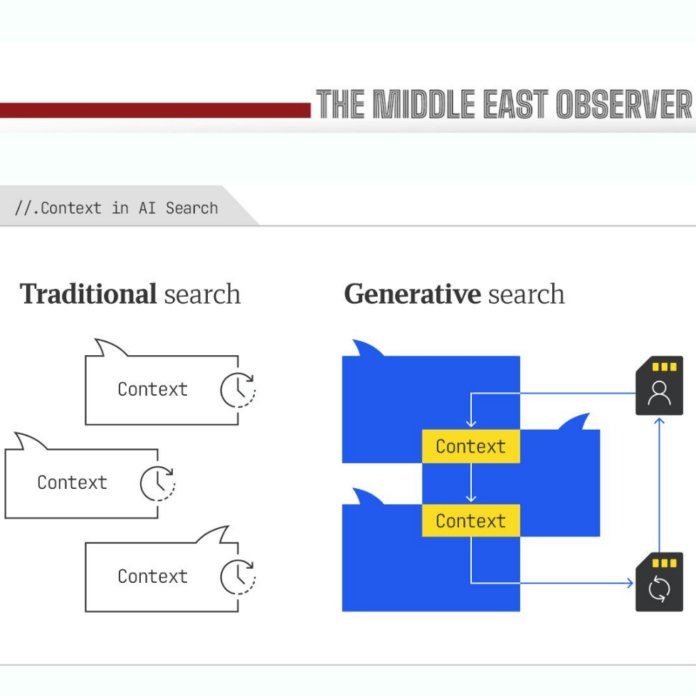
For more than two decades, search engines defined how people accessed information, evaluated options, and made decisions. Typing keywords into a search box and scanning a list of links became the dominant model for discovery. Today, that model is being fundamentally reshaped. Artificial intelligence is not only changing search technology, but also altering how people think, ask questions, and consume information.
Globally, more than half of internet users now interact with AI-powered systems as part of their information discovery process, whether through AI-enhanced search engines, conversational interfaces, voice assistants, or recommendation systems. At the same time, an estimated 60 percent of online searches now end without a click
From Searching to Asking: A Behavioral Transformation
AI has changed the psychology of information seeking. Users are no longer focused on finding sources; they are focused on getting answers. Analysis of AI usage patterns shows that more than 70 percent of interactions with generative AI tools are informational rather than transactional. Users primarily ask AI systems to explain concepts, summarize topics, compare options, or provide recommendations. Fewer than four in ten AI-assisted queries show immediate commercial intent, indicating that AI is being used earlier in the decision-making journey rather than at the final point of purchase.
Another defining behavior is cognitive offloading. Users increasingly delegate synthesis and evaluation to AI systems. Instead of reading multiple articles, they expect AI to consolidate viewpoints, highlight key risks, and present clear conclusions.
The Decline of the Traditional Search Journey
One of the most profound consequences of AI-driven discovery is the erosion of the traditional click-based search journey. AI-generated answers, featured summaries, and conversational responses often eliminate the need to visit external websites altogether.
Estimates suggest that between 15 and 25 percent of traditional search-driven website traffic has already been displaced by AI-generated responses. As AI summaries become more prominent across search platforms, this displacement is expected to increase.
Less clicking, more synthesizing is no longer a prediction—it is visible in performance data. When AI summaries appear, click-through rates for top organic results can drop sharply; one widely cited industry analysis reported a roughly 34.5% decline for the #1 result when an AI overview is present. In news-related queries, the share of “zero-click” sessions has been observed jumping from about 56% to 67% year over year—an 11-point shift in a single year.
This does not mean users are consuming less information. On the contrary, they are consuming more, but through fewer interfaces. The value chain is changing: discovery is increasingly happening “inside” the results page, not on the publisher’s page.
AI-generated overviews also reshape attention through design. They take up prime screen space, push traditional organic listings deeper below the fold, and in many cases become the first and last thing a user reads.
New Search Habits Across Channels
Globally, more than 20 percent of users now rely on voice search at least weekly, supported by an estimated eight billion voice-enabled devices in circulation. Social media has also evolved into a major search environment. Nearly half of consumers now use social platforms as a primary source for researching brands, products, and services, particularly among younger demographics. In many cases, discovery happens without any interaction with a search engine at all.
At the same time, AI has compressed decision cycles. Users can move from awareness to consideration within minutes by asking AI systems to compare options, highlight trade-offs, or summarize reviews. This shortens the influence window for businesses and places greater emphasis on early-stage visibility.
What This Means for Businesses
For organizations, the implications are strategic rather than tactical. Traditional search engine optimization, focused primarily on keywords and rankings, is no longer sufficient on its own. Content must now be optimized for comprehension, credibility, and contextual relevance.
AI systems prioritize clarity, authority, and trustworthiness. Superficial content, keyword-stuffed pages, and repetitive articles are increasingly filtered out. In contrast, well-structured, expert-driven content is more likely to be surfaced, summarized, and trusted by AI systems.
This shift also challenges how success is measured. As AI reduces direct website traffic, businesses must look beyond clicks and page views. Influence increasingly occurs without direct engagement. Brand presence within AI-generated responses, summaries, and recommendations is becoming a critical indicator of visibility.
This is where new practices are emerging: AI search optimization, generative engine optimization, and “visibility within synthesis.” The question is no longer only “Do we rank?” but “Do we appear in the answer?” If your brand is not retrieved, summarized, or cited in AI-driven responses, you may be absent from the decision session—regardless of how strong your traditional SEO is.
The paradox is that the traffic that does arrive can be more qualified. Users who click after reading an AI summary often have higher intent because the AI has already filtered and clarified options. But the total volume of visits may decline, and in some observed user behavior datasets, clicks on links inside AI summaries can be extremely low—reported as around 1% in certain analyses—while a meaningful portion of users end their session after reading the summary. For brands, this raises the stakes of being included in the synthesis itself.
The Middle East is experiencing this transformation at an accelerated pace. More than 55 percent of consumers report having used generative AI tools, with usage rates significantly higher among professionals, students, and digitally fluent audiences. In markets such as the UAE and Saudi Arabia, weekly or daily AI usage exceeds 40 percent among working-age populations.
This creates both opportunity and urgency for businesses in the region. Arabic-language content, in particular, faces rising standards. AI systems increasingly distinguish between high-quality native content and poorly translated or keyword-driven material. Brands that invest in clear, authoritative, and culturally relevant Arabic content will gain disproportionate visibility.
Trust, Risk, and the New Gatekeepers
Despite rapid adoption, trust remains a decisive factor. Users are increasingly aware of AI limitations, misinformation risks, and data privacy concerns. This places greater responsibility on businesses to ensure accuracy, transparency, and ethical use of AI-driven engagement.
With hallucinations, inconsistent sourcing, and the risk of summarizing publisher content without sending traffic back, business leaders must confront a new question: What does trust look like when answers are generated rather than visited? In an AI interface, the presentation of confidence can shape belief, even when details are incomplete. That makes governance, verification, and editorial discipline not just compliance issues, but competitive differentiators.
Content that demonstrates expertise, accountability, and clarity is more likely to be surfaced and trusted. Conversely, misleading or outdated information risks being excluded altogether. This underscores the need to integrate AI strategy into broader governance, brand, and risk frameworks rather than treating it as a purely technical function.
The Strategic Takeaway
Success in the AI era requires rethinking digital presence around authority, relevance, and value rather than traffic alone. It demands investment in high-quality content, readiness for conversational discovery, and acceptance that influence may occur without direct interaction.
AI is not merely changing how people search. It is changing how people think, decide, and trust. For business leaders, the shift is clear: the competitive battlefield is moving from blue links to synthesized answers—and from ranking to relevance inside the response.
