
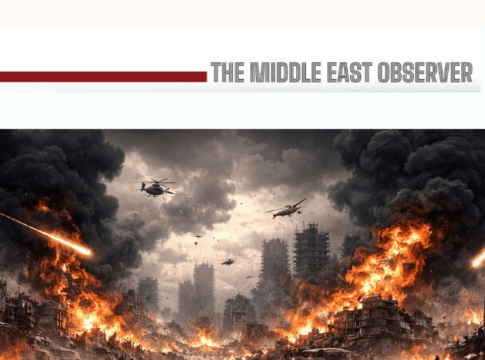
At the start of this new year, the world is being reminded of an old truth that many prefer to ignore: power does not last. It never has. Empires rise convinced of their permanence, only to discover—often too late—that strength without legitimacy is fragile, and dominance without rules is unsustainable.
The international system created after the Second World War was built around this lesson. It accepted that powerful states would always exist, but insisted that their power be restrained by law. Rules, institutions, and shared commitments were meant to prevent strength from turning into chaos. For decades, this system provided a basic framework for stability, even when it was imperfectly applied.
Today, that framework is under strain. New powers have emerged, particularly China, whose economic success is now shaping global politics. Instead of adapting the system to reflect a more shared world, leading states have increasingly chosen to bend or ignore the rules altogether. The belief seems to be that economic size, military force, or technological superiority can replace legitimacy. History suggests otherwise.
The United States, long the central pillar of the global order, has increasingly acted on the assumption that the system no longer serves its interests as it once did. National advantage has taken priority over collective responsibility. Commitments have become conditional, alliances more transactional, and international law something to be used when convenient and set aside when inconvenient. This shift may offer short-term flexibility, but it weakens the very foundations that once amplified American influence.
The damage is most visible in the breakdown of international accountability. Courts are challenged, legal norms are selectively enforced, and those who seek justice are sometimes punished rather than supported. In places like Gaza, the consequences are painfully clear. When international law is paralyzed or ignored, suffering expands, conflicts deepen, and the idea of fairness collapses.
When rules disappear, arrogance fills the space. Those who hold power act without restraint, believing that force alone will protect them. But economic strength fades, technology spreads, and military advantage erodes. None of these guarantees lasting authority. What endures is legitimacy—the shared belief that power is exercised within agreed limits.
A world without rules does not become more competitive; it becomes more dangerous. Without law, misunderstandings escalate faster, violence spreads wider, and crises spiral out of control. Chaos does not arrive with a single dramatic event, but through the steady erosion of trust in institutions meant to protect everyone.
The real challenge facing the world today is not who leads, but deciding whether leadership still respects limits. Restoring international law and giving real force to its institutions is not a moral luxury. It is a practical necessity. Without it, the myth of everlasting power will continue to push the world toward division and disaster.
Power will always shift. Economies will rise and fall. Technology will advance and then be overtaken. The only lasting safeguard is a global order governed by law, not force. The question is whether the world will rediscover this truth before the cost of forgetting it becomes irreversible.