
A world united in accountability towards Peace and a path for a nation’s re-birth
From Britain’s 1917 Balfour Declaration—a pledge supporting “the establishment in Palestine of a national home for the Jewish people”—to the Sharm El-Sheikh Summit of 2025, the pursuit of Palestinian statehood has endured more than a century of struggle, loss, and resilience. After decades of conflict and the sacrifice of thousands of lives, the world now finds itself at a turning point. With a ceasefire, a peace summit, and a reconstruction roadmap in motion, a long-deferred hope has begun to take tangible form—an achievement still incomplete, yet monumental in its promise.
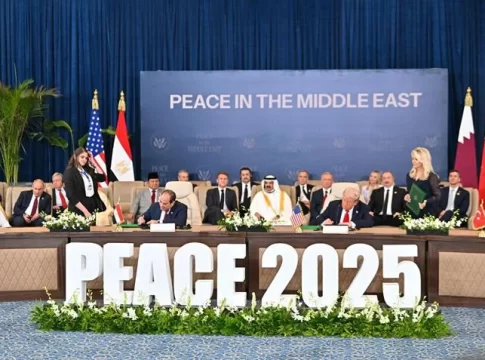
The Sharm El-Sheikh Peace Summit, co-chaired by Egyptian President Abdel Fattah El-Sisi and U.S. President Donald J. Trump, followed the declaration of a genuine ceasefire on October 9, 2025. The truce, painstakingly brokered through months of Egyptian, American, Qatari, and Turkish mediation, marked not only the end of hostilities but also the dawn of a new political horizon.
For many observers, this was more than a diplomatic event—it was the world’s collective resolve to walk the path of peace. Leaders from Azerbaijan, Bahrain, France, Indonesia, Jordan, Paraguay, Canada, Germany, Greece, Hungary, Iraq, Italy, Japan, the Netherlands, Norway, Pakistan, Spain, Saudi Arabia, the UAE, the UK, and India stood united in endorsing the Sharm El-Sheikh Agreement. Global institutions, including the United Nations, European Council, and League of Arab States, joined the proceedings, alongside former UK Prime Minister Tony Blair, whose presence symbolized continuity from past peace efforts.
What distinguished the summit was not merely its size, but its tone—marked by genuine optimism and shared moral purpose. After decades of failed accords and recurring wars, the world glimpsed, perhaps for the first time in a generation, the fragile yet luminous possibility of a stable and just Middle East.
Under the sky of the “City of Peace,” leaders gathered not to negotiate an end to violence, but to consolidate it—binding the ceasefire with political and moral legitimacy. Trump, El-Sisi, Qatar’s Emir Sheikh Tamim bin Hamad Al Thani, and Turkish President Recep Tayyip Erdoğan jointly signed a declaration endorsing the ceasefire and its political roadmap. The image of these leaders—representing divergent geopolitical camps—standing side by side evoked historic echoes of Camp David and Oslo, yet with a broader and more global reach.
President El-Sisi’s speech formed the emotional and moral centerpiece of the summit. In a delivery that recalled Anwar Sadat’s 1977 visit to Jerusalem, El-Sisi reaffirmed Egypt’s enduring commitment to peace, declaring with conviction:
“Let the war in Gaza be the last war in the Middle East.”
In a rare direct address to the Israeli people, he urged them to seize this historic moment to “usher in a new beginning defined by justice and peaceful coexistence.”
Concluding his remarks, El-Sisi awarded President Donald Trump the Order of the Nile—Egypt’s highest honor—praising him for demonstrating “the leadership that ends wars, not starts them.” The gesture encapsulated gratitude, diplomacy, and hope, framing the summit as a potential turning point in Middle Eastern history.
El-Sisi also revealed that Egypt and Jordan have begun training new Palestinian police units, with European partners expected to provide funding and technical support. The ultimate goal: the formation of a disciplined, locally respected security corps operating under the guidance of an International Stabilisation Force.
While the summit sparked celebration in Gaza and Tel Aviv, others urged caution. Human rights organizations highlighted that Israel has yet to face accountability for civilian casualties during the war and has not been compelled to finance Gaza’s reconstruction—an omission some warn could undermine the moral legitimacy of the peace process.
Others expressed concern that excluding Hamas from governance may create a dangerous power vacuum that future extremists could exploit. Yet, even among skeptics, there was a consensus that this framework—if implemented faithfully—represents the most credible peace roadmap in decades.
El-Sisi announced that Cairo will host the “Conference for Early Recovery, Reconstruction, and Development” in November 2025, aimed at turning pledges into projects. Under what President Trump has dubbed the “Gaza Miracle Initiative,” the United States will coordinate an investment task force comprising Arab sovereign wealth funds and global financial institutions to rebuild housing, power plants, and schools. Preliminary estimates place total funding requirements at $40 billion over five years.
For analysts, it is impossible to separate political ambition from personal legacy. Trump’s careful orchestration of the peace process has fueled speculation about his bid for the 2026 Nobel Peace Prize—a pursuit that, far from undermining the mission, is seen by some as complementary. As one European diplomat remarked in Sharm El-Sheikh:
“If Trump gets his Nobel, it means Gaza has peace and Palestine has a future. Those are two sides of the same medal.”
The defining test for this new era will lie in execution, not rhetoric. For peace to endure, the emerging Palestinian administration must prove itself capable of delivering stability, transparency, and economic progress. Security forces must uphold order without repression; reconstruction must advance swiftly to restore livelihoods and dignity; and the international community must sustain financial and political engagement.
Equally vital is the reform and reunification of Palestinian governance—the integration of Gaza and the West Bank under a single, legitimate national leadership. Should these pillars hold, the final clause of Trump’s peace plan—a U.S.-led dialogue on formal recognition of Palestinian statehood—could move from aspiration to declaration.
The Sharm El-Sheikh Peace Summit stands as more than a ceasefire—it is the embryo of transformation. Egypt has once again anchored peace in Arab soil; the United States has reclaimed its role as global dealmaker; and for the first time in decades, the word “Palestine” resonates not with tragedy, but with nation-building.
From Balfour to Trump, the long arc of history may finally be bending toward justice—not through a single declaration, but through the slow, collective forging of peace. If the commitments of October 2025 endure, the years ahead may witness not only the rebuilding of Gaza’s skyline, but the birth of a sovereign Palestinian state—a testament to diplomacy, perseverance, and shared humanity.
“Let this be the last war,” President El-Sisi declared.
“Let this be the first peace.”
