
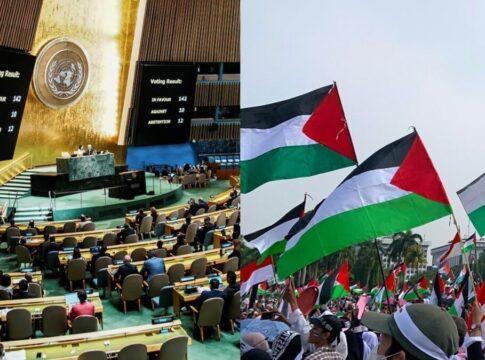
The United Nations General Assembly has delivered one of its clearest signals in years on the Israeli–Palestinian conflict, with 142 countries endorsing the New York Declaration calling for a two-state solution. The resolution, co-sponsored by France and Saudi Arabia, envisions a sovereign Palestinian state under the Palestinian Authority (PA) and the establishment of a transitional administration in Gaza once hostilities end.
The vote — 142 in favor, 10 against, and 12 abstentions — was overwhelming, though far from unanimous. Israel and the United States rejected the resolution, joined by Argentina, Hungary, Paraguay, Tonga, and several Pacific island nations including Micronesia, Palau, Nauru, and Papua New Guinea. A dozen other states abstained, underscoring continued hesitancy in parts of the international community even as the overwhelming majority backed the plan.
The declaration was unusually direct. It condemned Hamas’s October 7, 2023 attack on Israel while also It also condemned Israel’s siege and starvation in Gaza, which produced a humanitarian catastrophe. It demanded that Hamas disarm, release all hostages, and hand control of Gaza to the PA. At the same time, it urged the international community to mobilize reconstruction aid and consider transitional stabilization forces to ensure civilian protection.
Unlike past UN resolutions, which often carried aspirational language, this one is framed around “timebound, irreversible steps.” That language reflects growing frustration among member states with the stalemate of endless negotiations and escalating violence. Diplomats say the wording aims to lock in international expectations and discourage backsliding.
The lopsided vote revealed how isolated Israel and the United States have become on the issue, though Washington maintains that only direct negotiations can deliver peace. Netanyahu, only hours before the vote, rejected the very premise of a Palestinian state. Still, the political symbolism is potent. The vote signaled rare unity across Europe, Asia, Africa, and much of Latin America, giving the Palestinian cause its broadest formal backing in decades.
The resolution is nonbinding, but its passage may alter the diplomatic landscape in three key ways. First, it creates a benchmark against which future negotiations will be judged, placing pressure on Israel and its allies to explain deviations from a two-state trajectory. Second, it provides political cover for countries considering bilateral recognition of Palestine, potentially accelerating moves in Europe and Latin America. Third, it establishes a framework for international institutions to mobilize aid and oversight mechanisms linked to Palestinian governance and Gaza reconstruction.
Yet implementation remains fraught, as Israel shows no political appetite for compromise, expanding its circle of aggression towards US Allies in the Region targeting Hamass Leaders & negotiators, an issue that failed, yet caused a havoc away from the UN’s meeting outcome.
At this stage, The immediate priority is the establishment of a sustainable ceasefire in Gaza. Without an end to hostilities, any political framework risks being stillborn. The General Assembly’s recognition provides fresh legitimacy for international actors to press both sides toward halting violence, backed by the potential deployment of an internationally supported stabilization mechanism. Such a presence, whether under UN auspices or a regional mandate, could help monitor compliance, prevent flare-ups, and create the minimum security conditions required for political and humanitarian progress.
Equally urgent is the question of governance. The resolution’s call for the Palestinian Authority to assume responsibility over all Palestinian territories cannot succeed without substantial reform. The Palestinian Authority must reform to restore legitimacy and capacity, while reconciliation with Hamas and other factions is essential to prevent further fragmentation.
International guarantees will play a decisive role in sustaining any momentum generated by the vote. Regional powers such as Egypt, Qatar and Saudi Arabia, already deeply invested in mediation, will be central to providing both political cover and financial support. The European Union, often a major donor, and the UN itself will need to embed clear guarantees, ensuring that commitments extend beyond rhetorical endorsement.
Meanwhile, Gaza’s humanitarian crisis requires urgent action. Reconstruction of homes, hospitals, and infrastructure must be paired with transparent aid delivery and rigorous monitoring to ensure assistance reaches civilians rather than elites or armed groups. Restoring trust will also depend on involving local communities. Notions of displacing Gazans or pursuing ill-conceived development fantasies like a so-called ‘Gaza Riviera’ must be dismissed outright.
Finally, the diplomatic weight of the UN vote should not be underestimated. The New York Declaration establishes a new baseline for international discourse: the two-state solution is not merely aspirational but endorsed by a decisive global majority. The challenge now lies in converting that consensus into leverage. Future negotiations, whether bilateral or multilateral, will be measured against this yardstick. For Israel and the United States, explaining divergence from this overwhelming consensus will carry greater diplomatic cost. The declaration therefore represents not only recognition but also a potential pressure point—one that could shape the contours of Middle East diplomacy in the years ahead.