
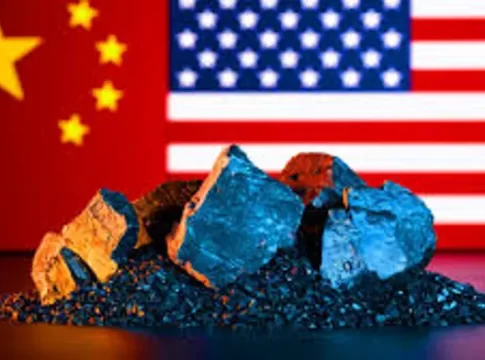
The global minerals market has entered its most uncertain phase in over a decade. Following China’s October decision to widen export controls on rare earths and processing technologies, prices of neodymium, dysprosium and terbium surged across Asian exchanges, igniting fears of a repeat of the 2010 supply shock. Yet unlike that episode, the 2025 rally is not speculative—it is geopolitical. Washington and Beijing are moving toward a tentative minerals truce, with U.S. President Donald Trump and Chinese President Xi Jinping expected to discuss easing curbs during this week’s APEC meetings in South Korea. Markets are watching for signs that China may relax export licensing or that the United States may roll back parts of its 54% tariff wall. Either outcome could puncture the “policy premium” that has inflated select mineral equities in recent months.
Rare earths and critical minerals have become the modern currency of power, underpinning electric vehicles, defense systems and digital infrastructure—the arteries of national security. China controls roughly 60% of global production and 90% of processing capacity, a dominance now being challenged through a new wave of U.S., Japanese and European strategic initiatives. The newly signed U.S.–Japan Critical Minerals Framework, pairing coordinated stockpiling with $550 billion in investment pledges, reflects the scale of this policy realignment. Meanwhile, the EU’s RESourceEU initiative and “anti-coercion” mechanism aim to blunt Beijing’s leverage through joint purchasing and stockpiles. Most notably, the Orion Critical Minerals Consortium—a $1.8 billion fund backed by the U.S. International Development Finance Corporation and Abu Dhabi’s ADQ—signals the deeper financialization of strategic supply chains.
For Middle Eastern investors, this geopolitical shake-up opens a once-in-a-generation entry point. Sovereign funds from the UAE, Saudi Arabia and Qatar have already begun building stakes across Africa, Central Asia and South America. ADQ’s role in Orion aligns with the UAE’s shift from energy exporter to technology-minerals investor, integrating logistics, ports and refineries into alternative supply corridors linking Africa to Europe and Asia. Saudi Arabia’s Manara Minerals, backed by Ma’aden and PIF, is pursuing global copper and nickel assets, while Oman’s Asyad Group develops critical-minerals logistics through its ports. The Gulf’s financial strength and proximity to resource basins position the region as a bridge between Western capital and emerging-market geology—a niche that grows in importance as Western banks grow cautious toward politically complex jurisdictions.
From Abuja to Santiago, emerging economies are recasting mineral wealth as a tool of monetary and fiscal stability. Nigeria’s National Gold Programme seeks to boost foreign reserves and steady the naira, while Zimbabwe’s gold-backed currency and Ghana’s gold-for-oil swap reflect a wider experiment in resource-backed finance as a hedge against dollar volatility. South America, too, is redefining the supply equation: Chile’s Codelco–SQM lithium partnership cements state control with investor participation; Argentina is liberalizing under President Milei; and Bolivia’s direct-lithium-extraction ventures with CATL are entering pilot stages. For investors, these moves underscore that mineral markets are no longer driven by spot prices alone—they hinge on policy regimes, royalty frameworks and refining access.
Should Washington and Beijing fail to stabilize relations, the world faces a multi-channel shock. Export controls could tighten, forcing the West to accelerate costly “friend-shoring” projects and triggering another round of raw-material inflation. Defense and EV manufacturers would scramble for magnet metals, while speculative capital could flood into marginal projects across Africa and Central Asia. Analysts warn that such a “dual decoupling” risks distorting capital flows—overvaluing unproven deposits, underfunding processing, and raising sovereign-risk exposure. In short, any new minerals bubble would be driven not by geology, but by geopolitics.
Conversely, even a limited China–U.S. understanding could ease near-term pressures. Licensing clarity and lower tariffs would allow rational price discovery and encourage investment in midstream processing rather than speculative mining. For investors, that would signal a value rotation from upstream exploration toward refining, recycling and component manufacturing. Copper, already trading near record highs on structural tightness, could remain the cycle’s “real-economy” winner, while lithium and nickel stabilize at more sustainable levels. Gold, meanwhile, is gaining traction as a reserve-diversification tool, particularly among African and Middle Eastern central banks.
Middle Eastern sovereigns should now leverage their neutral diplomatic position to co-finance ex-China mineral corridors across Africa and Asia, coupling logistics infrastructure with long-term offtake agreements. Private funds and family offices can target processing, recycling and ESG-compliant mining technologies—segments likely to attract Western concessional finance under supply-chain diversification drives. Global investors, in turn, should pivot from short-cycle price speculation toward structural enablers such as copper infrastructure, rare-earth magnets, battery-recycling capacity and traceability platforms. Yet risk hedging remains essential: flashpoints from Taiwan to the Red Sea can reprice metals by double digits overnight. Ultimately, the minerals race is no longer a commodities story but a capital-markets transformation, where access, compliance and credibility increasingly outweigh geology itself.
The minerals super-cycle narrative may be fading, but the strategic cycle is only beginning. The world is not running out of ore—it is running out of trust in who controls it. Whether the U.S.–China talks yield a lasting accord or merely a pause, investors must navigate a marketplace where national security, environmental scrutiny and financial ambition now overlap. The winners of this new order will be those who treat minerals as infrastructure assets, not speculative chips—anchoring supply chains, currencies and industries alike. For Middle Eastern investors, who already think in decades rather than quarters, that may be their ultimate advantage.