
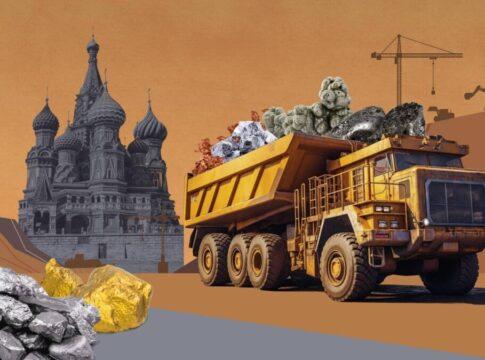
Russia has set an ambitious target to lift output of key rare and battery metals to 50,000 tonnes annually by 2030, covering lithium, tungsten, molybdenum, niobium, and zirconium. The plan, announced by the Ministry of Industry and Trade in March 2025, is central to Moscow’s strategy to reduce import dependence and secure inputs for defense, semiconductors, and clean-tech supply chains.
But the rollout collides head-on with Russia’s wartime economy, which is straining under unprecedented fiscal pressures. Sanctions, falling oil revenues, and 21% interest rates are squeezing domestic industry. State banks are extending politically directed loans to defense firms, leaving little room for long-term industrial investment. The contradiction raises doubts over whether Russia can realistically deliver its critical minerals vision by 2030.
War Financing Crowds Out Industry
Russia’s budget deficit hit $25.5 billion in Q1 2025—larger than the government’s projection for the full year. Revenues from oil and gas exports fell 10% year-on-year, while military expenditure surged 25%. Analysts at MMI, a Moscow budget monitoring group, estimate nearly a third of planned annual spending has already been consumed in the first three months.
Meanwhile, the Central Bank’s 21% interest rate, designed to stabilize the ruble, has become a chokehold on industrial firms. “Defense-linked companies are operating on margins of 19–20%,” said Alexei Rozstum, director of a Moscow-based investment group. “When banks restructure cheap, state-ordered loans under conditions of 20%+ interest rates, the entire financing model collapses.”
This wartime financial architecture is draining liquidity away from non-defense sectors—including mining and metallurgy—precisely when capital expenditure on critical minerals projects is most needed.
Mining Ambitions Under Sanctions
On paper, Russia’s resource base is formidable. The Kolmozerskoye lithium project in Murmansk, Tomtor rare earths in Yakutia, and niobium/molybdenum deposits in Irkutsk and Siberia could, if developed, position Russia as a significant alternative supplier outside China’s orbit. The Industry Ministry estimates that scaling to ~50,000 t/y of rare-metal products by 2030 would cut import dependence to 45% from today’s 70–80%.
But sanctions are choking access to capital, equipment, and midstream technologies essential for converting ore into high-purity oxides, metals, and alloys. “The mining side is feasible—Russia has the reserves,” said Dr. Irina Karpov, an independent critical-materials analyst. “The problem is separation, refining, and alloying. Without Western or Chinese tech, Russia risks becoming a discount supplier of concentrates.”
Processing delays already illustrate the risk. Rosneft only recently stepped in to take control of the delayed Tomtor project, signaling the state’s intent but also underscoring financing and operational hurdles.
The Global Supply Chain Lens
The International Energy Agency’s 2025 outlook highlights surging demand for battery metals and high-temperature alloys through the 2030s. If Russia succeeds, additional supply in lithium, niobium, and molybdenum could relieve some market tightness. But sanctions mean most of that supply would be directed to “friendly” buyers in Asia, Latin America, and the Middle East, bypassing Western OEMs.
Industry insiders caution that, under current conditions, Russia may deliver concentrates rather than value-added products. That would blunt the strategic payoff while limiting revenues. “Concentrates at a discount don’t shift the global balance,” said a European mining executive. “Refining is where the margins and influence lie.”
War vs. Industry: The Strategic Trade-Off
The deeper challenge is that Moscow is trying to finance two conflicting priorities: a resource-heavy war economy and a long-term industrial strategy. Military spending is crowding out investment in non-defense sectors, while sanctions block external financing. Social spending cuts risk political backlash, yet without peace, Russia cannot free resources for mining investment at scale.
“History suggests fiscal exhaustion is the greatest risk,” said Mark Sobel of OMFIF, pointing to how resource misallocation in the 1980s undermined the Soviet Union. “When a state diverts everything to defense, civilian industries stagnate. That pattern is repeating.”
Can Russia Hit the 2030 Bar?
Russia’s ambition to reach 50,000 tonnes of critical mineral output by 2030 is technically possible but financially precarious. Without sanctions relief or access to advanced processing technologies, Moscow may hit production milestones in tonnage but fail to capture value—exporting concentrates rather than refined materials.
In effect, the success of Russia’s minerals strategy is tied not just to geology but to geopolitics. A durable peace framework could unlock financing and redirect state spending toward industrial buildout. Without it, the war economy risks consuming the very resources needed to meet the 2030 goal.
For the global supply chain, the implication is clear: Russia’s reserves are vast, but unless its financial and political constraints ease, Chinese refiners will remain the dominant gatekeepers of value-added critical minerals well into the next decade.