
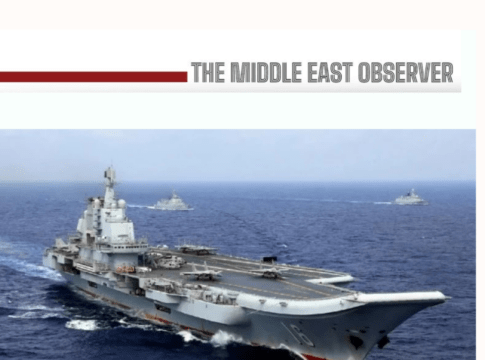
France will build a new nuclear-powered aircraft carrier to replace its ageing flagship, the Charles de Gaulle, President Emmanuel Macron confirmed on Sunday, committing to one of Europe’s most ambitious defence projects despite mounting pressure on public finances.
Speaking to French troops in Abu Dhabi, Macron said the decision to proceed with the Porte-Avions Nouvelle Génération (PA-NG) programme was taken this week, in line with France’s long-term military planning laws. He framed the move as essential to safeguarding national sovereignty and maritime power in an increasingly unstable global environment.
“In an age of predators, we must be strong in order to be feared, and especially strong at sea,” Macron said, announcing that France would equip itself with a new-generation aircraft carrier.
The PA-NG, scheduled for delivery in 2038, will replace the Charles de Gaulle, which entered service in 2001 and is currently France’s only aircraft carrier and the only nuclear-powered one operating outside the United States. Once completed, the new vessel will be the largest warship ever built in Europe.
With a displacement of around 78,000 tonnes and a length of 310 metres, the PA-NG will be significantly larger than its predecessor, which displaces about 42,000 tonnes. It will remain smaller, however, than the United States’ Gerald R. Ford-class carriers, which exceed 100,000 tonnes.
Like the Charles de Gaulle, the new carrier will be nuclear-powered and designed to operate France’s Rafale M fighter jets. It will also be equipped with two or three electromagnetic aircraft launch systems (EMALS), allowing faster and more efficient launch cycles for combat aircraft and support platforms.
Macron said the programme would provide a major boost to France’s industrial base, involving around 800 suppliers, roughly 80 percent of them small and medium-sized enterprises. He pledged personal oversight of the project and said he would visit the shipyard in February to meet companies involved in construction.
Army Minister Catherine Vautrin said the new carrier would give France the ability to conduct heavily armed, long-range deployments at short notice and sustain operations over extended periods—capabilities seen as critical to maintaining France’s role as a leading military power.
The programme is expected to cost about €10.25 billion, with work on nuclear propulsion components already under way. The final construction order is due to be placed under the 2025 budget, a step that has sparked debate in parliament as lawmakers grapple with budget constraints and rising public debt.
Some centrist and moderate left lawmakers have called for the project to be delayed, arguing that the scale of investment is difficult to justify under current fiscal conditions. Macron, however, has doubled down on defence spending, announcing €6.5 billion in additional military funding over the next two years and setting a target of €64 billion in annual defence spending by 2027, double the level when he took office in 2017.
France currently fields around 200,000 active military personnel and more than 40,000 reservists, a figure the government aims to raise to 80,000 by 2030. Within Europe, only a handful of countries operate aircraft carriers, and France remains the EU’s sole nuclear power and the only European state with a nuclear-powered carrier.
The Charles de Gaulle has played a central role in French and NATO operations for more than two decades, from Afghanistan to missions against the so-called Islamic State group in Iraq and Syria. Its service life, however, has been marked by recurring technical challenges and lengthy maintenance periods—factors that have reinforced the case for a next-generation replacement.
With the PA-NG, France is seeking to secure its naval aviation capability well into the second half of the 21st century, anchoring its strategic autonomy at sea amid intensifying global competition.