
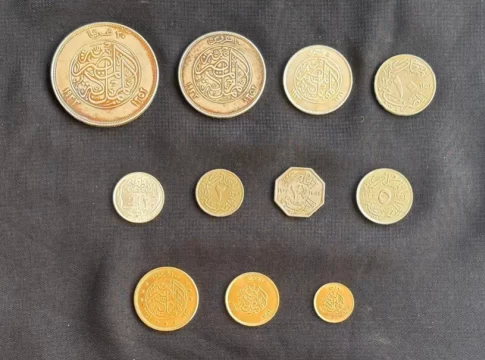
A sealed lead capsule buried beneath a 1930s villa in Alexandria has revealed a trove of rare Egyptian coins and a Greek-language document, shedding light on the city’s cosmopolitan past. Archaeologists from Egypt’s Supreme Council of Antiquities (SCA) uncovered the capsule during rescue excavations in one of the city’s historic districts, beneath the foundations of what was once the Salvago family’s residence — a prominent Greek household central to Alexandria’s economic and social life in the early 20th century.
Inside were thirteen coins spanning the reigns of Sultan Hussein Kamel and King Fuad I, including three gold coins of 20, 50 and 100 piastres — among the rarest in Egypt’s modern monetary history. Alongside them lay a typewritten Greek document signed by Constantine M. Salvago and his mother Julia K. Salvago, dated May 1, 1937, commemorating the villa’s foundation under French architect Jean Walter.
Officials said the capsule offers a striking connection between Alexandria’s modern and ancient heritage. SCA Secretary-General Mohamed Ismail Khaled called it “a tangible bridge between Alexandria’s past civilizations and its 20th-century cosmopolitan identity,” while Minister of Tourism Sherif Fathy described it as “a reminder that history often hides beneath our feet.”
Archaeologists believe the capsule was placed as a foundation deposit — a custom rooted in both Greek and Egyptian traditions, meant to bless new buildings with prosperity. The coins and document, remarkably intact, will go on public display at the Graeco-Roman Museum in Alexandria, offering visitors a rare glimpse into the city’s layered history.
As Dr. Leila Mansour, a modern-history researcher, noted: “This isn’t just a discovery of coins — it’s a rediscovery of Alexandria’s soul, frozen in metal and memory for nearly a century.”