
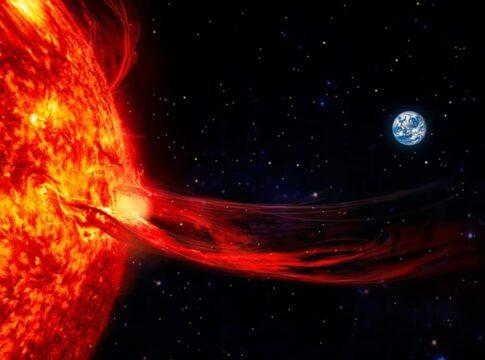
A significant increase in solar flare activity has been reported by scientists, with a striking rise in both the number and magnitude of active regions on the Sun. Remarkably, this includes areas currently on the Sun’s far side, hidden from terrestrial view.
The recent observations were disclosed by the Solar Astronomy Laboratory of the Russian Academy of Sciences’ Space Research Institute. The spike in solar activity began around midday on July 11, according to data from the Solar Orbiter spacecraft, which continuously monitors solar behavior. This surge saw 17 solar flares recorded between July 11 and 12, almost three times the typical July average.
“From July 11 to 12, 17 solar flares occurred, representing an approximately threefold increase in flare activity compared to the average levels for July,” the institute’s statement emphasized. This heightened activity is part of a global change in solar behavior, which researchers suggest could affect space weather conditions in the coming days.
Solar flares are intense bursts of radiation emanating from the release of magnetic energy associated with sunspots. Dr. Elena Petrova, a solar physicist at the Russian Academy of Sciences, explains, “This surge in solar flares is not just an isolated event but indicates a broader shift in solar dynamics. It’s crucial to monitor these changes as they can significantly impact satellite communications, GPS systems, and even power grids on Earth.
The global nature of this phenomenon might lead to increased auroral activity, potentially visible further from the poles than usual. Additionally, the fluctuations in solar behavior could disrupt radio communications and pose risks to astronauts aboard the International Space Station.
The implications of increased solar flare activity are far-reaching. Experts like Dr. Michael Thompson from NASA’s Goddard Space Flight Center highlight the need for enhanced vigilance in space weather prediction. “As our reliance on satellite technology grows, understanding and anticipating solar activity becomes critical,” Thompson notes.
Exclusive insights from the European Space Agency suggest that the Solar Orbiter mission may soon provide detailed images of the Sun’s far side, offering unprecedented views of these active regions. This could lead to breakthroughs in predicting solar behavior and preparing for its terrestrial impacts.
As scientists continue to analyze data from the Sun, global space agencies are on alert to mitigate potential disruptions. The significant uptick in solar flare activity serves as a reminder of the dynamic and sometimes volatile nature of our closest star.
In the coming weeks, researchers will focus on understanding the underlying causes of this solar surge and its potential effects, ensuring that both technology and infrastructure on Earth are shielded from the Sun’s intensified activity.
