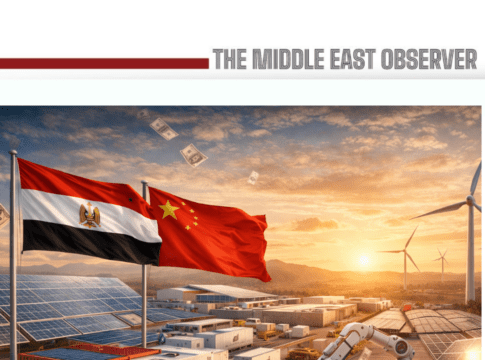
Egyptian industrial manufacturer Kemet Industries has signed two cooperation agreements worth a combined $700 million with Chinese clean-energy firms, marking one of the country’s most significant recent steps toward localising renewable-energy manufacturing. The agreements were signed during an official visit to China by Mahmoud Esmat, Egypt’s Minister of Electricity and Renewable Energy, and were confirmed by the Egyptian Cabinet.
Under the first agreement, Kemet will partner with Cornex New Energy to establish a $200 million energy-storage battery manufacturing plant in Egypt. Cornex, which specialises in lithium-ion batteries for energy storage systems, electric vehicles, and commercial applications, will provide the technology to localise battery cell production. The facility is expected to reach an annual capacity of 5,000 megawatt-hours (5 GWh) and will rely in part on locally sourced raw materials and components, although details on location, land allocation, and construction timelines have not yet been disclosed.
In parallel, Kemet signed a $500 million cooperation agreement with Suzhou GCL Photovoltaic Technology, a subsidiary of GCL Group, to develop a large-scale industrial complex producing solar cells and photovoltaic modules. The project will span approximately 280,000 square metres and is designed to reach an annual production capacity of 5 gigawatts (GW), using GCL’s proprietary technology to build domestic manufacturing capability and reduce reliance on imports.
From an industrial-policy perspective, the agreements signal a shift from stand-alone power projects toward localised clean-energy value chains, combining technology transfer, workforce development, and supplier ecosystem formation. If executed at scale, the battery and solar plants could anchor a broader manufacturing cluster encompassing components, testing, logistics, and downstream assembly, reinforcing the government’s push for private-sector-led growth and higher local content.
Regionally, the projects strengthen Egypt’s competitive positioning against other Mediterranean and MENA manufacturing bases by pairing scale, geography, and integrated capabilities. With access to major East–West trade routes and established export infrastructure—particularly through industrial zones such as the Suez Canal Economic Zone—Egypt aims to serve both domestic demand and regional markets. However, competitiveness will hinge on execution: timely land allocation, regulatory clarity, grid connectivity, cost-competitive energy supply for factories, and secure long-term demand through utility tenders, corporate PPAs, or export contracts.
Strategically, the decisive factors will be the clarity of project timelines and offtake arrangements, alongside the depth of technology transfer and localisation—particularly in battery manufacturing, where continued reliance on imported advanced materials could constrain long-term resilience if left unaddressed.