
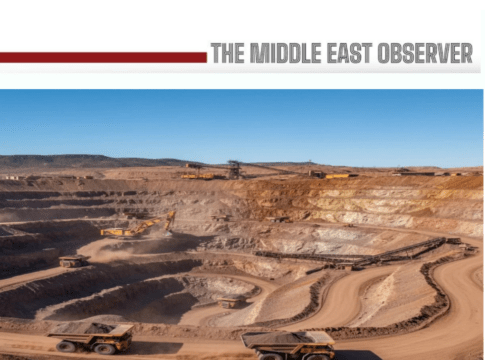
Nigeria is positioning its expanding lithium and gold projects as a pillar of broader economic recovery, as officials seek deeper partnerships with Saudi Arabia amid forecasts of the country’s fastest growth in more than a decade.
Nigeria’s solid minerals minister Dele Alake said recent investments — including a high-purity gold refinery in Lagos, three additional refineries under development and a $600m lithium processing plant in Nasarawa State nearing commissioning — are shifting the country from raw mineral exports toward domestic value addition. He made the remarks during talks with Ibrahim Al‑Khorayef, Saudi Arabia’s minister of industry and mineral resources, ahead of the Future Minerals Forum in Riyadh.
The discussions focused on cooperation in exploration, technology transfer, workforce training, mineral traceability and environmental, social and governance standards, with a joint working group preparing a draft memorandum of understanding to formalise collaboration. Saudi officials encouraged Nigeria to showcase mining investment opportunities to Gulf investors and to adopt advanced exploration technologies.
The minerals push comes as Nigeria’s macroeconomic outlook improves. The World Bank has revised its forecasts, projecting economic growth of 4.4% in both 2026 and 2027, the strongest performance in over ten years. Growth reached 4.2% in 2025, driven mainly by expansion in services — particularly finance and information and communication technology — alongside a modest recovery in agriculture and Nigeria’s emergence as a net exporter of refined petroleum products.
According to the World Bank, continued services growth, a rebound in agricultural output and gradual acceleration in non-oil industries are expected to underpin the outlook. Ongoing reforms to the tax system and prudent monetary policy are also seen as supporting investor confidence and easing inflation, while higher oil output should help offset weaker global prices and strengthen fiscal and external balances.
Regionally, Sub-Saharan Africa is forecast to grow by 4.3% in 2026, though the Bank cautioned that per-capita income gains remain insufficient to significantly reduce poverty, with risks from weaker external demand, commodity price volatility and political instability.
For Nigeria, officials argue that scaling up solid minerals — particularly lithium and gold critical to the global energy transition — could complement services-led growth and help anchor longer-term economic diversification.