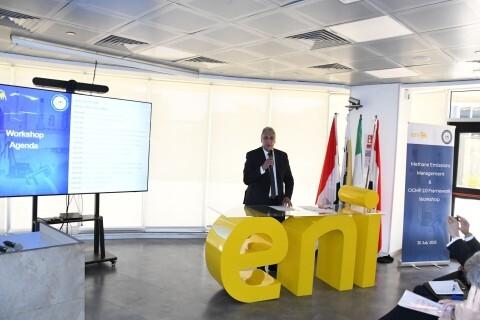
Agiba Petroleum Company, a joint venture between EGPC and Italy’s Eni, successfully commissioned its Arcadia‑28 well on July 19, following an advanced acid stimulation technique targeting the Masajid Carbonate formation. The operation raised daily output by roughly 4,100 barrels of oil equivalent (boe/d), according to the Ministry of Petroleum and Mineral Resources.
This development follows the earlier success of the Iris field, which continues to produce approximately 7,500 boe/d. By targeting previously underexplored rock layers underpinned by 3D seismic data, Agiba has demonstrated its ability to quickly convert geological insights into operational gains.
The activation of Arcadia‑28 aligns closely with Egypt’s national strategy to enhance domestic petroleum production and reduce import dependency—part of the Ministry’s first strategic pillar in its wider energy roadmap. Agiba’s achievement contributes to a sector-wide growth trend: production in its concession areas in the Western Desert has surged above 30,000 bbl/d, with associated gas output exceeding 5 million cubic feet per day following recent maintenance and interventions.
Dr. Yasser El Naggar, senior energy analyst at the Cairo Center for Economic Studies, hailed the well stimulation as a prime example of combining environmental and operational efficiency: “Agiba’s acid stimulation not only unlocks new reserves but supports flaring reduction and sustainability goals”—echoing Egypt’s commitment to lowering carbon emissions while optimizing output.
Oil analysts highlight that using proven techniques in adjacent fields reduces cost and delay, underscoring Egypt’s focus on near-field development rather than expensive greenfield drilling.
Agiba is executing a $500 million investment plan during FY2024–25, targeting an average output of 30,000 boe/d and 119 million cubic feet of gas per day. With Arcadia‑28 now contributing an additional 4,100 boe/d, the company is on track to meet its targets, as reaffirmed by company leadership and government officials.
Minister Karim Badawi and EGPC leadership—including CEO Salah Abdel Karim—recently highlighted Agiba’s trajectory to reduce per-barrel costs, expand infrastructure, and accelerate drilling activities across the Western Desert.
Agiba plans more wells across the Arcadia West field, leveraging the Masajid formation’s demonstrated potential. Based on Iris and Arcadia‑28’s performance, further drilling is expected to unlock similar reservoirs across adjacent concession zones.
On the sustainability front, Agiba has deployed zero-flaring initiatives, capturing gas that would otherwise be vented. A recent gas-capture station reduced CO₂ emissions by approximately 70,000 tons annually, while increasing output by 75 MMSCF per month, positioning Egypt’s energy industry as environmentally progressive.
Agiba’s rapid ramp-up of production exemplifies Egypt’s broader petroleum strategy: leverage cutting-edge stimulation techniques, focus on near-field expansion, and align growth with sustainability targets.
If Arcadia‑28 proves replicable across other fields, Agiba could sustain daily production of 30,000 boe/d or more through FY2026, as envisioned in its investment roadmap.
With geopolitical volatility impacting global energy markets, domestic boosts like these enhance Egypt’s ability to meet internal demand and bolster export potential—crucial objectives as the country reinforces its energy self‑sufficiency and long‑term development vision.