
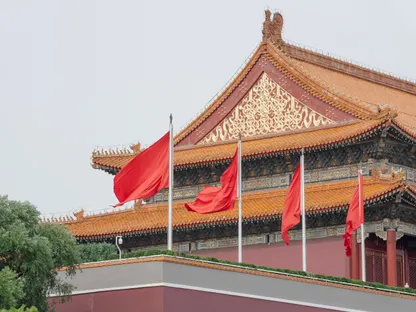
China’s senior leaders are meeting this week in Beijing for the 4th Plenum of the Chinese Communist Party (CCP) Central Committee, where the outline of the nation’s next Five-Year Plan (2026-2030) is expected to take shape. While the full blueprint will only be formally released next year, officials and state media are already signalling that the plan will be anchored around three broad themes: high-quality development, technological self-reliance, and a rebalancing toward domestic demand.
The practice of Five-Year Plans in China has long served as a major policy lever—tying the resources of state, Party and industry to strategic ends. As analyst Neil Thomas of the Asia Society Policy Institute observes, “Western policy works on election cycles, but Chinese policy making operates on planning cycles. Five-Year Plans spell out what China wants to achieve, signal the direction the leadership wants to go in and move the resources of the state towards these predefined conclusions.” In the coming iteration, Beijing appears to be recalibrating its template for a more troubled global environment.
China’s previous plans already left a sweeping mark on the world. In the early 1980s, the 6th Five Year Plan helped launch the “reform and opening-up” era under Deng Xiaoping, unleashing foreign investment and coastal export-led growth. Later, the 2011-15 window honed a strategy around “strategic emerging industries” — such as electric vehicles and solar panels — addressing the so-called middle-income trap. Today’s adults raised in the west may remember the “China shock,” when millions of manufacturing jobs were shifted overseas. The 2026-30 plan looks to continue that lineage while adapting to new headwinds: sluggish consumption, high youth unemployment, real-estate fragility and trade frictions.
State media and global reporters following the Plenum highlight three likely focal points. First, technological self-reliance; Beijing is expected to accelerate efforts in semiconductors, artificial intelligence, advanced manufacturing and “new quality productive forces.” According to the Financial Times, the next plan may elevate heavy investment in high-tech industries as tensions with the U.S. intensify. Second, domestic consumption and balanced growth: With the economy expanding at just 4.8 percent in Q3 2025, macro-economists argue that China must shift away from export and investment-driven growth toward boosting household spending. Third, high-quality development and governance, which the government defines as more strategic infrastructure, greener policies, regional convergence and better services for citizens, rather than raw GDP growth at any cost.
Experts say the signals emanating from this week’s meeting matter far beyond Beijing’s borders. “China’s Five‐Year Plans continue to be one of the most prominent examples of how state planning steers not just domestic policy but global supply-chains,” says Dr Helena Wu, a consultant on Asia industrial strategy. “Investors and global businesses interpret these plans like a roadmap: when China doubles-down on semiconductors or defines targets for the rare earths, the ripple effects show up in boardrooms from Tokyo to Silicon Valley.”
There is also exclusive news emerging from the corridors of power: according to a Chinese-official notice leaked to foreign media, the forthcoming blueprint may drop any explicit GDP-growth target, marking a departure from past versions. Instead, Beijing may adopt more flexible framing—focusing on metrics like urban jobless rate, per-capita income growth, R&D intensity and urbanisation rates. Reuters analysts see the plan’s growth anchor still in the 4.5-5.0 percent zone, but packaged differently.
That said, the path ahead is not without caution. China faces a slowing economy, structural challenges of “involution” (over-competition and diminishing returns), a property slump, demographic risks and rising geopolitical friction. Any misalignment between ambition and execution could lead to misallocated investment, regional overcapacity and global ripples.
As delegates in Beijing draft what will become the policy blueprint guiding China through the remainder of the decade, the world watches closely. Whether this next plan marks incremental adjustment or a bold reset will matter both within China and across global markets.