Spain’s King Felipe VI and Queen Letizia concluded a four-day state visit to Egypt (16–19 September 2025), their first since ascending the throne, at the invitation of President Abdel Fattah El-Sisi. The visit, accompanied by Foreign Minister José Manuel Albares and State Secretary for Trade María Amparo López Senovilla, represented a diplomatic and economic milestone, coming just months after El-Sisi’s February trip to Madrid formally upgraded bilateral ties to a strategic partnership.
The royal programme began in Cairo with a wreath-laying at the Unknown Soldier Memorial and an official reception at Al-Ittihadiya Palace, where they were received by the President and First Lady Entissar El-Sisi. Over the following days, Their Majesties met parliamentary leaders Hanafy El-Gabaly and Abdel Wahab Abdel Razek, Prime Minister Mostafa Madbouly, and Arab League Secretary-General Ahmed Aboul Gheit. Queen Letizia’s cultural engagements included visits to Historic Cairo’s City of the Dead, while the couple later travelled to Luxor to tour the Temple of Hatshepsut, the Valley of the Kings, and Spanish-led archaeological projects such as Proyecto Djehuty.
At the heart of the visit was the Egypt–Spain Business Forum, inaugurated by King Felipe and drawing more than 200 firms, with participation from Spanish multinationals and SMEs active in water, transport, energy, agri-food and tourism. Spanish companies highlighted a shift toward long-term operations and maintenance contracts, building on recent deals such as ACCIONA’s wastewater O&M concession and CAF’s metro contracts in Cairo. The forum underscored the scale of bilateral trade, which reached around $1.5 billion in H1 2025, and reaffirmed Spain’s position among Egypt’s key EU partners.
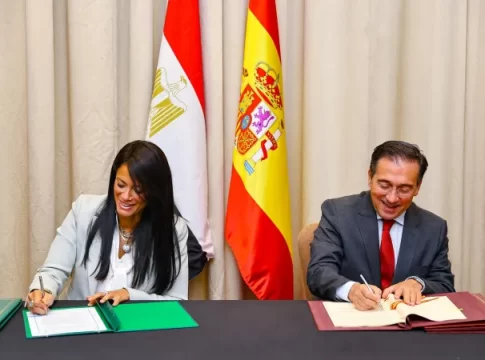
The tangible outcome of the trip was the signing of the Spain–Egypt Sustainable Development Partnership 2025–2030, a comprehensive framework for cooperation on climate resilience, water management, public services, and gender equality. The agreement provides a policy scaffold for EU-backed blended finance and investor protection, and is expected to anchor Spain’s corporate push in Egypt over the next five years. Egyptian officials also flagged that extradition and judicial-cooperation treaties were anticipated, although no official confirmation of signature has been issued to date.
Politically, the visit carried unusual weight. In Cairo, King Felipe condemned the “unbearable humanitarian crisis” in Gaza, citing the “unspeakable suffering” of civilians and calling for a viable Palestinian state—remarks that align with Madrid’s recognition of Palestine in May 2024 and underline Spain’s emergence as one of the EU’s most vocal critics of Israeli actions. For Egypt, which has positioned itself as regional mediator and humanitarian facilitator, the remarks reinforced diplomatic synergy.
Looking ahead, the new partnership agreement is expected to catalyse Spanish-led investment in climate and infrastructure projects, particularly in water treatment, metro upgrades, energy efficiency, and tourism development. With more than 60 Spanish firms already active in Egypt and €3 billion in annual trade, the emphasis is shifting toward sustainable, service-driven growth models that offer greater resilience in Egypt’s newly liberalised FX environment. Strategically, Spain’s approach mirrors EU peers in North Africa but leans on long-duration contracts in infrastructure and cultural diplomacy, offering both steady revenue streams for Spanish companies and long-term value for Egypt.
The visit thus closes not as a symbolic exercise but as a substantive pivot point: it hardwires a five-year development roadmap, strengthens commercial linkages, and situates Cairo and Madrid on convergent ground in regional geopolitics—anchoring a partnership designed to outlast immediate turbulence and deliver measurable outcomes for both nations.