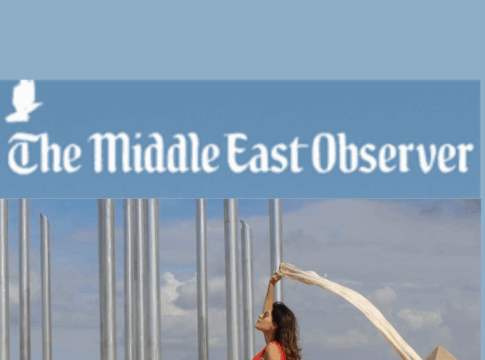
Brazilian artist Ana Ferrari has become the only Latin American participant in this year’s edition of Forever Is Now, the contemporary art exhibition held beside the Pyramids of Giza. Invited by Art D’Égypte’s founder Nadine Abdel Ghaffar, Ferrari unveiled “Wind”, an installation of 21 giant aluminum flutes that produce sound solely from the natural desert breeze. The work will remain on display in Egypt until December 6 before traveling to Rio de Janeiro in 2026.
Ferrari says the concept took shape after visiting the exhibition three years ago, when the “strong, almost speaking” Giza wind left a lasting impression. The artist, who has spent 15 years studying sound, frequencies, cymatics, and animism, sought to create an artwork that allows nature to “speak through its own instrument.”
The installation features polished, mirrored flutes arranged in a spiral formation. Each flute is tuned using laser-calibrated resonance chambers, inspired by cymatic patterns created by vibrating air. The reflective surfaces capture the surrounding pyramids, desert sky, and visitors, blending the artwork seamlessly into its historic setting. According to Ferrari, the wind itself acts as a “conductor,” shaping a unique melody with every change in direction and intensity.
Ferrari’s international career includes exhibitions at the Venice Biennale, Art Basel Miami, the Museum of Arts and Design in New York, and Sfer Ik Museion in Mexico, where she served as creative director. Her debut in the Arab world, she says, honors the region’s deep heritage of sound, healing, and cosmic harmony, creating “a bridge of resonance between distant cultures.”
After Egypt, “Wind” will be installed at Arpoador Beach in Rio starting March 2026. The flutes will be retuned to adapt to Rio’s humid, shifting wind currents—producing a soundscape entirely distinct from the dry, steady winds of the Egyptian desert.
Now in its fifth edition, Forever Is Now brings together artists from Lebanon, Italy, Russia, Portugal, Egypt, Germany, South Korea, Turkey, Benin, and France, using contemporary works to create dialogue with one of the world’s oldest monumental landscapes.