
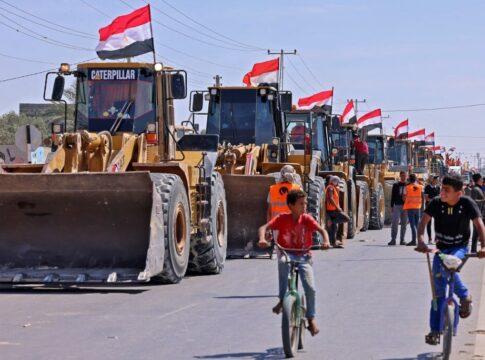
In the aftermath of the recently announced peace agreement in Gaza, Egyptian contracting and building-materials firms are actively preparing to play a major role in the reconstruction effort of the enclave, according to company executives interviewed by Al‑Shorouk. With the war declared over and a peace summit scheduled in Sharm El‑Sheikh co-chaired by Egyptian President Abdel Fattah el‑Sisi and U.S. President Donald Trump, Cairo-based firms say they are ready to leverage Egypt’s surplus in construction materials and existing manufacturing capacity to support rebuilding in Gaza.
According to United Nations data cited by United Nations sources, approximately 83 percent of buildings in Gaza City have been damaged, including roughly 17,734 structures declared completely destroyed, with the cost of reconstruction estimated at around $50 billion and taking up to a decade to complete. Egyptian companies highlight that domestic inventories of cement, steel, brick, and prefabricated materials position them to move quickly should contracts be awarded. One construction-sector executive told Al-Shorouk: “We already have capacity and materials ready — we just need the contract.”
In parallel, major global firms from Turkey, the United States, Qatar, the UAE and Britain are also presenting proposals for reconstruction contracts, intensifying competition. Industry analysts warn that while the opportunity is vast, execution will hinge on clear funding mechanisms and governance frameworks. “The cost and complexity of rebuilding Gaza are immense — materials, logistics, labour, security must all align,” says Dr. Helena Wu, a Middle East reconstruction specialist. “Egyptian firms can step in only if international donors, the Palestinian Authority and Egyptian authorities define transparent roles early.”
One exclusive insight: Egyptian officials confirmed that shipping and logistics channels via the Suez Canal Authority and neighbouring ports are being primed to facilitate large-scale imports of building materials and transport to Gaza — a move that gives local Egyptian contractors a logistics advantage not available to many foreign players. While official contracts have not yet been awarded, firms say bid documentation is being drafted and pre-qualification is underway.
Political context adds weight to the bids. The peace summit in Sharm El-Sheikh is expected to launch the formal reconstruction phase and host pledges from international donors. The International Monetary Fund notes that the deal opens a window for longer-term economic recovery in Gaza and surrounding states, including Egypt.
The Egyptian government has emphasised that reconstruction must help Gazans remain in the territory rather than being displaced — a position which Egyptian firms say aligns with their local-content capabilities.
Still, there are significant risks. Observers caution that Egypt-led contractor involvement must avoid perceptions of dominance or exclusion of Palestinian firms; inadequate accountability could undermine both business and political goals. “Reconstruction is not just about bricks and mortar,” notes Samir Zed, a regional economic adviser. “It’s about trust, fairness and local empowerment.”
As the reconstruction phase moves into view, Egyptian companies appear ready at the starting gate, materials in store and logistics mapped. Whether they cross the finish line will depend on whether the global rebuild of Gaza can be translated from vision into contracts—and from rubble to reliable homes.
