
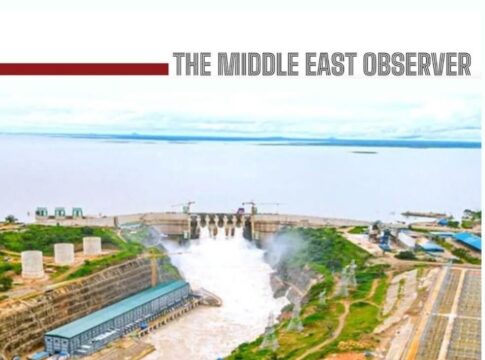
Tanzania’s Julius Nyerere Hydropower Plant and Dam, a flagship infrastructure project recognised by Engineering News-Record as the Best Project in the Water/Wastewater category this year, has emerged as a cornerstone of Africa’s renewable energy expansion and South-South industrial cooperation.
The 2,115-megawatt facility — now fully commissioned with all nine turbines operational — stands as the largest hydropower installation in East Africa, addressing rising electricity demand and bolstering Tanzania’s long-term energy security.
The project’s 134-metre-high dam on the Rufiji River at Stiegler’s Gorge creates a reservoir capable of storing approximately 34 billion cubic metres of water, providing both power generation and flood control benefits.
In awarding the plant top honours in its global infrastructure rankings, Engineering News-Record highlighted innovative construction techniques — notably the use of roller compacted concrete (RCC) — which accelerated large-volume placement, reduced curing times, and improved thermal control during massive pours, mitigating traditional dam-building risks.
The hydropower project was delivered by an Egyptian joint venture led by Arab Contractors Co. and Elsewedy Electric under a contract valued at approximately $2.9 billion, commissioned by the state-owned Tanzania Electric Supply Company (TANESCO).
Arab Contractors carried out the civil engineering scope, including the main dam and diversion tunnels, while Elsewedy Electric was responsible for the electro-mechanical package, encompassing turbines, generators and high-voltage transmission infrastructure.
Beyond power generation, which yields more than 6,000 GWh annually, the project has been a major economic catalyst. At peak construction, more than 12,000 workers were deployed on site, with thousands of Tanzanians trained in specialised skills.
The hydropower plant is expected to support industrialisation, attract investment, and reduce reliance on fossil fuels across the region. It also improves energy access in rural areas, contributing to broader socio-economic development objectives in line with Tanzania’s national planning frameworks.
The project has become a symbol of growing inter-African collaboration, reflecting strategic partnerships between governments and leveraging indigenous engineering capacity to deliver transformative infrastructure. Tanzanian and Egyptian leaders have emphasised the dam’s role in strengthening bilateral ties and enhancing regional integration.
While the hydropower station is now fully operational, discussions around environmental stewardship remain part of the broader narrative given its location within the Selous Game Reserve, one of the world’s largest protected wildlife areas. Nonetheless, Tanzanian authorities regard the facility as critical to achieving energy reliability and sustainable growth targets.
The Julius Nyerere Hydropower Plant and Dam stands at the intersection of engineering innovation, regional cooperation, and development ambition. Its recognition by Engineering News-Record cements its status as a benchmark for large-scale infrastructure projects across Africa, illustrating the continent’s growing capacity to deliver complex renewable energy solutions.
