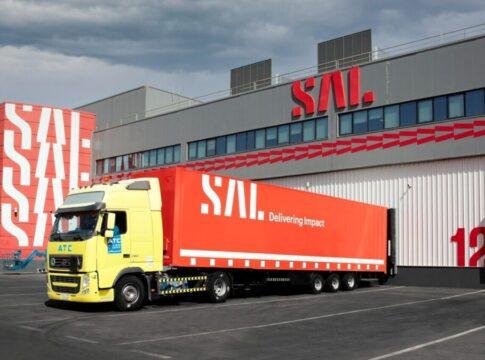
The Saudi Logistics Services Company (SAL) has sealed a 30-year lease for 1.57 million sqm of land in Falcon City, north of Riyadh. The company plans to invest nearly SAR 4.2 billion (US $1.14 billion) in developing a next-generation logistics zone — one designed to knit together the Kingdom’s rapidly expanding air, road, and rail corridors.
The project, announced through the Saudi stock exchange, marks one of the largest private logistics infrastructure commitments in Riyadh to date. SAL will pay SAR 16 per sqm annually, with a 1.5 percent yearly escalation and a three-year grace period. The lease, signed with Sela Company, includes an option to extend for another 15 years — signaling long-term confidence in the capital’s role as the beating heart of Saudi Arabia’s transport strategy.
Falcon City lies strategically between the King Khalid International Airport (KKIA) and the Riyadh–Qassim express corridor, offering SAL a unique tri-modal advantage: air connectivity via KKIA, highway access to central and northern Saudi regions, and proximity to the North–South rail line that eventually connects to the GCC and Red Sea ports.
The new zone forms part of SAL’s broader plan to diversify revenue streams, moving beyond handling and freight operations into asset ownership and long-term logistics leasing.
Analysts view this as an essential pivot in Saudi Arabia’s drive to triple the sector’s contribution to GDP under the National Transport and Logistics Strategy (NTLS), which aims to make the Kingdom a top-ten global logistics hub by 2030.
According to early plans, the Falcon City complex will house:
- Smart distribution and fulfillment centers integrated with automation, robotics, and AI-driven warehouse management systems.
- Cold-chain and pharma-grade facilities meeting GDP/GSP standards — a fast-growing niche amid food security and healthcare localization drives.
- E-commerce and last-mile consolidation hubs, tapping into Saudi Arabia’s booming digital retail market.
- Multi-tenant modular units offering plug-and-play readiness for SMEs and multinational 3PLs.
- Sustainability features, including rooftop solar readiness, low-energy lighting, and water recycling systems, in line with the Kingdom’s Green Initiative.
If executed effectively, the zone could serve as a benchmark for future mixed-use logistics cities across the region.
SAL’s entry into Falcon City places it in direct competition with some of the world’s leading logistics developers:
- The Special Integrated Logistics Zone (SILZ) at KKIA — run under the General Authority of Civil Aviation — already offers customs-free processing and 24-hour clearance, luring multinationals like Apple.
- Agility Logistics Parks operates over 870,000 sqm of warehousing in Riyadh’s Sulay district, with expansions adding 100,000 sqm of Grade-A space this year.
- DP World Saudi and the Saudi Ports Authority (Mawani) are building national-scale bonded parks around Jeddah and Dammam, while MODON continues to expand industrial zones offering lower-cost serviced plots.
Each brings a different edge: SILZ with regulatory ease, Agility with delivery speed and scalability, and DP World with port-linked integration. SAL’s Falcon City must therefore carve a distinctive competitive identity to thrive.
To translate a billion-dollar bet into market leadership, SAL will need to build on three strategic fronts:
- Speed-to-Tenant Advantage
Deliver pre-built, modular warehouses with digital infrastructure and automation interfaces, allowing occupiers to start operations within 90 days of lease signing — a sharp contrast to the typical 6-month regional lag. - Integrated Multi-Modal Connectivity
Offer tenants a real-time logistics “control tower” that synchronizes road, air, and rail movement, making Falcon City a true distribution nerve center rather than a static warehouse cluster. - Sustainability and Smart-Lease Innovation
Position Falcon City as the first carbon-conscious logistics zone in the region, with green-lease clauses, rooftop solar incentives, and data dashboards for energy monitoring — a move that could attract ESG-focused global clients.
Industry experts also emphasize the importance of anchor tenants — major e-commerce, FMCG, or pharmaceutical firms — to de-risk early phases and set a rental benchmark for smaller players.
Market watchers project that the Riyadh logistics segment will continue its double-digit growth trajectory, driven by the e-commerce surge, energy localization, and regional supply-chain diversification. With modern warehouse occupancy exceeding 97 percent and prime rents surpassing SAR 250–300 per sqm annually, demand for high-spec space far outstrips supply — providing an opening for SAL’s Falcon City to dominate the premium end of the market.
If delivered on time and to specification, the Falcon City project could become the Kingdom’s flagship inland logistics city, anchoring SAL as a regional leader and reinforcing Riyadh’s bid to become the logistics capital of the Middle East.