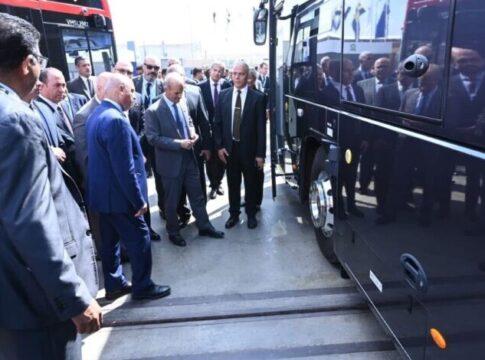
Egypt’s Manufacturing Commercial Vehicles (MCV) and Sweden’s Volvo Buses have inaugurated a new EGP 3 billion (≈$62 million) electric-bus production line in New Salhia City, Sharqia governorate, underscoring Cairo’s ambition to position itself as a regional hub for zero-emission transport.
The first phase of the plant—financed in part by the Arab African International Bank (AAIB) through a seven-year loan of EGP 770 million and €8 million in early 2024—includes new factory construction, machinery, and production lines. The facility will initially produce up to 1,200 units annually, with production dedicated to exports to Europe, one of the most demanding markets for environmental and quality standards.
Senior attendees at the inauguration included Deputy Prime Minister and Minister of Industry and Transport Kamel El-Wazir, Volvo Buses President Anna Westerberg, MCV CEO Karim Ghabbour, as well as the Swedish and Polish transport ministers and ambassadors. Officials from Volvo highlighted the move as part of a strategic agreement signed in 2023 to assemble electric buses in Egypt for European customers.
AAIB Vice Chairman and Managing Director Tamer Wahid said the bank’s rapid financing support was intended to “turn the idea into a tangible reality,” positioning MCV as a model for localising industry and expanding Egypt’s export base. He stressed AAIB’s long standing commitment to backing sectors that generate added value and attract foreign investment, noting that MCV’s products are now directly competing in Europe.
For his part, Ghabbour emphasised that Volvo’s decision to shift production from Poland to Egypt reflects “the confidence of international companies in Egyptian manufacturing and its quality, which matches—and even competes with—European standards.” He added that the new line will manufacture around 500 buses annually under the Volvo agreement, marketed and financed directly through Volvo in Sweden, raising MCV’s export share from 50% to 70% of sales and boosting foreign currency inflows.
El-Wazir described the investment as proof that Egypt can serve as a reliable export base for advanced global markets, aligning with the government’s goal of increasing industrial exports to $170 billion by 2030. The localisation target—about 50% Egyptian components per unit—supports the Automotive Industry Development Program (AIDP) launched in 2022, which aims to deepen supply chains and attract high-tech investment.
Egypt now has six automotive producers—five private and one state-owned—collectively capable of producing around 2,500 buses annually. The project also fits the government’s climate commitments, by cutting emissions and embedding international standards into local industry.
The timing coincides with Europe’s structural shift towards zero-emission buses: revised EU rules mandate that 90% of new city buses sold must be zero-emission by 2030, reaching 100% by 2035. At the same time, the EU Battery Regulation requires lifecycle carbon-footprint declarations and supply-chain due diligence, with stricter obligations taking effect in August 2025. Compliance will raise costs for exporters but ensures long-term demand for compliant suppliers.
Egypt faces stiff competition from regional peers. Turkey’s Karsan is targeting sales of 700 electric buses in 2025, mainly in Romania and Germany, while Morocco is rapidly expanding its ecosystem: Stellantis will lift Kenitra output to 535,000 vehicles, and Yutong is supplying more than 700 e-buses for the 2025 Africa Cup of Nations. These examples highlight both the opportunities and the challenges Egypt must navigate as it seeks to become a durable player in Europe’s green-mobility supply chain.
Sustaining local content in complex e-bus manufacturing—particularly in batteries and power electronics—remains a challenge. Yet with AAIB financing, Volvo’s long-term commitment, and strong government backing, MCV’s new line strengthens Egypt’s positioning in an increasingly competitive market. If successful, it could turn Egypt into both a regional and global hub for electric bus exports while reinforcing Cairo’s bid to diversify exports, attract foreign investment, and generate hard currency inflows.