
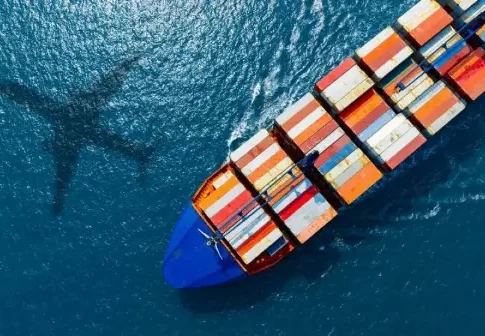
President Donald Trump has spotlighted transshipping as a central issue in his trade policy, aiming to curb what he perceives as a widespread loophole within international commerce.
President Trump recently announced a landmark agreement with Vietnam, doubling tariffs on goods considered transshipped – an indirect method where goods from one country ostensibly stop over in another to bypass higher tariffs. This practice has been a point of contention in Trump’s ongoing trade negotiations, particularly in relation to China’s strategic maneuvering to skirt trade barriers.
Transshipping traditionally involves cargo transitioning through a third country without significant modification, retaining its origin country’s tariff implications. However, the Trump administration is pushing for a broader definition. International trade lawyer Ted Murphy, writing in a recent blog post, suggested that products assembled in Vietnam with any degree of Chinese content might soon attract higher U.S. duties.
“This change could affect a substantial percentage of imports, depending on how much Chinese content is deemed excessive,” Murphy explains.
The administration’s intent appears to be refining the criteria for what constitutes ‘substantial transformation,’ seeking a clearer delineation between legitimate manufacturing processes and tariff evasion. A White House official noted that negotiations would be tailored to each country’s context, preventing a one-size-fits-all approach.
Trump’s intensified focus on transshipping has already drawn international reactions. China’s Commerce Ministry has warned of “resolute countermeasures” if they perceive exclusion from supply chains. The ramifications are not limited to China; trade expert Greta Piesch of Wiley Rein points out that any two countries with differential tariff rates could feel the impact.
The Harvard Business Review found that in 2021, approximately 16.5% of Vietnamese exports were rerouted through such means, underscoring the significance of Trump’s concerns about disguised Chinese goods.
Ryan Peterson, CEO of Flexport, raises a crucial point that if Trump’s expansive definition is implemented, it could drastically alter customs regulations, complicating and potentially increasing the cost of global trade compliance. “The changes could redefine customs legislation in ways that significantly complicate global trade,” Peterson warned in an online post, predicting legal challenges to these broad interpretations.
While details remain under negotiation, Trump’s administration has signaled its intention through recent trade agreements, such as the one with the UK over steel, which employs a “melt and pour” standard for origin determination, further tightening loopholes.
This focus on transshipping transcends party lines, with past administrations also grappling with the complexities of disguised commodity origins. As Piesch, a former general counsel in Biden’s trade office, notes, “This is a bipartisan concern that has persisted across administrations.”