
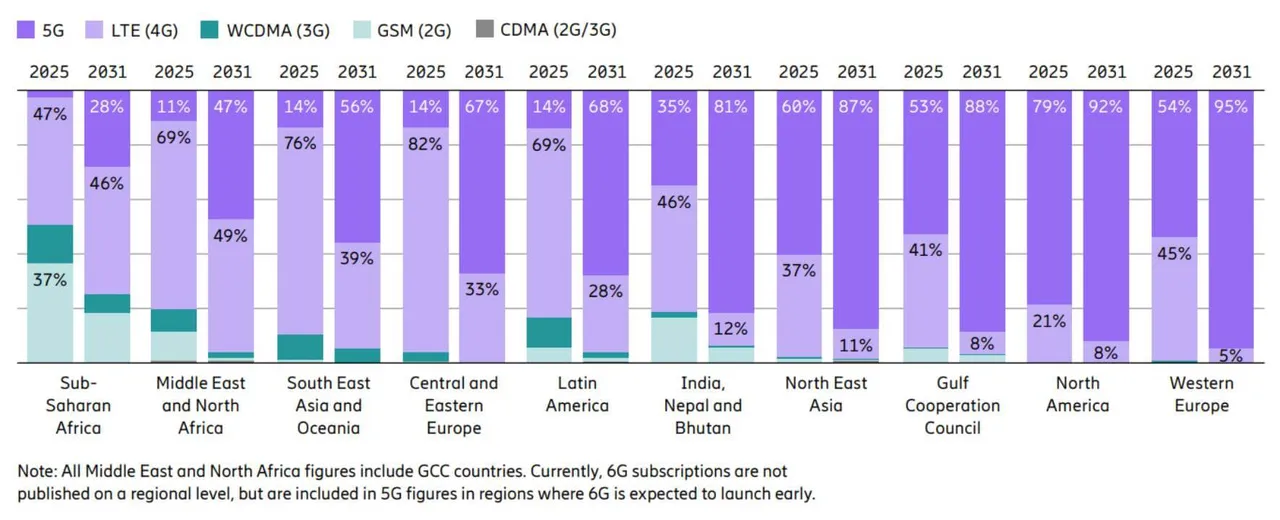
Sub-Saharan Africa is set to become the world’s fastest-growing 5G market over the next six years, with 5G subscriptions projected to surge more than twelve-fold from approximately 30 million in 2025 to around 370 million by 2031, according to Ericsson’s latest Mobility Report. While the region will continue to trail North America, Europe and parts of Asia in overall 5G penetration, Ericsson expects it to record the fastest rate of subscription growth globally, underscoring the continent’s rapidly accelerating digital transformation.
The report projects total mobile subscriptions across Sub-Saharan Africa to increase from approximately 1.05 billion in 2025 to 1.31 billion by 2031, driven by population growth, expanding mobile connectivity and rising smartphone adoption. By the end of the forecast period, 5G is expected to account for 28% of all mobile subscriptions, while 4G will remain the dominant mobile technology, expanding from 490 million to approximately 610 million subscriptions, representing 46% of the market.
The projections indicate that Africa’s telecommunications evolution will be characterised by coexistence rather than immediate replacement. As legacy 2G and 3G networks gradually decline, operators are expected to migrate users towards faster and more spectrum-efficient 4G and 5G networks capable of supporting significantly greater data consumption, enterprise connectivity and advanced digital services.
Ericsson expects average monthly mobile data usage per smartphone to more than double from 5.3 gigabytes in 2025 to 12 gigabytes by 2031, while total mobile data traffic across the region is forecast to increase from 2.8 exabytes per month to approximately 9.7 exabytes. The surge reflects growing demand for video streaming, cloud computing, mobile financial services, digital commerce and increasingly sophisticated enterprise applications.
A significant proportion of the projected expansion is expected to come from first-time mobile broadband users rather than existing customers upgrading their devices. Population growth, rapid urbanisation, expanding smartphone ownership and continued investment in mobile infrastructure are combining to accelerate digital adoption across many African economies, allowing the region to leapfrog several stages of traditional fixed-line telecommunications development.
The report argues that the next phase of network evolution will increasingly be driven by artificial intelligence. As AI-enabled applications become more widespread, mobile traffic patterns are expected to shift from predominantly download-oriented services towards more uplink-intensive applications requiring continuous real-time data transmission. Emerging technologies such as extended reality (XR), industrial automation, connected manufacturing, autonomous systems and intelligent edge computing will require faster, lower-latency and more resilient mobile networks.
According to Ericsson, this evolution provides African operators with an opportunity to build networks designed not only for consumer broadband but also for AI-enabled economies increasingly dependent on cloud computing, automation and machine-to-machine communications.
The broader economic implications extend well beyond telecommunications. Wider deployment of 4G and 5G infrastructure has the potential to accelerate digital inclusion, expand financial technology, improve access to healthcare and education, support precision agriculture and strengthen manufacturing productivity. Mobile connectivity is increasingly becoming a core component of national digital infrastructure rather than simply a communications service.
The expansion of high-capacity mobile networks is also expected to complement growing investment in hyperscale cloud infrastructure, regional data centres and artificial intelligence platforms. As international technology companies continue expanding cloud availability zones and digital infrastructure across Africa, improved mobile connectivity will become increasingly important in supporting AI development, digital services and regional innovation ecosystems.
For multinational corporations, network quality is becoming an increasingly important investment criterion. Reliable high-speed mobile infrastructure supports business process outsourcing, digital services, logistics management, industrial automation and advanced manufacturing. Consequently, telecommunications investment is expected to play a growing role in enhancing Africa’s broader industrial competitiveness and attractiveness for foreign direct investment.
Despite the optimistic long-term outlook, Ericsson cautions that the pace of adoption will vary considerably across the continent. While 36 of Africa’s 54 countries have launched commercial or pre-commercial 5G services, deployments remain concentrated primarily in major urban centres, business districts and high-density economic corridors. Extending coverage into secondary cities and rural areas will require substantial investment in spectrum, fibre backhaul, power infrastructure and network expansion.
Spectrum policy and regulatory certainty will remain equally important. Industry analysts increasingly argue that efficient spectrum allocation, infrastructure sharing, investment-friendly regulation and streamlined licensing frameworks will largely determine whether operators can deploy commercially sustainable 5G services beyond major metropolitan markets.
Affordability remains perhaps the greatest challenge. Industry estimates suggest smartphones priced between US$30 and US$40 are essential to unlock mass adoption across many emerging African economies. Although smartphone shipments recovered during late 2025, rising component costs, import duties and persistent inflation continue to constrain adoption of entry-level devices, slowing migration from legacy networks to 4G and 5G.
For equipment suppliers, the forecast reinforces Africa’s growing strategic importance. As mature telecommunications markets approach saturation, Sub-Saharan Africa represents one of the few regions where both subscriber growth and large-scale network expansion are expected to remain robust throughout the coming decade. That outlook presents significant opportunities for infrastructure vendors, network operators, tower companies, fibre providers and digital infrastructure investors.
The report ultimately highlights a paradox facing African telecommunications markets. Network technology is advancing rapidly, yet widespread digital transformation will depend as much on affordable devices, supportive public policy, digital literacy and sustained private investment as on spectrum availability or radio access technology itself.
Nevertheless, the long-term outlook remains encouraging. The projected increase from 30 million to 370 million 5G subscriptions represents one of the fastest rates of mobile technology adoption globally and reflects growing confidence in Africa’s digital future. Telecommunications networks are rapidly evolving into strategic economic infrastructure underpinning financial services, cloud computing, artificial intelligence, e-commerce, industrial automation and public-sector digital transformation.
If governments continue improving regulatory frameworks, expand spectrum availability, encourage infrastructure investment and improve smartphone affordability, Sub-Saharan Africa could emerge not only as the world’s fastest-growing 5G market but also as one of its most dynamic digital economies over the next decade. The region’s success will ultimately be measured not by the number of mobile subscriptions alone, but by its ability to translate digital connectivity into higher productivity, greater innovation, stronger industrial competitiveness and more inclusive economic growth.
Related news:
East African States Advance Joint Regional Satellite Initiative
Algiers Declaration Signals Africa’s Shift Toward Digital Sovereignty
Read also:
SpaceX, OpenAI and the Birth of the AI Capital Market
Spain’s Renewable Surge Turns Energy Transition into Economic Advantage