
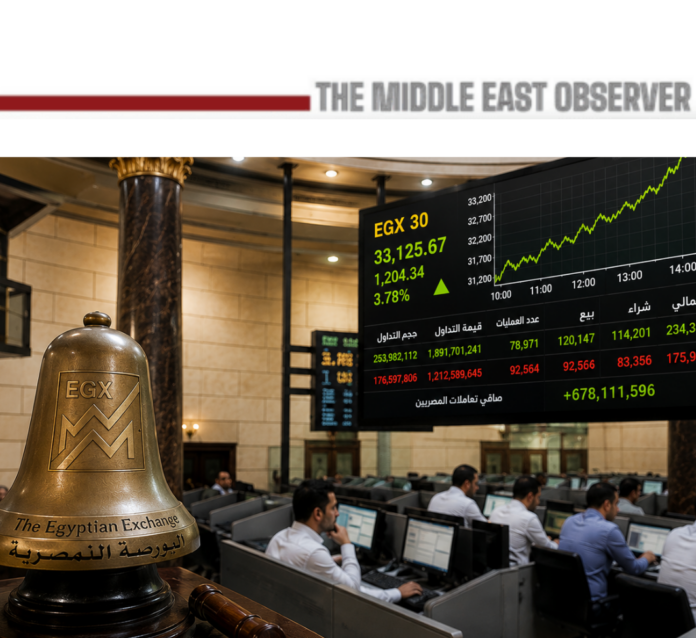
Domestic Buyers Lead Broad-Based Recovery Following Week of Profit-Taking
Cairo — Egyptian equities staged a strong recovery on Sunday as domestic investors returned to the market following a week of profit-taking, lifting all major indices and reversing a significant portion of recent losses.
The rebound marked the strongest session in several days and suggested that the market’s recent correction was driven more by valuation adjustments than by a deterioration in confidence toward Egyptian assets or the broader economic outlook.
The benchmark EGX30 index rose 2.31% to close at 51,994.63 points, recovering a substantial portion of the previous week’s losses. Gains extended across the market, with the EGX70 index of small- and mid-cap shares climbing 2.73% to 15,396.24 points, while the broader EGX100 advanced 2.73% to 21,179.3 points.
The rally was equally visible across other benchmarks. The EGX33 Sharia Index gained 3.09% to 5,782.95 points, while the EGX35-LV rose 2.46% to 6,050.84 points, indicating widespread participation across sectors and market segments.
Market capitalization increased to approximately EGP 3.716 trillion, recovering nearly EGP 67 billion from the previous session and partially reversing the losses accumulated during the market’s recent pullback.
Domestic Investors Drive the Recovery
The defining feature of Sunday’s rally was that it was largely driven by Egyptian investors rather than foreign capital.
Local investors recorded net purchases of approximately EGP 276.7 million, reversing the selling pattern that dominated much of the previous week. By contrast, non-Arab foreign investors were only marginal net buyers with purchases of around EGP 9.6 million, while Arab investors recorded net sales of approximately EGP 286.3 million.
The shift suggests many local investors viewed the recent correction as a buying opportunity rather than a signal of deteriorating fundamentals. Following several sessions of profit-taking and market weakness, bargain hunting emerged across a broad range of sectors as investors sought to rebuild positions at more attractive valuations.
The return of domestic buying is particularly notable because it marks a reversal from the pattern seen earlier in the month, when local investors were among the principal sellers while foreign investors provided support to the market.
Broad-Based Rally Reflects Improving Sentiment
Unlike earlier sessions characterized by selective gains, Sunday’s advance was broad-based and encompassed financial, industrial, consumer and agricultural stocks.
Among the session’s top performers, Egyptian Arabian Company for Securities and Bonds Brokerage (Themar) surged 20%, while Misr Oils & Soap also rose 20%. Lotus for Agricultural Investments and Development gained 11.81%, extending the strong performance recorded by several agriculture-related stocks in recent weeks.
The gains suggest investors are once again seeking exposure to sectors linked to domestic consumption, financial activity and Egypt’s longer-term economic expansion plans.
On the downside, losses were relatively limited. Middle & West Delta Flour Mills fell 5.97%, while Subscription Rights of Aspire Capital Holding for Financial Investments-3 declined 5.45%. Abou Qir Fertilizers lost 4.9%, continuing a recent period of weakness despite generally supportive conditions for export-oriented industrial companies.
Capital-Market Expansion Story Remains Supportive
The recovery comes as investors continue to evaluate a series of structural developments shaping Egypt’s investment landscape.
Over recent weeks, market participants have focused on a growing pipeline of potential public offerings, including planned listings linked to Qalaa Holdings, future state-ownership transactions and the eventual offering of Banque du Caire.
Investors are also closely monitoring prospective flotations from petroleum and private-sector companies, which are expected to deepen market liquidity and broaden the range of investable opportunities available to institutional investors.
The expansion of Egypt’s IPO pipeline is increasingly viewed as a key catalyst for attracting additional capital and supporting the long-term development of the Egyptian Exchange.
Debt Markets Continue to Support Confidence
At the same time, Egypt’s improving external liquidity position continues to support sentiment toward domestic assets.
Foreign-exchange reserves recently climbed to a record $53.13 billion, while Gulf support remains visible through the renewal of Kuwait’s $2 billion deposit at the Central Bank of Egypt.
Foreign demand for Egyptian government debt also remains resilient. Recent trading data showed continued purchases of treasury bills and government securities by international investors attracted by Egypt’s comparatively high real yields and strengthening external position.
The resilience of debt-market inflows has provided an additional anchor for confidence in Egyptian assets even during periods of volatility in equities.
Market View
The key takeaway from Sunday’s session was that the rebound was driven primarily by domestic investors rather than foreign capital. After a week dominated by profit-taking and declining valuations, local investors appeared increasingly willing to re-enter the market, suggesting confidence in the underlying investment case remains intact.
The recovery also occurred against a backdrop of continued strength in Egypt’s debt markets, rising foreign-exchange reserves and sustained Gulf support, factors that continue to underpin confidence in the country’s broader financial outlook.
Investors remain focused on a combination of improving external liquidity, resilient treasury-bill inflows and an expanding pipeline of capital-market transactions that could reshape the Egyptian Exchange over the coming year. While short-term volatility is likely to persist, the growing alignment between stronger macroeconomic fundamentals and a deeper capital-markets agenda continues to support the longer-term investment narrative.
The return of local buyers suggests many investors increasingly view recent market weakness as a valuation opportunity rather than a change in the underlying outlook for Egyptian assets. If sustained, that shift could provide an important foundation for a broader recovery in market participation as new listings and investment opportunities emerge.
