
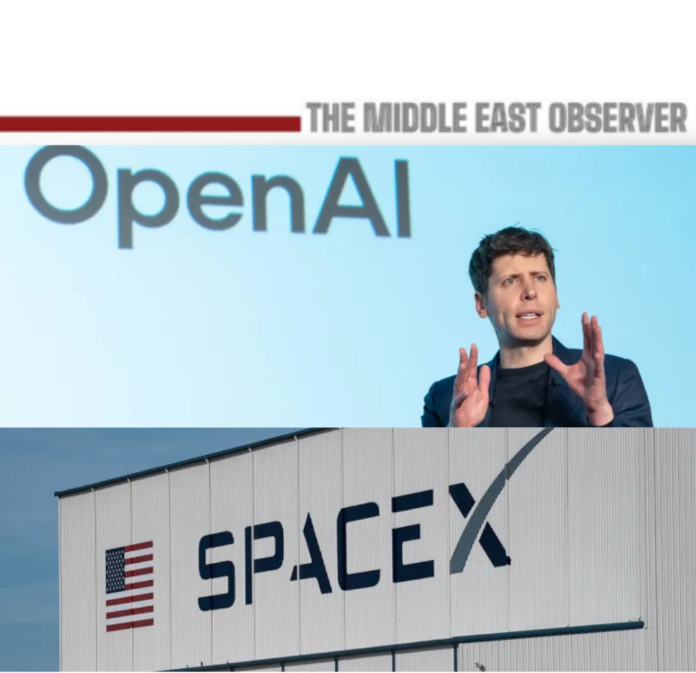
The emergence of trillion-dollar technology companies is reshaping global finance and giving rise to what investors increasingly describe as the AI Capital Market — a new investment ecosystem centered on artificial intelligence, computing infrastructure, advanced communications networks and the sovereign capital financing them.
At the forefront of this transformation is SpaceX, whose planned Nasdaq debut is expected to become the largest initial public offering in history. With a valuation approaching $1.8 trillion and investor demand reportedly several times oversubscribed, the listing is widely viewed as more than a landmark IPO. Rather, it represents the first major public-market test of a new generation of infrastructure-driven technology companies whose value is derived from strategic capabilities rather than traditional software models.
The offering arrives as OpenAI and Anthropic move closer to public markets. Anthropic recently secured financing at a valuation of approximately $965 billion, while reports indicate that OpenAI has confidentially filed for a future IPO. Together, these companies are creating a new class of technology assets whose valuations increasingly rival those of major sovereign economies and some of the world’s largest corporations.
The Economics Behind the Trillion-Dollar Valuations
Unlike previous technology cycles, today’s AI leaders are not merely selling software. They are building the digital infrastructure expected to underpin the next phase of global economic growth.
SpaceX generates revenue through multiple business lines, including satellite broadband services through Starlink, launch services for governments and commercial clients, defense-related contracts and emerging communications infrastructure. Starlink alone has become one of the world’s largest satellite internet networks, serving consumers, enterprises and government agencies across multiple continents.
OpenAI and Anthropic are pursuing equally ambitious commercial models. Revenue streams increasingly extend beyond chatbot subscriptions to include enterprise AI services, government applications, industrial automation, software development tools, AI agents and strategic cloud-computing partnerships. As businesses integrate generative AI into daily operations, these companies are positioning themselves as foundational service providers rather than niche technology vendors.
This helps explain why investors are willing to support unprecedented valuations. Industry forecasts suggest annual global spending on artificial intelligence could exceed $1 trillion during the next decade, while spending on data centers, advanced semiconductors and supporting infrastructure is expected to reach several trillion dollars cumulatively across the same period.
The infrastructure requirements underpinning this growth are equally unprecedented. The International Energy Agency estimates that global electricity demand from data centres could more than double by 2030 as artificial intelligence workloads expand, while leading technology companies are committing hundreds of billions of dollars to advanced semiconductors, cloud infrastructure and hyperscale computing facilities. In this environment, access to power, computing capacity and data networks is becoming as strategically important as access to capital itself.
Gulf Capital Moves Up the Value Chain
A defining feature of this emerging market is the increasingly prominent role of Gulf sovereign wealth funds and regional investors.
Saudi Arabia and the United Arab Emirates have steadily expanded exposure to frontier technologies, moving beyond passive financial investments toward strategic ownership of AI infrastructure and platforms. Saudi investors maintain significant exposure to SpaceX through holdings linked to Kingdom Holding, while Abu Dhabi-based MGX has emerged as one of the world’s most active investors in artificial intelligence.
The recent expansion of the UAE-backed Campus AI project in France demonstrates this shift. Rather than simply investing in technology companies, Gulf capital is increasingly helping finance the data centers, computing clusters and infrastructure required to power future AI systems.
For the region’s sovereign investors, the objective is becoming clearer: secure long-term exposure to the infrastructure layer of the AI economy rather than competing solely for returns in public equity markets.
From Crypto to Compute
The rise of AI-focused investments has coincided with a noticeable change in investor priorities.
For much of the previous decade, Bitcoin and other digital assets represented the dominant high-growth narrative in global markets. Today, capital is increasingly flowing toward companies that own computing capacity, data infrastructure, communications networks and AI models.
The transition reflects a broader shift in how investors assess future economic value. Scarcity remains important, but the scarce asset increasingly sought by markets is not digital currency—it is computational power.
As a result, investors appear more interested in owning the infrastructure enabling artificial intelligence than the assets that defined previous speculative cycles.
AI Becomes a Geopolitical Asset
Perhaps the most important aspect of the current market cycle is that artificial intelligence is no longer viewed solely as a commercial technology.
Governments increasingly regard AI infrastructure as a strategic national asset comparable to energy networks, telecommunications systems and transportation corridors. The competition for leadership in artificial intelligence is rapidly becoming intertwined with national security, industrial competitiveness and geopolitical influence.
The United States continues to dominate advanced AI development through companies such as OpenAI, Anthropic, Nvidia and SpaceX. China is simultaneously investing heavily in domestic AI champions, semiconductor manufacturing and computing capacity. Europe is accelerating efforts to establish AI sovereignty through projects such as Campus AI and other strategic infrastructure initiatives.
This competition extends beyond software. Access to electricity, advanced chips, data centers and communications networks is emerging as a critical determinant of future economic power. Countries capable of controlling these assets may gain significant advantages in productivity, innovation and strategic influence over the coming decades.
The Birth of a New Investment Era
The scale of projected valuations has inevitably prompted concerns about whether markets are entering another period of excessive optimism. Critics warn that expectations may be running ahead of earnings visibility, while supporters argue that today’s leading AI companies own tangible infrastructure and possess commercial opportunities far larger than those available during previous technology booms.
Regardless of where valuations ultimately settle, the direction of travel is increasingly clear.
If SpaceX completes a successful market debut and future listings from OpenAI and Anthropic follow, 2026 may be remembered as the year a new capital-market hierarchy emerged—one defined not by cryptocurrencies or social media platforms, but by ownership of artificial intelligence infrastructure, advanced computing capacity and strategic digital networks.
Throughout the nineteenth century, investors competed to finance railways that connected continents. The twentieth century was shaped by ownership of oil fields, energy systems and telecommunications networks. The twenty-first century is increasingly becoming a contest over intelligence itself—who can build it, finance it, control the infrastructure behind it and deploy it at scale.
The next great investment race may therefore be less about technology products and more about ownership of the digital infrastructure powering the global economy. In that emerging landscape, SpaceX, OpenAI and Anthropic may be remembered not simply as successful technology companies, but as the founding pillars of the AI Capital Market.
Related news:
AI restructures the future of Jobs in the market
Nvidia Plans to Resume AI Chip Deliveries to China
Abu Dhabi and Nvidia Launch Middle East’s First AI & Robotics Research Hub
Read also:
Egypt Clears $6.1bn Energy Arrears, Targets Output Growth
Gold Price Retreats: Bullion Falls Below $4,200 as Iran Conflict Reignites