
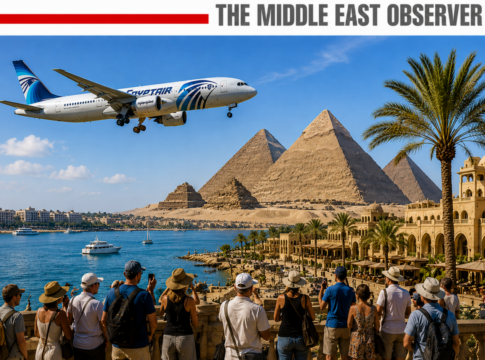
Cairo — Egypt’s tourism industry is entering the peak summer season from a position of strength despite heightened geopolitical tensions across the Middle East, as hotel occupancy rates surged during the Eid Al-Adha holiday and Gulf carriers expanded services to the Mediterranean resort city of Alamein. The developments highlight the resilience of one of Egypt’s most important sources of foreign-currency earnings and underscore growing confidence in the country’s efforts to develop new tourism growth centres beyond its traditional Red Sea and Nile Valley destinations.
The strong performance comes as tourism operators across the region assess the potential impact of escalating tensions linked to the US-Iran confrontation and wider security concerns in the Middle East. Yet Egypt’s tourism sector has continued to attract both international and domestic travellers, reinforcing its position as one of the region’s most diversified tourism markets and demonstrating an ability to weather geopolitical uncertainty that has periodically disrupted travel flows elsewhere in the region.
Tourism remains a cornerstone of Egypt’s economy, serving as a critical source of foreign exchange, employment and private-sector investment. The sector’s resilience has continued into 2026, with Egypt welcoming 6.1 million visitors during the first four months of the year, a 7% increase compared with the same period in 2025. The figures follow a record 19 million tourist arrivals in 2025 and suggest sustained momentum as the government pursues an ambitious strategy to attract 30 million annual visitors by 2030. Against that backdrop, the strong Eid holiday occupancy levels provide an early indication that demand remains robust heading into the peak summer season.
Hotel occupancy approached or exceeded 90% across several destinations during the Eid holiday period. Cairo and Giza recorded some of the strongest performances, with a number of Nile-front properties operating at full capacity, while Red Sea destinations including Hurghada, Marsa Alam and Sharm El-Sheikh benefited from sustained demand from European source markets led by Germany, the United Kingdom, Italy and France.
Along the Mediterranean coast, New Alamein, the North Coast and Marsa Matrouh also reported strong occupancy levels, supported by rising domestic travel, returning Egyptians from overseas and the start of the summer holiday season. The broad-based nature of demand across cultural, coastal and leisure destinations suggests that Egypt’s tourism growth is increasingly supported by multiple visitor segments rather than reliance on a limited number of source markets.
At the centre of Egypt’s tourism diversification strategy is New Alamein, which has emerged as one of the country’s most closely watched tourism and real-estate developments. The city forms part of a broader effort to create new urban, leisure and investment hubs along the Mediterranean coast, broadening Egypt’s tourism offering beyond its traditional cultural and Red Sea destinations.
Growing airline interest is reinforcing that ambition. According to industry officials, Saudi Arabia’s national carrier plans to operate six weekly flights to Alamein from the end of July, including three services from Riyadh and three from Jeddah. Flydubai is also scheduled to launch four weekly flights between Dubai and Alamein from 20 June before increasing operations to daily services in July.
The expansion builds on momentum established during the 2025 summer season, when Gulf carriers including Saudi Airlines, Flynas, Etihad Airways and Flydubai introduced direct services to Alamein for the first time. Those routes helped broaden access to Egypt’s Mediterranean coast and contributed to growing regional awareness of the destination.
For airlines, the additional capacity reflects confidence that Alamein is evolving from a seasonal domestic resort into a broader regional tourism market capable of attracting visitors from across the Gulf. For Egypt, the route expansion represents another step in efforts to diversify tourism offerings, extend visitor spending beyond traditional destinations and increase the sector’s contribution to economic growth.
Tourism and Antiquities Minister Sherif Fathy has repeatedly highlighted the sector’s ability to maintain growth despite global and regional challenges, while emphasising continued investment in tourism infrastructure, hotel development and international air connectivity.
With international arrivals continuing to rise, European demand remaining resilient and airlines expanding capacity into emerging destinations, Egypt enters the summer season with considerable momentum. More importantly, the combination of diversified tourism assets, expanding connectivity and sustained investment suggests the country is strengthening its position as one of the Mediterranean’s most competitive tourism markets. As Cairo pursues its goal of attracting 30 million visitors annually by the end of the decade, the performance of destinations such as Alamein will be closely watched as a measure of Egypt’s ability to translate large-scale tourism investment into sustained growth, higher visitor spending and increased foreign-exchange earnings.
