New archaeological discoveries at two of Egypt’s most important heritage sites are offering fresh insight into how successive civilisations adapted, reused and reinterpreted religious, political and cultural traditions over more than two millennia, reinforcing Egypt’s standing as one of the world’s richest repositories of historical heritage.
The findings, announced by Egyptian authorities in Luxor and Beni Suef, span periods ranging from the Middle Kingdom through the Greek, Roman and early Christian eras. Collectively, they provide rare evidence of cultural continuity in Egypt, where new rulers and belief systems frequently incorporated earlier traditions and monuments rather than replacing them outright.
At Ihnasya El-Medina in Beni Suef Governorate—known in antiquity as Heracleopolis Magna—an Egyptian archaeological mission affiliated with the Supreme Council of Antiquities uncovered a series of artefacts and architectural remains that further illuminate the city’s role as a major religious, political and economic centre across multiple historical periods.
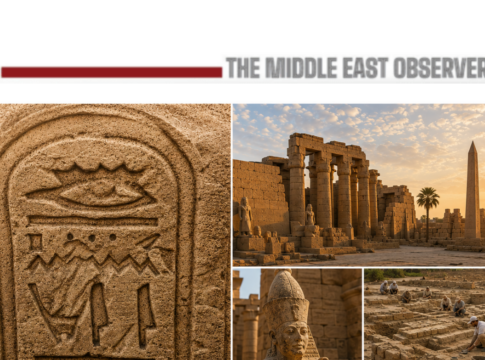
Among the most significant finds is a reused stone block bearing the cartouche of King Senusret III, one of the most influential rulers of Egypt’s Middle Kingdom. Archaeologists believe the inscription strengthens evidence linking the king to important building activity in Heracleopolis and underscores the city’s importance during an era marked by political consolidation and administrative expansion.
The mission also uncovered extensions of a Roman basilica, remains of an earlier Doric temple and a rare marble head of Aphrodite, the Greek goddess of love and beauty. The sculpture is notable for both its artistic quality and preservation, offering further evidence of the cultural and artistic influences that shaped Egypt during the Hellenistic and Roman periods.
Additional discoveries included fragments of wall sculptures and clay moulds used in coin production during the Roman era, indicating that Heracleopolis remained an active commercial and administrative centre long after the end of Pharaonic rule.
Perhaps the most revealing discovery is evidence that architectural elements from the earlier Doric temple were repurposed during the sixth century AD in the construction of the basilica. The findings provide a tangible illustration of how successive religious communities adapted existing monuments to serve new functions, preserving elements of the past while reshaping them to reflect changing spiritual and social realities.
Further south at the Karnak Temple complex in Luxor, restoration work uncovered a sandstone relief dating to approximately 2,000 years ago that appears to depict a Roman emperor represented in the traditional form of an Egyptian pharaoh.
The relief was discovered during conservation work near the northern gate associated with Ramesses III. While depictions of Roman emperors in Egyptian temples are known to scholars, each new example adds valuable evidence to understanding how Roman authority was presented within Egypt’s religious landscape following the Roman annexation of the kingdom in 30 BC.
By adopting Pharaonic iconography and appearing in temple reliefs performing traditional royal and sacred functions, Roman emperors sought to reinforce their legitimacy among Egyptian subjects and align themselves with one of the ancient world’s most enduring political and religious traditions. Archaeologists say the newly discovered relief contributes to a relatively limited body of evidence illustrating how Roman rulers integrated themselves into Egyptian temple culture while maintaining imperial authority.
The discoveries also demonstrate how major archaeological insights continue to emerge even from sites that have been studied for generations. For historians, they provide fresh material for understanding the interaction between Egyptian, Greek, Roman and early Christian communities across different periods of the country’s history.
Beyond their scholarly importance, the findings support Egypt’s broader strategy of expanding cultural tourism and diversifying visitor experiences beyond internationally renowned destinations such as the Giza Pyramids and the Valley of the Kings. Authorities have increasingly focused on promoting lesser-known archaeological sites, particularly in Middle Egypt, as part of efforts to encourage longer visitor stays and broaden the economic impact of heritage tourism.
The discoveries come as Egypt continues to invest heavily in archaeological research, conservation projects and museum development, including the Grand Egyptian Museum and a growing network of restored heritage attractions. Tourism remains one of Egypt’s most important sources of foreign currency earnings, generating a record $15.3 billion in revenues during the 2023/24 fiscal year, while cultural tourism continues to play a central role in attracting international visitors.
Taken together, the discoveries at Heracleopolis and Karnak reveal more than a collection of isolated artefacts. They offer a compelling illustration of a recurring theme throughout Egyptian history: the ability of successive civilisations—from Middle Kingdom rulers and Greek settlers to Roman emperors and early Christian communities—to adapt existing traditions while leaving their own imprint on one of the world’s oldest continuously inhabited cultural landscapes.