When I entered Al-Ghad Theatre to attend the stage production Adagio: The Last Melody, the first thing that caught my attention was not the set design, lighting, or performances. It was the empty seats.
The scene was revealing and painful. The audience could almost be counted on the fingers of one hand. Such a moment compels anyone observing Egypt’s cultural landscape to confront a question extending far beyond a single performance: how can State Theatre remain economically sustainable under such circumstances?
At first glance, this may appear to be a purely financial question. In reality, however, it is a cultural and developmental one touching upon the role of the State in producing culture and the limits of the relationship between artistic value and economic return. Adagio: The Last Melody, presented by Al-Ghad Theatre under Egypt’s National Theatre Sector, offers a practical case study of this dilemma.
The ticket price was only EGP 42. Assuming attendance did not exceed eight or ten people, total ticket revenue for that evening would have amounted to only a few hundred Egyptian pounds. Even if attendance improved on other nights, the broader question would remain unchanged: can ticket sales alone sustain a State Theatre institution?
The answer is almost certainly no.
Electricity costs alone — including stage lighting, sound systems, and air conditioning — can exceed the revenue generated from a poorly attended performance. Added to this are maintenance expenses, salaries, technicians’ wages, and production costs including scenery, costumes, music, lighting, and publicity. Once the economic value of rehearsal hours is considered, the gap between revenue and expenditure becomes strikingly apparent.
Yet the evening’s most telling observation was not numerical. During the performance, some actors were personally involved in moving scenery and changing set pieces between scenes — tasks typically handled by stage crews or specialised technicians.
Some may interpret this as collective dedication or creative resourcefulness. More broadly, however, it reflects the operational pressures confronting publicly funded theatre institutions and the limitations of the resources available to them.
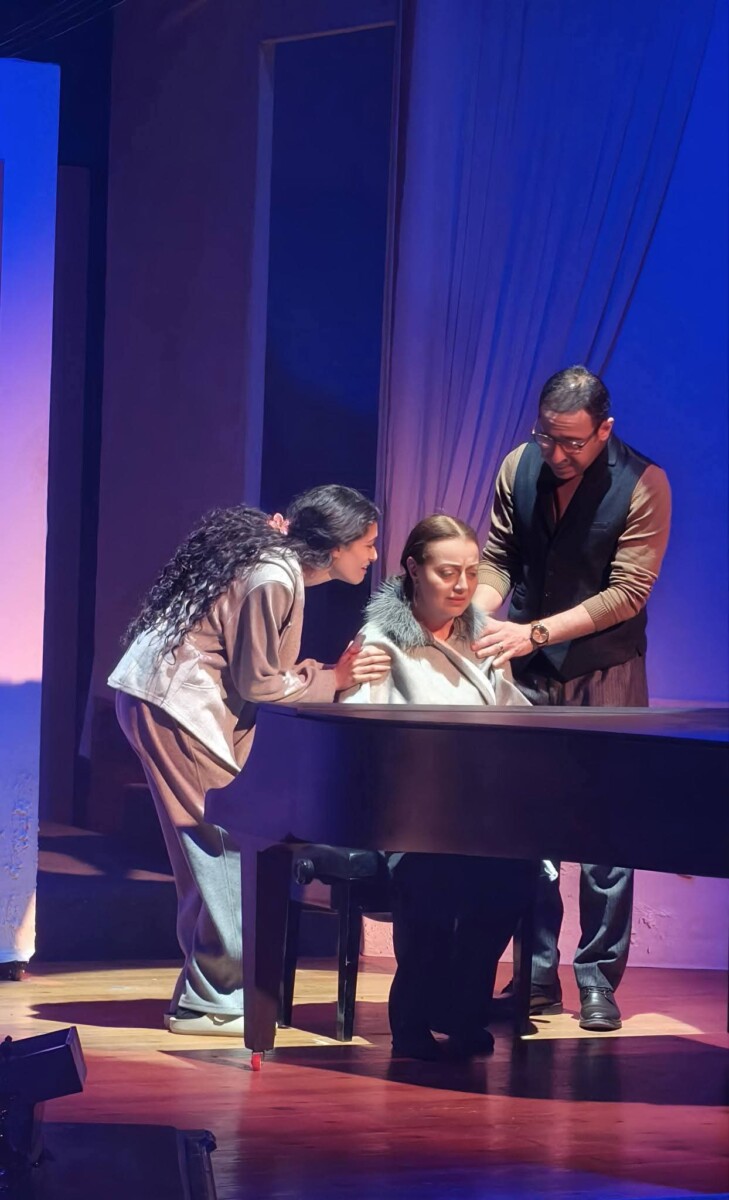
The same reality was visible in the technical infrastructure. The sound equipment appeared not to have undergone substantial modernisation in years. At certain moments, voices struggled to reach the audience clearly, inevitably affecting the viewing experience — particularly in a production such as Adagio, which relies heavily on music and singing. This is not merely an artistic issue, but also an economic one. Investment in cultural infrastructure is not a luxury; it is essential to preserving the quality and competitiveness of the cultural product itself.
Still, judging State Theatre solely through an accounting lens would be incomplete.
The State Theatre was never designed as a purely commercial enterprise. If cultural institutions were assessed exclusively according to profit-and-loss calculations, many public theatres around the world would have disappeared decades ago. Like libraries, museums, and cultural centres, theatre provides a public service whose value extends beyond immediate commercial return.
Modern economics offers a more useful framework through the concept of Social Return on Investment (SROI), which evaluates the broader social value generated by projects even when they fail to produce direct financial profits. Viewed through this lens, the central question changes fundamentally:
What value does a production such as Adagio generate for society itself?
To answer that question, one must turn to the work.
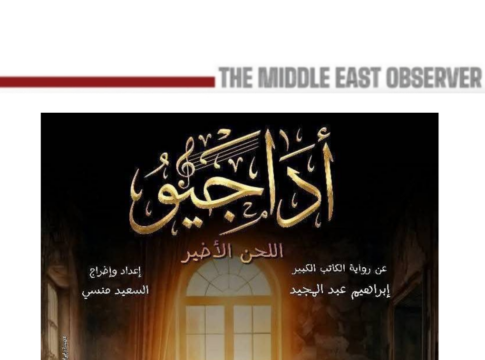
Adagio: The Last Melody is based on the novel Adagio by acclaimed Egyptian novelist Ibrahim Abdel Meguid. Like much of Abdel Meguid’s work, the novel inhabits a literary universe where memory intertwines with the present and time itself becomes a dramatic force. The stage adaptation and direction were undertaken by El-Saeed Mansi, who emphasised the emotional and human dimensions of the text while transforming it into a musical theatrical experience whose measured rhythm reflects the meaning of the musical term “adagio.”
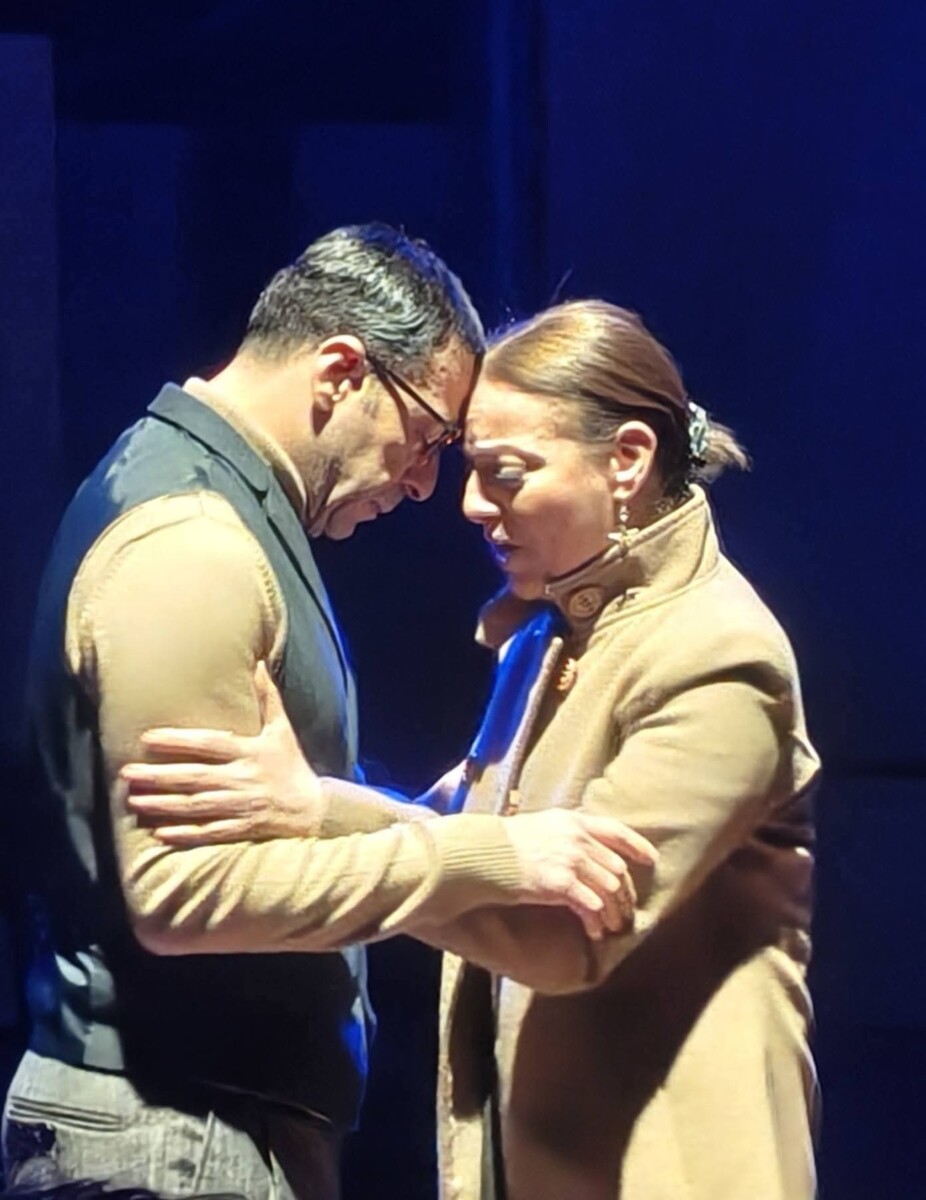
The story revolves around Samer and Reem, two characters navigating a world shaped by love, illness, memory, and loss. Rather than relying on spectacle or dramatic shocks, the production builds its emotional power gradually. Love emerges not as triumph, but as an attempt to resist time itself. Memory becomes less an act of recollection than a mechanism of survival.
Mansi places music at the centre of the dramatic structure rather than treating it as accompaniment. Songs and musical sequences occupy a substantial portion of the performance, merging singing and acting into a single expressive language.
The cast performs with a strong ensemble spirit. Leading roles are delivered by Rami El-Tombary and Heba Abdel Ghani, alongside Basma Shawky, George Ashraf, Jana Atwa, Mohamed Diab, Ahmed Hisham, and Omnia Mohsen. Much of the production’s emotional effectiveness rests upon the artistic chemistry between the two leads, particularly during the musical and emotionally charged scenes.
The production also reflects substantial collective effort from its artistic team. Set design was created by Ahmed El-Alfy, music and compositions by Rafik Gamal, and lyrics by Hamed El-Sahraty, supported by a wider technical and visual production team. The result is a sincere artistic endeavour, even if available resources occasionally fall short of the ambitions inherent in the source material.
In many ways, Adagio embodies a central paradox in the economics of culture.
On one hand, it is a production unlikely to recover its costs through ticket sales alone. On the other, it represents a serious artistic effort dedicated to bringing contemporary Egyptian literature to the stage while preserving a cultural tradition whose value cannot be measured exclusively through commercial metrics.
If the logic of the free market were applied rigidly to theatre, the result could be a cultural landscape dominated solely by commercially marketable productions designed for mass audiences. More intellectually demanding literary works such as Adagio could gradually disappear from production schedules altogether.
This is where the historical role of State Theatre becomes clear. Its mission is not simply to sell tickets, but to preserve cultural diversity and create space for works that may never become commercial successes yet still enrich public cultural life.
Acknowledging the importance of public support, however, does not eliminate the need for reform.
State theatres require stronger marketing strategies, upgraded technical infrastructure, broader use of digital platforms, and more effective approaches to audience development. Public funding should function as a tool empowering culture — not as a permanent substitute for administrative efficiency and continuous modernisation.
I left Adagio thinking simultaneously about two realities.
The first was the production itself: a sincere artistic effort marked by emotional sensitivity and a genuine attempt to translate literature into theatre.
The second was the economic environment within which the production operates.
Inside that theatre hall, where only a handful of spectators were seated, there were also dozens of individuals who had devoted months of work so that the stage lights could shine for two hours. Between those two realities — the limited audience on one side and the immense effort invested on the other — lies the true dilemma of State Theatre in Egypt.
Perhaps, then, the most important question is not how much revenue Adagio generated at the box office.
Rather, it is this:
How much would society lose if productions such as Adagio disappeared altogether?
Culture, ultimately, is not merely a commodity to be bought and sold. It is a long-term investment in consciousness, imagination, and identity — assets whose value may be difficult to quantify on a balance sheet, yet remain among the most important a nation can produce for its citizens.