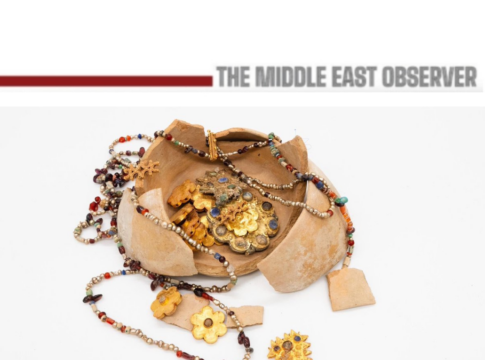
The recent discovery of nearly 100 Abbasid-era gold jewelry pieces at the Dariyah archaeological site in Saudi Arabia’s Al-Qassim region is offering historians and archaeologists more than a collection of ancient ornaments — it is revealing fragments of an entire social and economic world that flourished during the Islamic Golden Age.
Announced by the Saudi Heritage Commission, the discovery includes floral gold ornaments, coloured stone inlays, multi-coloured beads, and a large circular decorative piece crafted using advanced techniques such as hammering, embossing, and stone-setting. Archaeologists believe the collection once formed a complete luxury adornment set dating back to the Abbasid period between the 8th and 13th centuries.
Unlike coins or royal inscriptions that often focus on rulers and political authority, the jewelry offers a more intimate portrait of life during the Abbasid era — reflecting wealth, fashion, craftsmanship, artistic taste, and social status within a highly sophisticated society.
The floral motifs and geometric symmetry reveal artistic traditions that flourished under Abbasid cultural influence, when artisans across the Islamic world blended Persian, Mesopotamian, Byzantine, and Arabian design elements into a distinct aesthetic identity that would later influence Islamic art for centuries.
The excavation also uncovered foundations of stone buildings, plastered rooms, pottery, fire hearths, and metal tools, suggesting the area functioned as an active settlement rather than merely a stopping point along historic routes. Archaeologists date the remains to the late ninth century AD, when Baghdad served as the political and intellectual centre of the Abbasid Caliphate and among the world’s most influential cities.
At the time, Abbasid influence connected some of the medieval world’s most important commercial, intellectual, and urban centres. Luxury objects such as the Dariyah jewelry likely circulated among wealthy merchant families, elite travellers, or prosperous communities benefiting from expanding regional commerce and pilgrimage activity.
The discovery additionally highlights the sophistication of Abbasid-era craftsmanship and the existence of highly specialised artisans capable of producing luxury objects for affluent social classes during a period marked by scientific advancement, economic prosperity, and rapid urbanisation across the Islamic world.
Saudi officials have not yet formally announced the final museum destination for the collection, though discoveries of this scale are widely expected to become part of the Kingdom’s expanding museum and cultural tourism initiatives linked to Saudi Vision 2030.
As The Middle East Observer notes, the importance of the discovery lies not simply in the value of the gold itself, but in the historical narrative it reconstructs. Beneath the sands of Al-Qassim emerges evidence of a society shaped by commerce, refined craftsmanship, urban development, and cultural confidence at a time when the Abbasid world stood among history’s leading political and intellectual centres.
The jewelry therefore survives not merely as decoration from a distant age, but as testimony to the economic vitality, artistic sophistication, and cultural interconnectedness of one of the medieval world’s most influential civilizations.