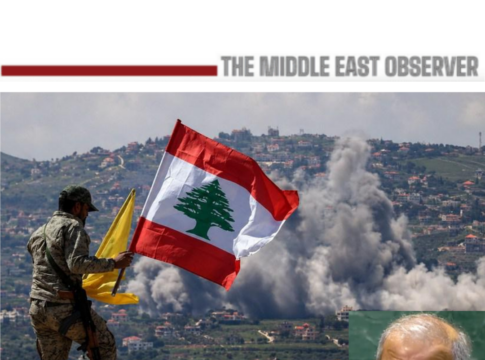
Lebanese Prime Minister Nawaf Salam stated publicly that Israeli forces currently control 68 locations and villages in southern Lebanon following the latest escalation with Hezbollah, warning that parts of the south — particularly areas surrounding Bint Jbeil — now resemble the scale of destruction witnessed in the Gaza Strip. International media reports, including Reuters, separately verified that Israel has established an expanded “security zone” extending several kilometers into Lebanese territory, while the Israeli military reportedly published operational maps showing deployment lines covering dozens of southern Lebanese villages. The developments come amid rising regional tensions, continued cross-border confrontations, and mounting international pressure to redefine Lebanon’s security architecture.
The crisis has unfolded despite the existence of a ceasefire framework and ongoing US-mediated negotiations between Lebanese and Israeli representatives aimed at reducing escalation and stabilizing southern Lebanon. Yet while diplomatic efforts continue, developments on the ground increasingly suggest that military realities are moving in the opposite direction. Israeli military operations have continued to intensify across southern Lebanon, accompanied by repeated evacuation warnings targeting villages near operational zones and further waves of displacement among civilians already affected by months of conflict.
Israeli military statements indicated that more than 1,100 targets in Lebanon had reportedly been struck since the ceasefire arrangements entered into force, while Lebanese authorities placed casualty figures substantially higher than Israeli estimates. Lebanese official figures indicate that more than 520 individuals have been killed since the agreement, bringing the broader death toll since the beginning of the latest Israeli military campaign in March to nearly 2,880 fatalities. The continued expansion of military operations has deepened fears inside Lebanon that the ceasefire framework risks gradually losing operational credibility as large sections of southern Lebanon remain exposed to sustained military pressure and destruction.
The core challenge facing current negotiations is therefore no longer limited to securing a temporary ceasefire, but rather whether a sustainable framework can emerge that simultaneously addresses Israeli security concerns versus deeply perceived long-term occupation intentions, restores Lebanese sovereignty, and gradually resolves Hezbollah’s future military status through a peaceful state-led integration process.
Lebanese officials had hoped that Washington, as sponsor of the ceasefire understandings and negotiations, would exert stronger pressure on Israel to fully implement ceasefire obligations and withdraw from Lebanese territory. However, growing political criticism inside Lebanon argues that American guarantees have thus far failed to effectively restrain Israeli military operations. Particular controversy has surrounded US-backed ceasefire language proposed earlier this year granting Israel the right to take “necessary measures” against perceived imminent threats — wording critics argue has effectively provided Israel broad operational flexibility under the justification of self-defense.
Israeli Prime Minister Benjamin Netanyahu has meanwhile signaled that Israeli military operations in Lebanon may continue regardless of developments on other regional fronts, including Iran, reinforcing concerns that the conflict is increasingly tied not only to immediate border security calculations but also to wider Israeli domestic and regional political dynamics.
Yet beyond the military dimension, the deeper strategic question facing Lebanon — and increasingly the international community — revolves around Hezbollah’s long-term role within the Lebanese state.
For years, discussions surrounding Hezbollah have largely oscillated between confrontation, containment, sanctions, or military pressure. However, historical precedent suggests that long-term stabilization in deeply fragmented societies rarely succeeds through exclusion alone. Sustainable stability more often emerges through gradual political integration, negotiated security arrangements, institutional guarantees, and phased de-escalation.
In this context, Lebanon may eventually require a carefully structured domestic framework that recognizes Hezbollah not merely as an armed actor, but also as a significant political and social component within Lebanon’s internal fabric. Any durable settlement would likely require balancing several parallel realities simultaneously through a Declaration of Principles — a domestic agreement designed to meet the mutual interests of the Lebanese state and its major political constituencies. Such a framework would involve preserving Lebanese sovereignty, strengthening national institutions, rebuilding a sustainable economy, ensuring that weapons regulation and integration occur gradually and peacefully, and guaranteeing political participation and representation for all major Lebanese constituencies.
Historical examples provide important lessons. One of the most frequently cited international precedents remains the Good Friday Agreement, which gradually transformed decades of violent conflict into a political process centered on guaranteed participation, power-sharing, and negotiated weapons decommissioning. The Irish Republican Army’s eventual disarmament did not emerge through immediate military defeat alone, but through a political formula in which key stakeholders were assured that their communities would retain representation, influence, and a stake in the future political order. The process required years of confidence-building, external guarantees supporting political stability and limiting the risks of renewed confrontation, political compromise, and phased security arrangements.
At the same time, international and regional actors continue to emphasize that the Lebanese Armed Forces and Lebanese state institutions must remain the sole legitimate national authority responsible for safeguarding territorial sovereignty and maintaining internal stability.
As a result, any realistic long-term framework would likely require a gradual transition model involving expanded state authority, economic reconstruction incentives, phased weapons regulation, border stabilization arrangements, and increased integration of armed structures into official state institutions under negotiated guarantees.
Such a path would inevitably face major regional obstacles. Nevertheless, the current trajectory increasingly demonstrates that repeated cycles of escalation risk further weakening Lebanon’s economy, infrastructure, institutions, demographic stability, and investor confidence. The continuation of military operations under the shadow of incomplete ceasefire implementation also risks undermining the credibility of diplomacy itself, potentially transforming negotiations into a parallel process unfolding alongside continued escalation rather than a mechanism for genuine de-escalation.
Many analysts therefore argue that Lebanon’s long-term survival may ultimately depend less on military victories by any side and more on constructing an inclusive political-security arrangement capable of preserving internal coexistence while preventing Lebanon from becoming a permanent arena for regional conflict.
As The Middle East Observer notes, the challenge facing Lebanon today is not simply how to end the current confrontation, but how to build a stronger and more integrated state structure capable of peacefully absorbing its competing forces while preserving national cohesion and restoring full state authority over time. History repeatedly suggests that negotiated inclusion — however difficult, gradual, and politically sensitive — is ultimately more durable than indefinite fragmentation, particularly when recurring cycles of conflict repeatedly return all parties to the negotiating table in search of a sustainable political settlement.