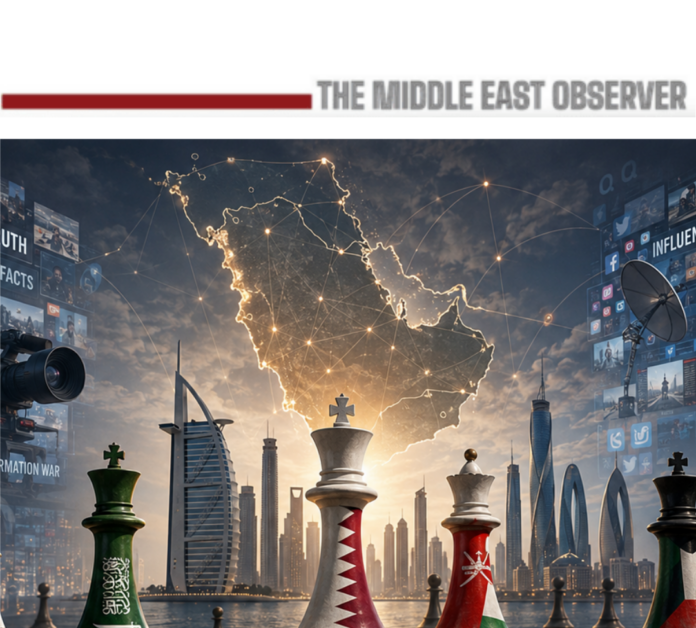
It increasingly appears that the confrontation between the United States and Iran has entered a phase of managed escalation rather than full-scale warfare, leaving behind limited skirmishes unlikely to fundamentally alter the broader strategic balance. The region now appears to be transitioning from a stage of “conflict resolution” to one of “conflict management,” where the battlefield itself is gradually becoming secondary to what may be described as a “war of narratives.” Each side seeks to portray the other as the initiator of violations of international law while simultaneously claiming political and strategic victory.
When major powers reach military stalemate, or recognize that direct confrontation would carry catastrophic costs for all parties involved, the struggle often shifts from conventional warfare to the battle over perception and legitimacy. In this context, the objective is no longer necessarily the physical defeat of the adversary, but rather convincing domestic and international audiences that one’s position is stronger, more legitimate, and strategically sustainable.
In traditional wars, victory was measured by territorial conquest and the raising of flags over enemy capitals. In the current confrontation, however, victory carries different definitions. For Iran, success lies primarily in regime survival and demonstrating that the “maximum pressure” strategy failed to alter the structure or strategic orientation of the Iranian state. For the United States, victory is framed as “containment” — preventing Tehran from crossing strategic red lines, particularly regarding nuclear escalation or full control over critical maritime corridors, without becoming entangled in another costly regional war. However, increasing debate surrounds Washington’s capacity to fully secure these restrained objectives.
International law itself has increasingly become a diplomatic instrument within this struggle rather than a universally applied moral framework. Washington focuses on Iran’s support for regional armed groups and alleged threats to maritime security, while Tehran highlights the American withdrawal from the nuclear agreement, targeted assassinations, and military escalation as justification for what it describes as defensive measures. Iran has additionally linked any sustainable ceasefire framework to broader regional files extending beyond the Gulf, including Southern Lebanon and potentially Gaza.
The recent military exchanges between the two sides largely function as strategic signaling mechanisms rather than attempts at decisive battlefield victory. Limited strikes often appear designed less to destroy the opponent’s capabilities than to provide symbolic demonstrations of retaliation capable of sustaining domestic morale and political cohesion. This has created what may be described as a “fragile equilibrium,” in which both parties appear to recognize that a state of “no peace, no war” currently represents the least costly option available. Within this environment, media Narratives fill this vacuum because admitting to a stalemate is a bitter pill that is hard for markets to politically absorb.
One of the most important consequences of the conflict has been the continued erosion of the notion of absolute American unipolar dominance. From this perspective, Iran — despite severe sanctions and economic strain — has managed to resist pressure exerted by both a global nuclear power and a regional nuclear-capable state while relying heavily on relatively low-cost military technologies. Tehran has therefore emerged, if not victorious, then at minimum in a strengthened geopolitical position, particularly regarding its influence over the strategic Strait of Hormuz. A strategic pathway that had already been open prior to the outbreak of the war.
This transformation reflects what many geopolitical analysts describe as the gradual transition toward a more multipolar international order. The conflict has reinforced the growing strategic importance of asymmetric warfare tools, including drones and cruise missiles, which have altered traditional deterrence calculations by imposing disproportionate economic costs on technologically superior adversaries. In practical terms, using multi-million-dollar interceptor systems against low-cost drones creates an unsustainable long-term economic equation for the defending side.
The changing status of the Strait of Hormuz represents another central dimension of this evolving strategic landscape. Since the end of the Second World War, the United States traditionally viewed unrestricted maritime navigation through the Gulf as a non-negotiable strategic principle. Yet, Iran has now demonstrated an ability to influence or disrupt this freedom in accordance with the level of regional escalation, transforming the Strait from a largely Western-dominated passage into a contested sphere of influence in which Tehran possesses important geographic and operational advantages.
At the same time, the conflict has also exposed limitations within traditional concepts of nuclear deterrence. Despite the nuclear capabilities associated with both the United States and Israel, the possession of nuclear weapons by the U.S. and Israel did not deter Iran from striking military bases, leading to the erosion of “nuclear deterrence prestige.” This has provided a “manual” for other local powers on how to challenge superpowers without triggering a total apocalypse.
While Iran’s geopolitical standing appears to have strengthened, it has come at a considerable domestic cost due to the weight of prolonged sanctions and economic pressures. In this sense, the strategic gains primarily favor the “State and the Regime” in consolidating their external position, while the broader burden increasingly falls on both Iranian society and the international community’s ability to absorb the long-term consequences of this enduring confrontation. The regional discourse, consequently, appears to have shifted from asking, “When will Iran fall?” to “How will the region and the world coexist with Iran’s expanding influence?”
This transition coincides with theories predicting the decline of the American Empire. According to General John Bagot Glubb’s theory in The Fate of Empires, it argues that major powers often decline under the weight of “imperial overstretch,” where the financial and military costs of maintaining global dominance begin to exceed sustainable domestic capacity. From this perspective, the average lifespan of great empires is about 250 years. Given that the American “Empire” , often traced to the country’s independence in 1776, has now reached that 250-year mark. The “Imperial Overstretch”- characterized by massive military spending to maintain global hegemony- is exhausting the domestic economy. Historically, major empires have often weakened internally before facing external decline; in this context, the growing polarization between liberal and conservative currents within the United States is viewed by some observers as reflecting increasing strain on the country’s social and political cohesion.
In this shifting landscape, China appears as the candidate for global economic leadership, while Israel seeks to fill the American vacuum in the Gulf as a regional superpower. This creates a “geopolitical mosaic” where China manages the economy while regional players like Israel and Iran compete over “security contracts”. Israel presents itself as a “Security Provider,” offering advanced intelligence and defense technology (like the Iron Dome and David’s Sling). However, Israel faces fundamental obstacles: the lack of popular legitimacy due to the Palestinian cause and its small geographical and demographic size, which prevents it from conducting the wide-scale deployments once managed by American fleets.
Amidst this tug-of-war, Egypt’s deployment of air force and air defense elements to the UAE — alongside the reported presence of Pakistani military forces in Saudi Arabia — was reflective of broader efforts to reshape regional security arrangements. According to the analysis, these deployments indicate a shift from symbolic political alliances toward more operational regional security coordination aimed at preserving the Gulf from becoming an exclusive sphere of influence for either Iran or Israel.
The emerging regional security architecture increasingly appears to be structured around layered deterrence and strategic depth. At the local level, Gulf states continue to rely on the expansion and modernization of their national armed forces. At the broader Arab and regional level, countries such as Egypt and Pakistan — and potentially Türkiye in the future — are being viewed as critical pillars of strategic reinforcement capable of providing both operational depth and conventional military backing. At the global level, the balance is gradually shifting toward deeper economic and strategic engagement with China, while the United States is perceived by many regional actors as playing a comparatively more restrained role than in previous decades.
Within this evolving framework, recent confrontations have also raised questions regarding the long-term sustainability of depending primarily on advanced technological defense systems, particularly after Israeli air-defense networks faced difficulties fully containing the saturation tactics of Iranian drones and missile barrages. In contrast, Egypt and Pakistan are often perceived as embodying a different military doctrine centered on endurance, manpower, and preparedness for prolonged high-intensity ground engagements. The deployment of Egyptian pilots in the UAE or Pakistani forces in Saudi Arabia therefore carries symbolic and strategic significance beyond technical cooperation, reflecting what many in the region interpret as a genuine “commitment of blood” if circumstances require it. Recent events have reinforced the argument among regional strategists that artificial intelligence and advanced defense technologies alone cannot secure borders without the parallel presence of soldiers prepared to sustain frontline realities — a principle that Gulf states increasingly appear to be rediscovering as part of a broader recalibration of their security doctrine.