
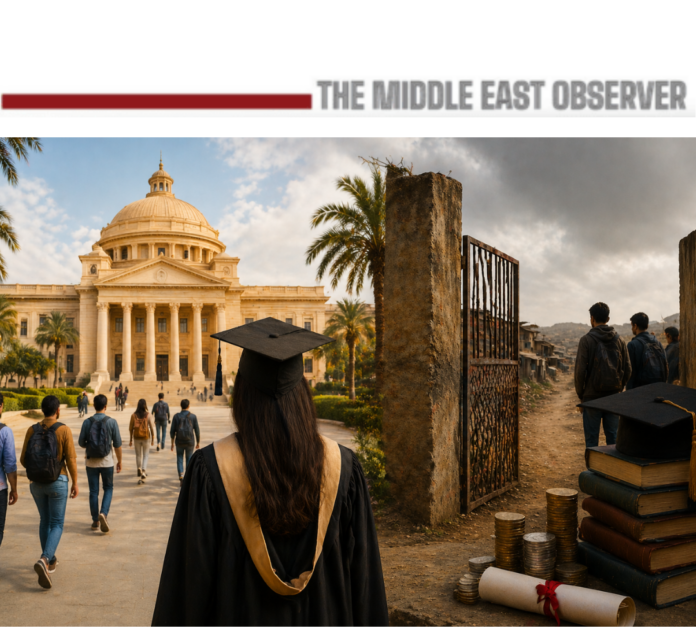
At a time when Egypt is navigating sustained economic pressures, difficult questions must be raised about how public resources are allocated—and whether current spending priorities remain aligned with national needs. Few issues illustrate this challenge more clearly than the financing of graduate education in Egypt’s public universities.
For decades, the state has continued to offer master’s and doctoral degrees to Egyptian students at near-symbolic cost, despite the substantial public funding required to sustain these programs. In principle, investing in higher education is a legitimate national objective. Yet in an environment marked by budget deficits, inflation, strain on public services, and declining purchasing power, the continuation of heavily subsidised postgraduate education warrants closer examination.
The contradiction is increasingly difficult to ignore. While hospitals face shortages and public schools struggle with overcrowding and underdeveloped infrastructure, the state continues to absorb the high cost of advanced academic degrees for a relatively limited segment of society. This raises a fundamental policy question: are scarce public resources being directed toward Egypt’s most urgent developmental priorities?
Although official data does not explicitly disclose the full cost of educating a graduate student in public universities, indirect indicators provide important insight. Foreign students enrolled in the same programs are often charged thousands of dollars annually, while Egyptian students pay only nominal fees. The gap between the two reflects a significant implicit subsidy borne by the state, covering academic supervision, laboratory access, infrastructure, and faculty remuneration.
The issue, however, is not simply the existence of public support, but the absence of a measurable return on that investment.
A considerable proportion of master’s and doctoral graduates do not ultimately join academic or research institutions. Instead, many pursue these degrees for career advancement outside academia or for social recognition rather than research contribution. As a result, the state is effectively financing the training of research-qualified individuals whom its own institutions neither absorb nor require.
This dynamic raises important concerns around distributive equity. How can extensive public support for advanced degrees—benefiting a relatively narrow segment—be justified when large parts of the population continue to face declining quality in basic education and healthcare? Why should one citizen receive a substantial hidden subsidy for a doctorate while another lacks access to adequate primary schooling?
In practical terms, the current model reflects an imbalanced allocation of public resources. It prioritises costly postgraduate education for a minority, while more pressing sectors remain underfunded.
Equally concerning is the weak alignment between graduate funding and Egypt’s broader development agenda. There is limited evidence of a structured mechanism linking subsidised postgraduate programs to national economic priorities, technological advancement, or public policy needs. In many cases, graduate education operates as an open-ended system, with insufficient strategic direction and unclear outcomes.
Supporters of the current framework often invoke the principle of access to education. However, support without prioritisation or efficiency becomes increasingly difficult to sustain under fiscal constraints. Effective public investment must be targeted—aligned with national priorities rather than applied as a universal entitlement.
Reform, therefore, does not imply withdrawing support for graduate education altogether. Rather, it calls for restructuring. Full public funding should be directed toward disciplines and candidates that meet clear academic and national needs, while other students contribute a more proportionate share of the actual cost of their education.
No country seeking sustainable development can continue financing high-cost educational programs indefinitely without evaluating their outcomes, relevance, and economic return. Egypt’s current approach reflects an earlier model of state responsibility—one that may no longer be viable under present economic conditions.
Reconsidering the financing of postgraduate education is no longer a purely academic exercise. It has become an economic imperative—one that must be guided by the principles of efficiency, fairness, and responsible stewardship of limited public resources.