Cairo — Egypt’s Ministry of Petroleum and Mineral Resources has announced a new natural gas discovery at the Nidoco N-2 exploratory well in the West Abu Madi concession, located in Kafr El-Sheikh governorate in the Nile Delta region.
According to an official ministry statement, the discovery was achieved following the successful drilling of the Nidoco N-2 well, which is situated approximately three kilometres offshore in shallow waters.
The concession is operated by Eni in partnership with BP and the Egyptian General Petroleum Corporation through their joint venture Petrobel, reflecting continued collaboration between Egypt and international energy majors in upstream development.
The Ministry indicated that the well is expected to deliver around 50 million cubic feet of natural gas per day, contributing to domestic supply and supporting efforts to narrow the gap between production and consumption.
In line with the Ministry’s statement, the well was drilled from an onshore location using advanced directional drilling technologies, enabling access to offshore reservoirs while reducing operational costs and improving efficiency.
Officials further emphasized that the discovery’s proximity—less than two kilometres from existing production facilities—will allow for a rapid tie-in to the national gas network, with early production expected within the coming weeks.
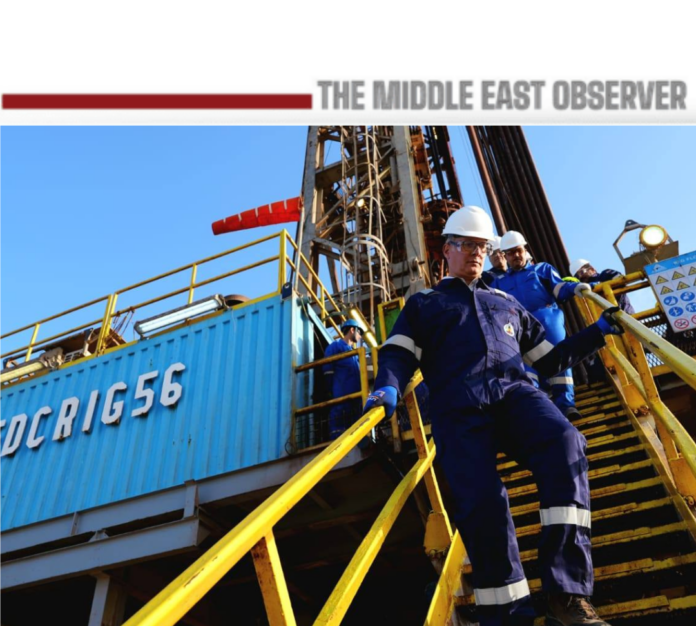
Minister of Petroleum and Mineral Resources Karim Badawi noted during an inspection of the EDC-56 drilling rig that the project reflects the sector’s strategy of maximizing the use of existing infrastructure while accelerating development timelines and enhancing capital efficiency.
The Ministry added that the discovery forms part of a broader push to expand exploration activity and boost output, with Egypt planning to drill a significant number of exploratory wells to secure additional reserves and strengthen energy security.
As The Middle East Observer notes, the Nidoco N-2 discovery underscores Egypt’s evolving upstream strategy—focused on fast-track developments, cost-efficient drilling techniques, and infrastructure-led production integration—at a time when the country is working to stabilize gas supply amid rising domestic demand.