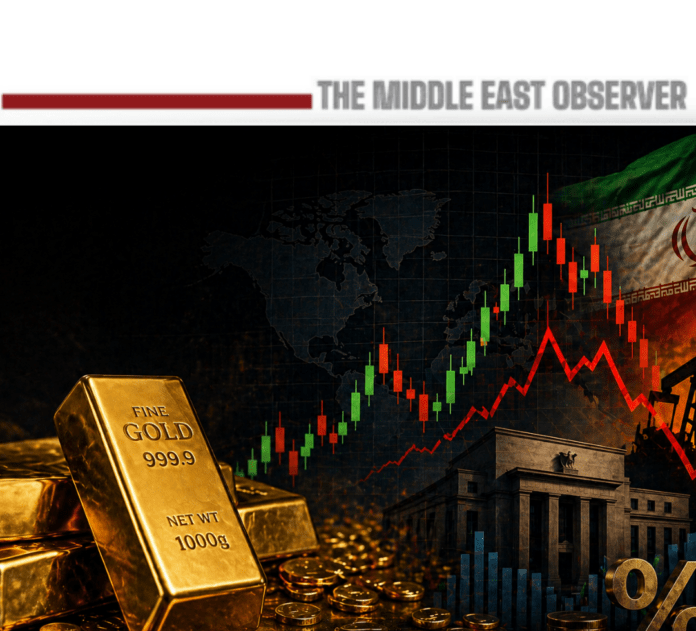
CAIRO — Gold prices declined on Tuesday as investors weighed the impact of the ongoing conflict involving Iran alongside shifting expectations for global interest rates, according to market data reported by Bloomberg.
Spot gold fell by around 1.2% to $4,624 per ounce in London trading, after briefly dropping below $4,620, reflecting continued volatility as markets respond to both geopolitical developments and macroeconomic signals. Other precious metals also declined, with silver, platinum, and palladium recording losses, while the US dollar edged higher.
The move comes as energy flows through the Strait of Hormuz remain severely disrupted, amplifying supply concerns in global oil markets. The strait—one of the world’s most critical energy corridors—normally carries roughly a fifth of global oil and liquefied natural gas shipments, meaning any sustained disruption has immediate implications for prices and inflation expectations.
Diplomatic developments have added further uncertainty. Iran has reportedly indicated willingness to consider a temporary arrangement to reopen the strait in exchange for easing restrictions on its ports, though the proposal has been met with caution by US officials, according to international media reports.
The energy shock linked to the conflict has heightened inflation risks, prompting markets to reassess the trajectory of monetary policy. Investors increasingly expect major central banks to keep interest rates higher for longer, with some analysts not ruling out additional tightening should inflationary pressures persist.
This dynamic has weighed on gold, which does not yield interest. According to market commentary cited by Bloomberg, the metal has declined notably since the escalation of the conflict in late February, reflecting a shift toward yield-bearing assets.
Market focus now turns to upcoming policy decisions from the US Federal Reserve, the European Central Bank, and the Bank of England, while the Bank of Japan earlier kept its benchmark rate unchanged at 0.75%, with signals pointing to a potential tightening bias.
A note from Heraeus Precious Metals highlighted that prolonged geopolitical uncertainty combined with energy-driven inflation could sustain volatility in gold prices, while also providing longer-term support under a stagflationary scenario.
As The Middle East Observer notes, gold markets are currently caught between two opposing forces: geopolitical risk, which typically supports safe-haven demand, and tightening financial conditions, which reduce the metal’s appeal.
The disruption in Hormuz has intensified this tension by linking energy supply shocks directly to inflation expectations and central bank policy. While geopolitical risks remain elevated, the immediate effect has been to strengthen the case for tighter monetary conditions—offsetting gold’s traditional safe-haven role.