
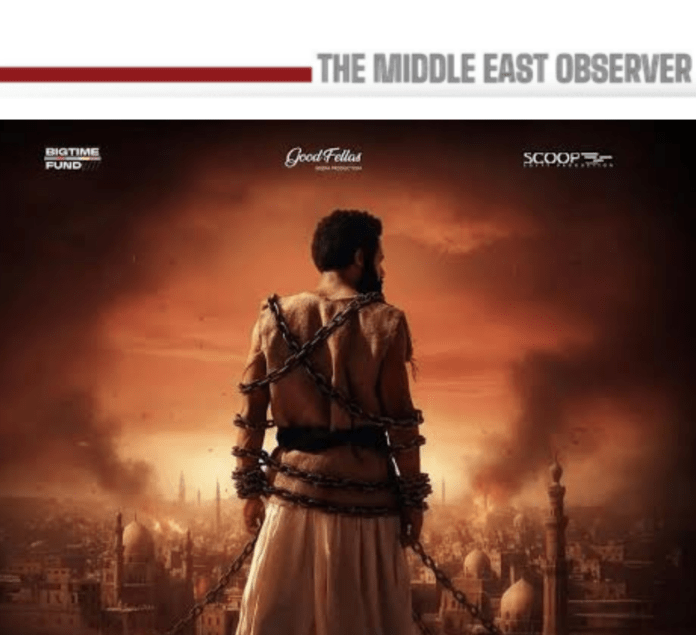
Cairo — Egyptian actor Mohamed Ramadan is set to headline the upcoming historical drama “Assad”, a film that has drawn heightened attention ahead of its anticipated release in mid-May, positioning itself as one of the most debated Arab productions of the year due to its focus on slavery and racial hierarchies in 19th-century Egypt.
The project, directed by Mohamed Diab and written by the trio Khaled Diab, Mohamed Diab, and Sherine Diab, is set in circa 1840 Egypt, a period marked by complex socio-economic transformations under Ottoman-Egyptian rule. According to statements by Khaled Diab, the film explores themes that have been largely absent from mainstream Egyptian cinema, particularly the structures of servitude, social stratification, and racial dynamics during that era.
The narrative reportedly unfolds around a love story that escalates into broader conflict, serving as an entry point into a wider examination of power relations and coercive systems. Diab emphasized in media remarks that the work seeks to interrogate historical realities often overlooked in cultural production, framing the film as both a dramatic and socio-political commentary.
However, the project has also sparked early controversy following remarks attributed to the writers suggesting that forms of inherited servitude may persist socially in parts of Upper Egypt, albeit in non-formalized structures distinct from historical slavery systems. These claims have prompted debate among cultural commentators and social researchers, with specialists noting that while historical slavery did exist in Egypt—particularly prior to its gradual abolition in the late 19th century—modern characterizations require careful academic framing to avoid conflating legally abolished systems with contemporary socio-economic inequalities.
Historians generally point to Egypt’s integration within broader Ottoman and African trade networks in the 18th and 19th centuries, where enslaved individuals were present in domestic, agricultural, and military contexts. The abolition process unfolded progressively through the 19th century, influenced by both internal reforms and international pressure. Experts caution that any contemporary parallels should be treated analytically within frameworks of class hierarchy, patronage systems, and rural socio-economic dependency, rather than direct equivalence to slavery as a legal institution.
From a cinematic standpoint, industry observers view “Assad” as a high-risk, high-impact production, particularly given Ramadan’s established mass appeal and ability to drive box office performance across Egypt and the wider Arab market. Critics note that the actor’s casting suggests a deliberate attempt to bridge commercial cinema with heavier historical and social themes, potentially expanding the scope of mainstream Egyptian film narratives.
The film features a supporting cast including Maged El Kedwany, Razane Jammal, Ali Qassem, and Rakeen Saad, reinforcing its positioning as a major regional production. Promotional materials released by Ramadan on social media frame the film around themes of freedom, resistance, and identity, with the actor describing it as a potential “film of the year.”
According to initial distribution plans, “Assad” is expected to premiere in Egypt for a limited theatrical window of approximately one week in mid-May before expanding into wider Arab markets, a strategy that reflects both domestic testing and regional rollout ambitions.
From an industry and cultural perspective, the film’s ultimate reception is likely to hinge on its historical accuracy, narrative sensitivity, and handling of socially charged themes, as Egyptian cinema increasingly navigates the intersection between commercial storytelling and historically grounded social critique.
