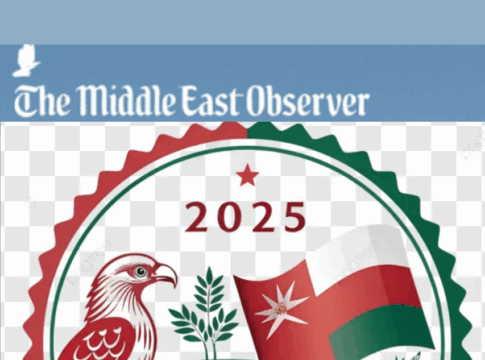
As the Sultanate of Oman marks its National Day on November 26–27, 2025, the nation reflects on a historical arc that stretches back more than three and a half centuries. The commemoration honors Oman’s liberation from Portuguese rule in 1650, a turning point that secured its status as the oldest continuously independent state in the Arab world. From its early prominence as a hub of metallurgy and maritime trade to its emergence in the 17th century as an Indian Ocean empire reaching from Persia to Zanzibar, Oman has long embodied cultural depth, strategic resilience, and sovereign continuity.
Today’s celebrations offer an opportunity to assess how the Sultanate has transformed from the quieter decades of the early 20th century into a modern, stable, and forward-looking Gulf state. This evolution has not only reshaped Oman internally but has also strengthened its relationships with long-standing regional partners—none more enduring than its ties with the Arab Republic of Egypt. The Oman–Egypt relationship reflects a model of respect and genuine partnership, built on historic affinity, cultural familiarity, and decades of consistent diplomatic cooperation. It is now expanding through deeper economic, developmental, and investment-driven collaboration.
Modern Omani history is anchored in the leadership of the Al Bu Said dynasty, which resumed rule in 1744 and continues to guide the nation today. The turning point of the contemporary era came in 1970 with the accession of Sultan Qaboos bin Said Al Said, whose era of “renaissance” delivered sweeping improvements in education, healthcare, infrastructure, and national institutions, while promoting diplomatic moderation and internal cohesion. His legacy of gradual, steady modernization remains evident.
This continuity is carried forward under His Majesty Sultan Haitham bin Tariq, who has preserved Oman’s foundational stability while steering the country toward a more diversified economic future. Central to this trajectory is Oman Vision 2040—an ambitious national development blueprint focused on economic diversification, social progress, cultural vitality, and sustainable long-term growth. The calm, rational and purposeful style of governance has made Oman one of the region’s most stable and well-administered states.
Oman now stands at a pivotal moment as it shifts from a hydrocarbon-centric model toward a more multifaceted economy. Vision 2040 prioritizes emerging sectors such as tourism, logistics, mining, renewable energy, manufacturing, ICT, and knowledge industries, while retaining the strengths of its energy sector. Socially, the Sultanate has made remarkable gains in human development, infrastructure, and service delivery—achievements strengthened by its moderate foreign policy and internal stability.
Against this backdrop, Oman–Egypt relations have grown into a multidimensional strategic partnership. Historical links between the Omani coast and the Nile Valley span centuries, forming a deep reservoir of shared heritage. In recent years, government-to-government cooperation has expanded through agreements in trade, investment, labor mobility, and regional security, reflecting mutual trust and aligned priorities. Cairo has repeatedly described the relationship as “close and strategic,” underscoring its long-term importance.
Trade between the two nations reached approximately USD 858 million in 2024, a solid base with significant room for expansion. Egypt exported USD 194.36 million worth of goods to Oman—mainly fruits, nuts, medical instruments, vegetables, and other industrial products—while Omani exports to Egypt, totaling around USD 663.07 million, were dominated by metal ores, seafood, plastics, fuels, and iron and steel. These figures highlight the complementarity between Oman’s resource strength and Egypt’s industrial and agricultural capacity.
Looking ahead, the economic relationship is poised for substantial growth. Oman’s emergence as a major maritime and logistics hub on the Arabian Sea, coupled with Egypt’s industrial scale and large consumer market, creates a strong foundation for broader integration. One promising track is the expansion of Egyptian manufactured goods and agro-products in Oman and the wider Gulf. Strengthening cold-chain links, establishing long-term supply agreements, and tailoring agro-processing lines to Gulf standards could significantly improve efficiency and market penetration while enhancing Oman’s food-security strategy.
Omani investment in Egypt represents another major opportunity, especially in sectors undergoing rapid transformation. Egypt’s renewable energy program—including wind, solar, and green hydrogen projects around the Suez Canal Economic Zone—offers attractive prospects for long-term Omani capital. Cooperation in mining could evolve from simple commodity trade into joint ownership of concessions and processing plants. Tourism integration—pairing Egypt’s heritage attractions with Oman’s natural and cultural destinations—could also create a powerful dual-country offering.
The maritime and logistics sectors may offer the most transformative opportunities. Oman’s ports in Salalah, Sohar, and Duqm are expanding rapidly as global transshipment centers, while Egypt’s Sokhna and East Port Said occupy critical positions along the Suez Canal. A dedicated Oman–Egypt maritime corridor, supported by efficient shipping services and integrated supply-chain operations, would connect the Arabian Sea directly to major international trade routes, reducing transit times and diversifying logistics options. The nearing completion of the UAE–Oman Hafeet Rail project further amplifies this potential by enabling a multimodal route linking Abu Dhabi, Sohar, Sokhna, and onward to North Africa and Europe.
Human capital cooperation offers equally significant potential. More structured mobility programs would allow skilled Egyptian technicians, engineers, logistics workers, and renewable-energy specialists to take on accredited placements in Oman. In parallel, Omani professionals could benefit from training and development opportunities in Egypt’s extensive educational and healthcare systems. Joint centers of excellence in logistics, petrochemicals, tourism, and energy would support this exchange and create a shared talent pipeline.
Industrial integration is an especially promising pillar. Oman’s exports of plastics, petrochemical feedstocks, and metals to Egypt can serve as the basis for developing shared industrial clusters in the Suez Canal Economic Zone. With Omani investment and raw materials, Egyptian factories could produce high-value goods—from plastic components and packaging materials to auto parts and construction inputs—for regional and international markets. Food-processing ventures that merge Egyptian agricultural production with Omani packaging capacity present another avenue for export-driven manufacturing.
None of these opportunities can reach their full potential without smoother trade facilitation. Streamlined customs procedures, mutual recognition of industrial and food-safety certifications, coordinated inspections, and digital documentation would significantly reduce time and cost for cross-border business. Linking national single-window systems and exploring partial local-currency settlement could further strengthen bilateral trade flows and empower SMEs to participate more actively.
Taken together, these dynamics show how a fully aligned economic partnership could transform the Oman–Egypt relationship. With complementary strengths, strategic locations, and well-articulated national visions, the two countries are positioned to expand their trade far beyond the current USD 1 billion threshold. As Oman celebrates its National Day, the Sultanate stands as a model of stability, strategic foresight, and measured progress. At the same time, its growing partnership with Egypt reflects a shared commitment to development, regional stability, and deeper Arab economic integration.
Rooted in history, energized by modern cooperation, and strengthened by emerging opportunities, the Oman–Egypt relationship is poised to enter a new era—one defined not only by mutual respect but by tangible, long-term economic transformation that will benefit the people and governments of both nations.