
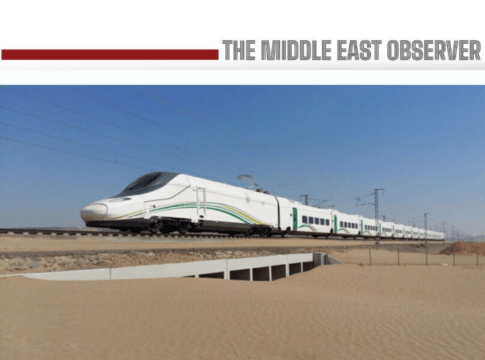
Saudi Arabia and Qatar are advancing plans to construct a high-speed electric railway linking their capitals, marking one of the most ambitious recent cross-border transport initiatives in the Gulf. The Saudi Cabinet has approved the high-speed rail agreement, with parallel endorsement announced by Qatari authorities.
The proposed 785-kilometer line is designed for speeds exceeding 300 km/h, potentially reducing travel time between Riyadh and Doha to around two hours, according to project specifications cited in official communications.
The initiative is widely interpreted as a major step toward reviving the long-envisioned Gulf Railway, first approved by GCC leaders in 2009 but delayed by shifting national priorities and cross-border coordination challenges. Recent progress in domestic rail networks and emerging regional links has renewed confidence that Gulf rail integration may be re-entering an execution phase.
The Riyadh–Doha corridor is designed as a high-speed passenger line connecting Riyadh and Doha, with intermediate stations reported in Saudi Arabia’s Eastern Province, including Al-Hofuf and Dammam. The route is expected to integrate with major aviation gateways, notably King Salman International Airport in Riyadh and Hamad International Airport in Doha, enhancing multimodal connectivity.
Public information indicates the project has progressed beyond concept stage following formal approvals and is expected to move into detailed design, engineering, and procurement phases. Construction contracts have not yet been publicly announced, and total project cost has not been formally disclosed.
Official statements reference an estimated completion timeline of approximately six years, implying potential operational commencement in the early 2030s—around 2031–2032—subject to procurement, engineering execution, and bilateral coordination.
Qatari transport authorities have referenced a projected long-term combined economic impact of approximately SAR 115 billion on the GDP of both countries, reflecting anticipated gains from enhanced trade flows, labor mobility, tourism expansion, and infrastructure multiplier effects. The specific timeframe for this estimate has not been publicly detailed.
Preliminary projections cited in regional reporting suggest the line could serve more than 10 million passengers annually once fully operational. However, detailed feasibility studies and official demand models have not yet been released publicly.
For Qatar, the railway presents a structural opportunity to deepen regional tourism integration. The country welcomed approximately five million visitors in 2024, generating roughly QAR 40 billion in tourism revenues.
Enhanced rail connectivity with Saudi Arabia—its largest neighboring market by population—could stimulate high-frequency weekend travel, event-driven visits, and short-stay leisure demand. Using current tourism revenue averages as a baseline, incremental rail-enabled visitor growth could translate into multi-billion-riyal annual revenue additions, depending on pricing, service frequency, and tourism packaging strategies.
These figures remain illustrative scenario estimates rather than official forecasts, but they highlight the potential scale of opportunity if the rail link materially increases visitor flows.
The convenience of a two-hour city-to-city journey may particularly benefit conferences, sports events, and retail-driven short breaks. Efficient cross-border processing will be central to preserving this time advantage and ensuring competitiveness with short-haul aviation.
For Saudi Arabia, the return profile extends beyond inbound tourism. The line reinforces Riyadh’s positioning as a regional business and entertainment hub, complements domestic transport expansion, and strengthens the Eastern Province as a logistics and commercial node.
Intermediate station cities such as Dammam and Al-Hofuf could experience secondary economic uplift through hospitality, retail, and transport integration. Airport-to-airport connectivity may also enhance aviation network efficiency, potentially substituting short-haul flights while enabling carriers to redeploy capacity toward longer-haul international routes.
Within the framework of Vision 2030, improved regional mobility aligns with broader objectives to increase tourism arrivals, expand private-sector participation, and enhance infrastructure connectivity.
Despite strong political backing, execution will depend on finalization of delivery structures, regulatory harmonization, immigration frameworks, pricing competitiveness relative to aviation, and alignment with domestic rail networks in both countries.
Megaproject rail developments in the region historically face sensitivity to procurement cycles and engineering complexity. While early-2030s operations appear achievable under current guidance, actual commissioning will depend on disciplined project management and sustained bilateral coordination.
If delivered as planned, the Riyadh–Doha high-speed railway could become one of the most tangible recent steps toward realizing the broader GCC rail vision—signaling renewed commitment to regional physical integration and offering a viable alternative to short-haul air travel within the Gulf.
For Qatar, the project presents tourism and service-sector expansion potential. For Saudi Arabia, it strengthens infrastructure leadership and regional connectivity ambitions. For the GCC collectively, it represents a renewed attempt to translate long-standing rail integration goals into operational reality.