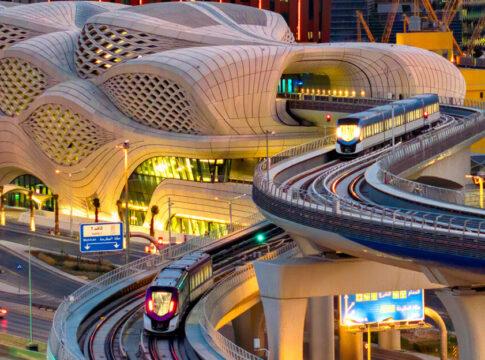
Saudi Arabia is preparing to launch a driverless monorail system in the capital’s King Abdullah Financial District (KAFD), underscoring the Kingdom’s ambition to redefine sustainable mobility and smart urban living under Vision 2030
The 3.6-kilometer elevated circular line, awarded in late 2024 to a consortium including CRRC Nanjing Puzhen, Hassan Allam Construction Saudi, and CRRC Hong Kong, will feature six stations and six autonomous trains, capable of transporting up to 3,500 passengers per hour. Construction is expected to commence in Q4 2025, with test operations and commissioning scheduled for 2027 “The monorail project is in the design stage, and we expect works to begin by the last quarter of this year,” said Faddy Al-Aql, Chief Asset Delivery Officer at KAFD DMC. “Trial operations are scheduled for early 2027, with public commissioning in the same year.”
The monorail is more than a transit system: it is integral to KAFD’s “10-Minute City” master plan, in which all destinations—workspaces, residential towers, leisure areas—are reachable within a 10-minute walk. Suspended, climate-controlled pedestrian bridges will interlink the monorail with the district’s buildings, public plazas, and the Riyadh Metro Line 1 station, ensuring multimodal connectivity.
Oversight and technical assurance are being managed by Parsons, which provides project management and construction supervision, and Ricardo, tasked with systems integration, safety engineering, and regulatory compliance. Their roles reflect the Kingdom’s reliance on global expertise for mega-projects and help mitigate execution risks.
The Riyadh monorail is emblematic of Vision 2030, which seeks to diversify the Saudi economy away from hydrocarbons by building globally competitive cities and infrastructure. KAFD itself is a Public Investment Fund (PIF)-owned mega-district positioned as a financial hub for the Middle East.
According to Stephen Thomas, COO of KAFD DMC, the global public transportation market is projected to expand from US$6.1 billion in 2024 to nearly US$29 billion by 2034, a compound annual growth rate of 16.8%. The Riyadh monorail thus places Saudi Arabia within an expanding global industry, while showcasing its domestic appetite for technology-led transport solutions.
By integrating seamlessly with the Riyadh Metro—which carried over 18 million passengers in its first 11 weeks of operation in early 2025—the monorail ensures scalability of demand while reducing local car dependency. For investors, this adds credibility to Riyadh’s infrastructure pipeline, strengthening prospects for foreign partnerships in transport, real estate, and smart-city services.
While momentum is clear, challenges remain:
- Schedule slippage is a risk, given the multi-party structure involving Chinese, Egyptian, and Saudi firms. Early integration of project offices aims to minimize delays.
- Financial transparency is limited, as no official cost estimate has been disclosed. Given KAFD’s PIF ownership, financing is secure, but market analysts point to the need for clearer disclosure to reassure private partners.
- Regulatory alignment is essential. Ensuring the monorail meets international safety and automation standards while integrating with the Riyadh Metro will require close oversight from both Saudi regulators and Ricardo’s safety teams.
Riyadh is not alone in deploying monorails as part of a smart mobility strategy. São Paulo operates the world’s largest Bombardier Innovia monorail, designed for medium-density corridors, while Dubai’s driverless metro remains a benchmark for automated systems in the Gulf. KAFD’s monorail is comparatively smaller in scale but tailored for district-level circulation and seamless integration with larger networks.
Regionally, this project complements Saudi Arabia’s broader transport drive—including NEOM’s Oxagon and The Line transit systems—while setting a precedent for compact, tech-driven mobility nodes across the Gulf.
The Riyadh KAFD monorail represents a landmark in district-level mobility planning, reinforcing Saudi Arabia’s ambition to craft walkable, tech-driven, globally competitive cities. With its integration into Riyadh’s metro and alignment with Vision 2030, the project is more than infrastructure: it is a signal of economic diversification, global partnerships, and a reimagined urban future.